 Safekipedia
15th century
Adapted from Wikipedia · Adventurer experience
The 15th century was the time between January 1, 1401 and December 31, 1500. This was a time of big changes in the world.
In Europe, this period included the end of the Middle Ages and the start of the Renaissance. Important ideas about art, money, and record-keeping began in places like Italy. Big wars such as the Hundred Years' War ended, and new rulers came to power in places like England.
One of the most important events was the fall of Constantinople to the Ottoman Turks. This brought many Greek thinkers and books to Italy and helped the Renaissance grow. Also, a man named Johannes Gutenberg invented the printing press, which made it easier to share books and ideas.
In other parts of the world, big empires like the Aztec Empire and the Inca Empire were strong, but European explorers like Christopher Columbus began to arrive, changing history forever. In Africa, changes were happening too, with new powers rising and old kingdoms facing tough times.
Events
1401–1409
This time had many big changes. New countries formed, like the Malwa Sultanate in India and the Sultanate of Malacca. Fights happened, such as the Battle of Ankara between big empires. In China, the capital moved from Nanjing to Beijing.
1410s
This time had important fights like the Battle of Grunwald, which made the Teutonic Knights weaker. The last Welsh war began, led by Owain Glyndŵr. In Europe, important people like Henry the Navigator started plans for new discoveries.
1420s
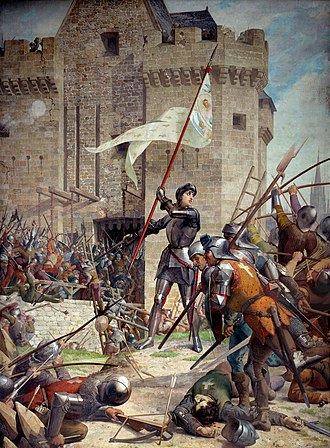
The building of the Forbidden City in Beijing was finished. In Africa, the Ife Empire ended. New leaders came to power, like James I in Scotland and Itzcoatl in the Aztec Empire. Joan of Arc helped in the Hundred Years' War.
1430s
Leaders changed in many places. Rajah Lontok and Dayang Kalangitan ruled Tondo together. Big trials and fights happened, like the trial of Joan of Arc and the Battle of Lipany. Pachacuti started the Inca Empire.
1440s
Eton College was created. The Golden Horde split into smaller parts. Leaders like Moctezuma I started ruling the Aztecs, and Oba Ewuare made Benin strong. Jan van Eyck, a famous painter, died. Portuguese sailors began trading with Africa.
1450s
Machu Picchu was built. Dayang Kalangitan became Queen of Tondo. Bahlul Khan Lodhi started the Lodhi dynasty in Delhi. The Fall of Constantinople ended the old Byzantine Empire. The Battle of Castillon was the last fight of a long war. Joan of Arc was cleared of wrong charges.
1460s
The League of Mayapan broke apart. Sarajevo was started by the Ottomans. Big fights happened, like the Battle of Mortimer's Cross and the Battle of Towton. Sonni Ali Ber of the Songhai Empire took over Mali. Edward IV of England married Elizabeth Woodville.
1470s
Stephen the Great of Moldavia defeated enemies. The kingdom of Champa was taken over by Vietnam. The Wattasid Sultan took control in Morocco. Burgundy Wars happened in Europe. Muscovy took over Novgorod. A big mosque was built in Java.
1480s
Muscovy became independent. The Spanish Inquisition began. Diogo Cão was the first European to reach the Congo. The Jews left Andalusia. William Caxton printed the first books in English. Henry VII became King of England after the Battle of Bosworth.
1490–1500
Askia Muhammad made the Songhai Empire very big. Boabdil gave up Granada, ending a long fight in Spain. Christopher Columbus sailed to the Americas. Spain and Portugal agreed to divide the world outside Europe. Vasco da Gama sailed from Europe to India and back. Guru Nanak began teaching Sikhism. Portuguese sailor Pedro Álvares Cabral claimed Brazil for Portugal.
Inventions, discoveries, introductions
See also: Science and inventions of Leonardo da Vinci
See also: Timeline of historic inventions § 15th century
The 15th century brought many important changes and new ideas. The Renaissance changed how people thought about the world, science, and art. The Modern English language began to develop from older forms of English.
New things like public banks and the noon bell in Catholic areas appeared. Huge collections of books were made, such as the Yongle Encyclopedia. The Hangul alphabet was invented in Korea, and Scotch whisky was introduced.
Printing technology grew with the development of woodcut and the use of movable type. Johannes Gutenberg improved the printing press in Europe around 1455. Artists learned new ways to draw, such as linear perspective. New musical instruments like the harpsichord were invented around 1450. In 1492, Christopher Columbus reached the Americas.
Images
Related articles




This article is a child-friendly adaptation of the Wikipedia article on 15th century, available under CC BY-SA 4.0.
Images from Wikimedia Commons. Tap any image to view credits and license.