 Safekipedia
Altai Mountains
Adapted from Wikipedia · Adventurer experience
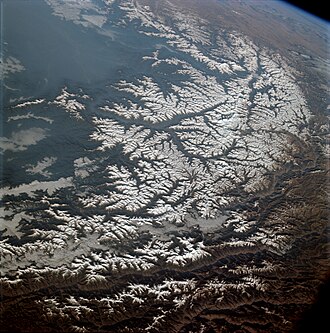
The Altai Mountains are a grand mountain range in Central Asia, where four countries meet: Russia, China, Mongolia, and Kazakhstan. These tall mountains are where important rivers like the Irtysh and Ob start their journey. The highest point in the Altai Mountains is Belukha, standing at 4,506 meters (about 14,783 feet) above sea level.
The Altai Mountains connect to other ranges, such as the Sayan Mountains to the northeast, and slope down toward the Gobi Desert in the southeast. To the southwest, they are separated from the higher Tian Shan mountains by the Junggar Basin.
People living in this area are few but come from many different backgrounds, including Turkic peoples, Mongols, and others. Their lives depend on raising animals like cattle, sheep, and horses, as well as hunting, farming, working in forests, and mining. The name of a group of languages once thought to be related, called the Altaic language family, comes from these famous mountains.
Etymology and modern names
The name "Altai" comes from an old word meaning "gold" or "golden." This idea of gold is linked to the rich history and culture of the area.
People in different countries and languages have their own special names for these mountains. In Mongolia, they are called Altain nuruu, in the Altay language they are Altay tuular, in Kazakhstan they are Altaı taýlary, in Russia they are Altajskije gory, in Uyghur they are Altay Taghliri, in Chinese they are ā'ěrtài shānmài, and in Dungan they are Arteː shanmeː. Each name shows how important these mountains are to the cultures around them.
Geography
For the area north of the Altai, see Geography of South-Central Siberia and South Siberian Mountains.
The Altai Mountains are a big, remote mountain area in central Asia. They cover about 845,000 km2 and stretch for 2,525 km. The highest peak is Belukha Mountain, which is 4,506 m tall.
The mountains have many smaller ranges and lakes. One well-known lake is Teletskoye. It is about 80 km long and 5 km wide. The Altai Mountains are home to people such as the Telengit and Kyrgyz. They live in the valleys and plateaus.
Fauna
The Altai mountains have many different animals because of their many landscapes, including grassy areas, forests, and high alpine regions. Steep slopes are where you can find the Siberian ibex, while gentler slopes have the rare argali. There are five kinds of deer, such as the Altai wapiti and Siberian roe deer. Large animals like wild boars live in lower areas, and predators such as snow leopards, wolves, Eurasian lynx, and brown bears live in the northern parts. Birds like the western Siberian eagle-owl also live here.
In the past, the Caspian tiger lived in the southern parts of the Altai mountains, but it is no longer there. The wisent, a type of ancient cow, used to live in the Altai mountains until the Middle Ages, and now a small group is kept safe in the Altai Republic. Small frogs called moor frogs live near water, even at very high altitudes.
History
The Altai Mountains have had a calm climate for thousands of years, which helped protect many old items. Scientists found a group of early humans called the Denisovan here. They lived with other ancient humans like Neanderthals and early Homo sapiens. These discoveries came from DNA and tools found in the Denisova Cave.
Many different groups lived in the Altai Mountains over time, including early herders and horse riders. Some think the mountains might be where people first began to ski, based on old rock drawings found there.
World Heritage Site
Main article: Golden Mountains of Altai
A big area of 16,178 km2 (6,246 sq mi)2, including the Altai and Katun Natural Reserves, Lake Teletskoye, Mount Belukha, and the Ukok Plateau, is a special place protected by the world called a World Heritage Site. It is named the Golden Mountains of Altai. This area has many kinds of plants, from grassy lands to forests and snowy mountains. These mountains help protect animals that are in danger, like the Snow leopard, Altai argali, and Siberian ibex. Nearby, the Uvs Nuur basin is also protected.
Geology
The Altai Mountains were formed when Earth's plates moved. The land of India pushed into Asia long ago. This made cracks and faults in the ground, like the Kurai and Tashanta fault zones. These areas can still shift and change the land.
Scientists found signs of huge floods in the past in this region. These floods came from a very large lake made by glaciers. The lake was even bigger than a famous lake that once held back ice in North America.
Seismic activity
Earthquakes don’t happen often here. In 2003, a strong earthquake shook the area near the Chuya Basin. This quake caused damage and changed life for people living nearby.
Images
Related articles


This article is a child-friendly adaptation of the Wikipedia article on Altai Mountains, available under CC BY-SA 4.0.
Images from Wikimedia Commons. Tap any image to view credits and license.