 Safekipedia
Armstrong Flight Research Center
Adapted from Wikipedia · Adventurer experience
The NASA Neil A. Armstrong Flight Research Center (AFRC) is an important place for studying airplanes and flying machines, run by NASA. It is located inside Edwards Air Force Base in California. This center helped make many exciting firsts in aviation happen, like the first airplane to go faster than the speed of sound.
AFRC has some of the most advanced airplanes in the world. It has supported big moments in flying history, such as the first pure digital fly-by-wire airplane. The center also used to have a second site in Palmdale, California, where it worked with special science airplanes like SOFIA (Stratospheric Observatory For Infrared Astronomy). As of 2023, Bradley Flick is the director of the center.
The center began in 1946 and has had many names over the years. It was finally named after Neil Armstrong in 2014. Neil Armstrong was a test pilot there and the first person to walk on the Moon. The center was also home to special airplanes like the Shuttle Carrier Aircraft, which carried space shuttles back to Kennedy Space Center when they landed at Edwards.
AFRC also looked after a very old B-52 Stratofortress bomber called Balls 8. This airplane was used to drop many fast research airplanes into the sky for testing. It was retired in 2004 and is now on display near Edwards' North Gate.
Location
The Armstrong Flight Research Center is near the Rogers Dry Lake. It sits on the northwest side of the lake, just south of the North Gate. You need permission to enter both Edwards AFB and the NASA center.
The Rogers Dry Lake is great for flight tests. It has dry ground, few rainy days, and big open spaces for planes to land safely. Sometimes, the lake can work as a runway longer than 40,000 feet. It even has a giant compass rose, over 5,200 feet across, so planes can land from any direction.
List of current projects
The Armstrong Flight Research Center is working on several exciting projects. These include the X-59 QueSST, which is designed to make quieter supersonic flights, and the X-66 Sustainable Flight Demonstrator, aimed at creating more eco-friendly aircraft. Other projects involve studying how to safely integrate unmanned aircraft into national airspace, and the TGALS project which focuses on new technologies for aviation.
Historic projects
Douglas Skyrocket
Main article: Douglas Skyrocket
NASA's predecessor, NACA, used the Douglas D-558-2 Skyrocket. This airplane could use rocket or jet power. It helped scientists learn about flying very fast and how airplanes stay steady. On November 20, 1953, the Douglas Skyrocket became the first airplane to fly more than twice as fast as sound, reaching a speed of Mach 2.005. Like the Bell X-1, the Skyrocket could be launched from the air using a B-29 Superfortress. But it could also take off from a runway with special helpers called JATO units.
Controlled Impact Demonstration
Main article: Controlled Impact Demonstration
The Controlled Impact Demonstration was a project with the Federal Aviation Administration to test a new kind of jet fuel. The goal was to see if this fuel could reduce damage in airplane accidents. On December 1, 1984, a remote-controlled Boeing 720 airplane was flown into special equipment that opened the wings. This caused fuel to spill and create a big fire. Even with the new fuel, the fire was still very large and took an hour to put out.
Though the new fuel did not stop the fire, it did help cool parts of the airplane and stop some fuel from burning. Scientists also used special crash test dummies in the airplane to learn more about how to keep people safe during accidents.
Linear Aerospike SR-71 Experiment
Main article: Linear Aerospike SR-71 Experiment
LASRE was a NASA test with Lockheed Martin to study a new kind of engine design for spacecraft. The test aimed to collect information to help improve computer tools used in designing these engines. LASRE was a small model with eight engine parts. It was carried on the back of an SR-71 Blackbird airplane and acted like a moving wind tunnel.
The test looked at how the engine’s airflow affects the airplane’s shape at certain heights and speeds, up to about 340 m/s (760 mph). This helps designers find ways to reduce problems caused by the interaction between the engine and the airplane.
Lunar Landing Research Vehicle
Main article: Lunar Landing Research Vehicle
The Lunar Landing Research Vehicle or LLRV was made during the Apollo Project to practice landing on the Moon. These vehicles, sometimes called "Flying Bedsteads," were used by the research center, now known as the Armstrong Flight Research Center, at Edwards Air Force Base, California. They helped astronauts learn the skills needed to land the Apollo Lunar Module on the Moon, where there is no air.
Aircraft on display
Here are some special airplanes you can see at the Armstrong Flight Research Center:
- NB-52B Balls 8 NASA 008
- Bell X-1E AF Ser. No. 46-063
- F-104N - NASA 826
- F-8 Supercritical wing - NASA 810
- F-8 Digital Fly-by-wire - NASA 802
- F-15B ACTIVE - NASA 837
- Grumman X-29 - NASA 849
- Lockheed SR-71 Blackbird LASRE - NASA 844
- Northrop HL-10 Lifting Body - NASA 804
- Rockwell HiMAT
List of center directors
The Armstrong Flight Research Center has had many directors over the years.
| No. | Image | Director | Start | End |
|---|---|---|---|---|
| 1 | Walter C. Williams | September 30, 1946 | Fall 1949 | |
| Fall 1949 | July 1, 1954 | |||
| July 1, 1954 | September 15, 1959 | |||
| 2 |  | Paul F. Bikle | September 15, 1959 | May 31, 1971 |
| Acting |  | De E. Beeler | June 1, 1971 | October 11, 1971 |
| 3 |  | Lee R. Scherer | October 11, 1971 | January 19, 1975 |
| 4 |  | David R. Scott | April 18, 1975 | October 30, 1977 |
| Acting | Isaac T. Gillam | October 30, 1977 | June 18, 1978 | |
| 5 | June 18, 1978 | October 1, 1981 | ||
| 6 |  | John A. Manke | October 1, 1981 | April 27, 1984 |
| 7 | 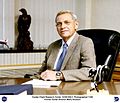 | Martin Knutson | May 1984 | December 2, 1990 |
| 8 |  | Kenneth J. Szalai | December 3, 1990 | March 1, 1994 |
| March 1, 1994 | July 31, 1998 | |||
| Acting |  | Kevin L. Petersen | August 1, 1998 | February 7, 1999 |
| 9 | February 8, 1999 | April 3, 2009 | ||
| Acting |  | David D. McBride | April 4, 2009 | January 3, 2010 |
| 10 | January 4, 2010 | December 4, 2022 | ||
| 11 |  | Bradley Flick | December 5, 2022 | March 19, 2026 |
Notable employees
The Armstrong Flight Research Center has been home to many talented people. Famous astronauts like Neil Armstrong and David Scott worked there. Other skilled pilots and engineers such as Bill Dana, C. Gordon Fullerton, and Milt Thompson also worked there. These people helped make important discoveries in aviation and space exploration.
Images
Related articles


This article is a child-friendly adaptation of the Wikipedia article on Armstrong Flight Research Center, available under CC BY-SA 4.0.
Images from Wikimedia Commons. Tap any image to view credits and license.