 Safekipedia
Battle of Chaeronea (338 BC)
Adapted from Wikipedia · Adventurer experience
Battle of Chaeronea (338 BC)
The Battle of Chaeronea was fought in 338 BC near the city of Chaeronea in Boeotia. It was a big fight between Macedonia under Philip II and an alliance of city-states led by Athens and Thebes. This battle was very important because it showed the strength of Macedonia and changed the history of Greece.
Before this battle, Philip had worked hard to bring peace to Greece after many wars. But some city-states, especially Athens, did not like Philip's power and wanted to break free from his control. This led to tension and finally to the battle at Chaeronea.
During the battle, the Macedonian army, led by Philip, faced a strong position but managed to win after a long fight. The defeat of Athens and Thebes meant that Philip could create a new peace agreement for Greece. This led to the formation of the League of Corinth, which made all the Greek states allies of Macedon. Philip was then chosen to lead a big war against the Achaemenid Empire, but before he could start, he was killed, and his son Alexander took over.
Background
Main articles: Rise of Macedon, Third Sacred War, and Peace of Philocrates
After becoming king in 359 BC, Philip II of Macedonia made his kingdom stronger. He expanded into areas like Thrace and Chalkidiki near the Aegean Sea. During this time, two important Greek cities, Athens and Thebes, had their own problems, which helped Philip.
Philip joined a big fight called the Third Sacred War, which began in 356 BC. He won an important battle and gained control of a region called Thessaly. By 346 BC, Philip was strong enough to end the war without more fighting. The people of Phocis, who started the war, were punished, but not too harshly.
The people of Athens were tired of fighting and worried about Philip’s strength, so they made a peace treaty with him, called the Peace of Philocrates. However, some Athenians, like a leader named Demosthenes, didn’t like this peace and wanted to fight Philip instead. They looked for reasons to say Philip was breaking the peace. Eventually, the Athenians allied with other cities against Philip, which led to more conflict.
Prelude
Philip wanted to lead armies in southern Greece. This became linked to a new war called the Fourth Sacred War. The people of Amphissa in Ozolian Locris had started farming land near Delphi that belonged to the god Apollo. This made the Amphictyonic council declare war on Amphissa. A Thessalian delegate suggested Philip lead the effort. This gave Philip a reason to move into southern Greece.
At the start of 339 BC, the Thebans had taken a town called Nicaea near Thermopylae. Philip had controlled it before, but this was not a formal declaration of war. Philip found another path over Mount Callidromos into Phocis. This allowed him to enter central Greece without interference.
Philip had been kind to the Phocians after ending the Third Sacred War in 346 BC, and they became his allies. He arrived in Elatea and helped restore the Phocian cities. In August 338 BC, the big battle at Chaeronea finally happened.
When the Athenians heard Philip was near Elatea, they became very worried. Demosthenes, a leader in Athens, suggested forming an alliance with the Thebans to fight back. The Thebans agreed to join forces, even though they usually disagreed with Athens. The Athenian army moved toward Boeotia and joined the Thebans. There were some small fights before the battle. Finally, in August 338 BC, Philip’s army marched down the main road from Phocis to attack the allied forces at Chaeronea.
Opposing forces
The Macedonian army was led by Philip II. It had around 30,000 foot soldiers and 2,000 horse soldiers. Philip commanded one part of the army. His young son Alexander led another part. Alexander would later rule the Persian Empire.
The other side had soldiers from several city-states. These included Achaea, Corinth, Chalcis, Epidaurus, Megara, and Troezen. Most soldiers came from Athens and Thebes. The Athenian leaders were Chares and Lysicles. The Thebans were led by Theagenes. We don’t know the exact number of soldiers on this side, but some ancient writers thought they had more. Historians today think the numbers were about the same.
Strategic and tactical considerations
The army from Athens and Thebes set up near Chaeronea, along the main road. On the left side, they stood near the foothills of Mount Thurion, blocking a smaller road to Lebedea. On the right side, they were next to the Kephisos River, near a hill called Mount Aktion. This made their position very safe.
Because of where they stood, Philip could not easily focus his soldiers against the right side of the allies. The left side of the allies was far forward, which could threaten Philip's right side. Also, the troops on the left were on higher ground, making it hard for Philip to attack. So, the allies were in a very strong spot.
Battle
Details about the Battle of Chaeronea are limited, with the main description coming from Diodorus. He described the battle as fierce, with soldiers from both sides fighting hard.
One story says that Philip, the leader of Macedonia, used clever tactics. He let the Athenians follow his troops, then turned around and attacked them when they were tired. His son Alexander helped break through the enemy lines. This led to the victory of Macedonia and its allies.
Aftermath
Main articles: League of Corinth and Wars of Alexander the Great
This battle was very important in ancient history because it let Philip II of Macedon take control. After the battle, Philip wanted the cities of Greece to join him for his plans against Persia. He treated some cities harshly and others more gently to keep peace.
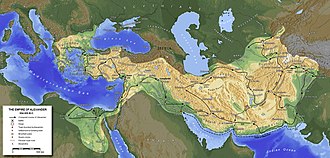
Philip made a group called the League of Corinth to keep Greece united and peaceful. This helped him get support for his war against Persia. Sadly, Philip was killed before he could lead this war, and his son Alexander took over. Alexander then went on to conquer the whole Persian Empire.
Images
Related articles




This article is a child-friendly adaptation of the Wikipedia article on Battle of Chaeronea (338 BC), available under CC BY-SA 4.0.
Images from Wikimedia Commons. Tap any image to view credits and license.