 Safekipedia
Blackboard
Adapted from Wikipedia · Adventurer experience
A blackboard or a chalkboard is a reusable surface where people can write or draw using sticks of chalk. These sticks are made from materials called calcium sulphate or calcium carbonate.
Originally, blackboards were made from smooth, thin sheets of dark stone called slate. They had a dark background that made the white chalk easy to see, helping everyone in the room read what was written.
Blackboards have been a useful tool for teachers and students for many years, helping share ideas and lessons in classrooms around the world. Today, many schools use different kinds of boards, but the classic blackboard still reminds us of learning’s history.
Design
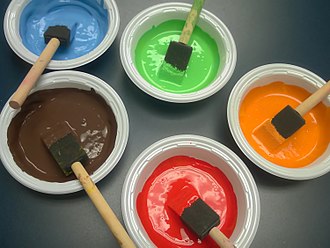
A blackboard is a simple board painted with dark, non-shiny paint. It is often black or sometimes dark green. Some blackboards are made from a special plastic that looks like chalkboard and can be shaped into art pieces. Restaurants and bars sometimes use blackboards on A-frames to show their daily specials. There is also adhesive blackboard material that can be stuck to walls or doors.
Modern blackboards can have a rolling sheet of plastic that moves between two rollers. This gives more space to write and saves what was written before. The best blackboards are made from strong painted steel and can last many years of heavy use. Big lecture halls often have several blackboards arranged in a grid, so lecturers can easily move them to write and show lots of information at once.
Chalk sticks
Chalk sticks are white and come in many colors for use with blackboards. White chalk sticks are made from a mineral called chalk or limestone, which is calcium carbonate. Colored chalk sticks are made from calcium sulphate in a special form called dihydrate, written as CaSO4·2H2O, which comes from a material called gypsum. Chalk sticks that contain calcium carbonate usually have about 40–60% of CaCO3 (calcite).
Issues with use
When people run their fingernails or sharp metal objects across a blackboard, it makes an unpleasant sound that most people dislike. Research from the University of Cologne in Germany showed that humans naturally hate this sound. These findings were shared at a meeting of the Acoustical Society of America.
Etymology and history
In old Indian schools, children used black tablets for writing. Large blackboards started appearing in European schools in the 1500s for music lessons. The word "blackboard" was first used in English in the 1700s. In the United States, chalk was first used on a blackboard in 1801 during a math lecture. By the 1840s, factories began making blackboards from slate. In 1930, green enamel boards were introduced and became common in schools in the United States during the 1950s.
Images
Related articles



This article is a child-friendly adaptation of the Wikipedia article on Blackboard, available under CC BY-SA 4.0.
Images from Wikimedia Commons. Tap any image to view credits and license.