 Safekipedia
Bulgarian language
Adapted from Wikipedia · Adventurer experience
Bulgarian is an Eastern South Slavic language spoken in Southeast Europe, mainly in Bulgaria. It is the language people in Bulgaria use every day.
Bulgarian is closely related to the Macedonian language. Together, they form a special group called the East South Slavic languages. These two languages share some unique features. For example, they do not use special word endings to show how words relate to each other.
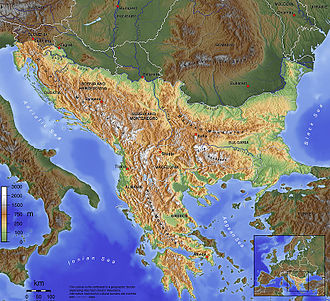
Bulgarian is the official language of Bulgaria. Since 2007, it has also been one of the official languages of the European Union. Many people outside of Bulgaria, in countries like Ukraine, North Macedonia, Moldova, Serbia, Romania, Hungary, Albania, Greece, and Turkey, also speak Bulgarian.
History
Main article: History of Bulgarian
The Bulgarian language has had many stages. The earliest stage began when Slavic people moved to the eastern Balkans around the 6th century CE. After that came Old Church Slavonic, which Saints Cyril and Methodius used when they translated the Bible and other books from Greek into Slavic.
Then came Middle Bulgarian, used in the Second Bulgarian Empire, Walachia, Moldavia, and the Ottoman Empire. Modern Bulgarian began in the 16th century and changed a lot in the 18th and 19th centuries. Today’s written Bulgarian is based on Eastern dialects but tries to balance East and West Bulgarian sounds.
Geographic distribution
Bulgarian is the main language of Bulgaria. About 6 million people there speak it.
Many Bulgarian speakers live in other countries too. You can find them in Ukraine, Moldova, Transnistria, Romania, Serbia, Hungary, Albania, Greece, and Turkey. There are also Bulgarian speakers in Germany, Spain, Italy, the United Kingdom, the United States, and Canada. These communities grew after the 1990s.
Dialects
Main article: Bulgarian dialects
Bulgarian has different ways of speaking called dialects. The biggest difference is called the "yat border." It goes from the city of Nikopol on the Danube River to the city of Solun (Thessaloniki) on the Aegean Sea.
West of this border, people say the old "yat" sound as "e" everywhere. For example, they say "mleko" for milk and "hleb" for bread.
East of this border, people switch between "ya" and "e." They say "ya" when the word is stressed and the next letter is not a front vowel. For example, they say "mlyako" for milk and "hlyab" for bread. But they say "e" in other places, like "mlekar" for milkman and "hlebар" for baker.
The main Bulgarian language uses the eastern way of speaking. But many people in western Bulgaria, including the capital Sofia, still use their own way of speaking. Some people use "ya" too much, which is called "over-ya-ing."
Relationship to Macedonian
Main article: Macedonian language § Relationship to Bulgarian
Further information: Political views on the Macedonian language
See also: Bulgarian nationalism, Macedonian nationalism, Pluricentric language, and Accession of North Macedonia to the European Union
Bulgarian and Macedonian are very similar languages. In the past, many experts thought the dialects in parts of Bulgaria, North Macedonia, and Northern Greece were all Bulgarian dialects.
Later, new ideas led to the creation of a separate Macedonian language. Today, some experts still see Macedonian as part of Bulgarian, while many others see it as its own language. This question depends more on politics than on language rules.
Phonology
Main article: Bulgarian phonology
Bulgarian sounds are similar to other South Slavic languages but are different from Serbian. There are differences between Eastern and Western Bulgarian dialects. Eastern dialects change some sounds before certain vowels and reduce some vowel sounds when they are not stressed. Western dialects do not change sounds as much.
Standard Bulgarian uses a mix of these features. It allows some sound changes only before certain vowels and reduces only a few vowels. Bulgarian has six main vowel sounds, but more different sounds can occur. There is debate about how many consonant sounds Bulgarian has. Some say there are 22, while others say there are at least 39. This debate began in the 1950s and continues today.
Alphabet
Main article: Bulgarian alphabet
See also: Bulgarian Braille
In 886 AD, the Bulgarian Empire introduced the Glagolitic alphabet, made by the Saints Cyril and Methodius in the 850s. Later, the Glagolitic alphabet was replaced by the Cyrillic script. This new script grew from the Preslav Literary School in Bulgaria in the late 800s.
In the 1800s, many versions of the Cyrillic alphabet were used. One version with 32 letters, suggested by Marin Drinov, became popular in the 1870s. In 1945, two letters were taken away, leaving 30 letters. When Bulgaria joined the European Union on January 1, 2007, Cyrillic became an official script of the European Union, along with the Latin and Greek scripts.
Grammar
Main article: Bulgarian grammar
Bulgarian has different types of words. Some words change, and some words stay the same. Words that change include nouns, adjectives, numbers, pronouns, and verbs. Words that don’t change include adverbs, prepositions, conjunctions, particles, and interjections.
Nominal morphology
Main article: Bulgarian nouns
Nouns and adjectives in Bulgarian can be masculine, feminine, or neuter. They also have singular and plural forms. Adjectives match nouns in gender and number. Pronouns also change based on gender and number.
Nominal inflection
Gender
Bulgarian nouns can be masculine, feminine, or neuter. You can often tell the gender by the ending of the word. For example, words ending in a consonant are usually masculine, words ending in -а or -я are usually feminine, and words ending in -е or -о are usually neuter.
Number
Bulgarian has singular and plural forms. Different endings are used for plural forms, and these can change based on the gender and ending of the singular form.
Case
Main article: Case system of Bulgarian
Cases are mostly used in pronouns. There are four cases: nominative, accusative, dative, and vocative.
Definiteness (article)
Bulgarian uses a definite article that comes after the noun, similar to some other languages. The ending of the article changes based on the noun’s ending.
Adjective and numeral inflection
Adjectives and numbers match the gender and number of the nouns they describe. They can also take the definite article.
Pronouns
Main article: Bulgarian pronouns
Pronouns change based on gender, number, and case. They include personal, relative, reflexive, interrogative, negative, indefinite, summative, and possessive pronouns.
Verbal morphology and grammar
Main article: Bulgarian verbs
Verbs in Bulgarian change based on person, number, voice, aspect, mood, and tense.
Finite verbal forms
Verbs can be simple or compound and match the subject in person and number.
Aspect
Bulgarian verbs have perfective and imperfective aspects. Perfective verbs show the action is completed, while imperfective verbs do not.
Mood
Bulgarian has several moods, including indicative, imperative, subjunctive, conditional, and inferential.
Tense
There are three main tenses: present, past, and future. These combine with aspect and mood to form different verb forms.
Adverbs
Adverbs are often formed from the neuter singular form of adjectives. Other adverbs come from older case forms or are unique words.
Other features
Questions
Questions without a question word use the particle ли after the verb.
Significant verbs
Be (Съм)
The verb съм is used as an auxiliary for perfect, passive, and conditional forms.
Will (Ще)
The verb ще is used to form the future tense.
Have/Don't have (Имам and нямам)
These verbs can be used impersonally to mean "there is/are" or "there isn’t/aren’t any."
Conjunctions and particles
But
Bulgarian has several words for "but," used in different situations.
Vocative particles
These particles strengthen statements and are informal.
Modal particles
These particles express the speaker’s mood relative to the situation.
Intentional particles
These express intent or desire and are informal.
Pronouns of quality
Bulgarian has pronouns like kakav (what sort of) and takuv (this sort of).
Miscellaneous
Bulgarian people sometimes shake their head for "yes" and nod for "no," which is different from some other cultures. The language also has many words for family relationships.
| word | literal meaning | sentence | meaning of sentence as a whole |
|---|---|---|---|
| – | – | edna kola | a car |
| takava | this sort of | edna takava kola ... | this car (that I'm trying to describe) |
| nikakva | no sort of | edna takava nikakva kola | this worthless car (that I'm trying to describe) |
| nyakakva | some sort of | edna takava nyakakva nikakva kola | this sort of worthless car (that I'm trying to describe) |
Syntax
Main article: Bulgarian grammar
Bulgarian uses a special way of speaking called clitic doubling to add emphasis. For example, in everyday speech, people might say:
Аз (го) дадох подаръка на Мария.
This means "I gave it the present to Maria." Another way to say it is:
Аз (ѝ го) дадох подаръка на Мария.
Which means "I gave her it the present to Maria."
In spoken Bulgarian, clitic doubling is often needed to show important information. For example:
Подаръка (ѝ) го дадох на Мария.
This translates to "The present [to her] it I-gave to Maria."
Or:
На Мария ѝ (го) дадох подаръка.
Meaning "To Maria to her [it] I-gave the present."
Clitic doubling can also show relationships between words. For example:
Петър и Иван ги изядоха вълците.
This means "Petar and Ivan were eaten by the wolves."
Compared to:
Петър и Иван изядоха вълците.
Which means "Petar and Ivan ate the wolves."
Clitic doubling is also needed when using certain expressions, such as "играе ми се" (I feel like playing), "студено ми е" (I am cold), and "боли ме ръката" (my arm hurts). For example:
На мен ми се спи, а на Иван му се играе.
This means "I feel like sleeping, and Ivan feels like playing."
На нас ни е студено, а на вас ви е топло.
This translates to "We are cold, and you are warm."
Иван го боли гърлото, а мене ме боли главата.
Meaning "Ivan has sore throat, and I have a headache."
Except for these cases, clitic doubling is not used in formal writing.
Vocabulary
Main article: Bulgarian vocabulary
Most Bulgarian words come from old Slavic roots. Many of these words changed over time in Bulgaria.
Other words in Bulgarian come from different languages. Bulgarian has borrowed words from many places, such as:
- Latin
- Greek
- Ottoman Turkish (including Arabic through Ottoman Turkish)
- Russian
- Italian
- German
- English
- French
These words entered Bulgarian at different times. Some came from when Bulgaria was part of the Roman Empire. Others came during Ottoman rule. After Bulgaria became independent, many French words were added. In recent years, English words, especially in science and technology, have also become common.
Sample text
Here is the first article of the Universal Declaration of Human Rights written in Bulgarian:
Всички хора се раждат свободни и равни по достойнство и права. Те са надарени с разум и съвест и следва да се отнасят помежду си в дух на братство.
The same text can be written using the letters we use in English:
Vsichki hora se razhdat svobodni i ravni po dostoynstvo i prava. Te sa nadareni s razum i sŭvest i sledva da se otnasyat pomezhdu si v duh na bratstvo.
In English, it says:
All human beings are born free and equal in dignity and rights. They are endowed with reason and conscience and should act towards one another in a spirit of brotherhood.
Universal Declaration of Human Rights romanization Latin alphabet IPA
Images
Related articles



This article is a child-friendly adaptation of the Wikipedia article on Bulgarian language, available under CC BY-SA 4.0.
Images from Wikimedia Commons. Tap any image to view credits and license.