 Safekipedia
Camarasaurus
Adapted from Wikipedia · Adventurer experience
Camarasaurus (/ˌkæmərəˈsɔːrəs/ KAM-ər-ə-SOR-əs_) is a genus of sauropod dinosaur that lived during the Late Jurassic, between about 155 and 145 million years ago, in North America. It was named by Edward Drinker Cope in 1877. There are four types, or species, of Camarasaurus: C. supremus, C. grandis, C. lentus, and C. lewisi. The name means 'chambered lizard' because of special hollow spaces in its neck bones.
Camarasaurus was a large, strong sauropod dinosaur. The biggest type, C. supremus, could grow up to about 23 meters (75 feet) long and weigh as much as 42 tonnes. It had a strong skull with powerful jaws and special spoon-shaped teeth for eating plants. This dinosaur lived at the same time as other famous dinosaurs like Stegosaurus, Allosaurus, and Brachiosaurus.
Scientists have found more than 530 fossils of Camarasaurus, so it is one of the best-known dinosaurs. Some fossils show that Camarasaurus could live to be about 40 years old, which is very old for a dinosaur. It probably ate plants from trees and bushes at heights between 2 and 5 meters (about 6 feet 7 inches to 16 feet 5 inches) off the ground.
History
Fossils of Camarasaurus were first found in spring 1877 by Oramel William Lucas in Morrison Formation rocks in Garden Park, Colorado. Lucas sent the fossils to Edward Drinker Cope, a scientist in Philadelphia. Cope identified them as a new genus and species, naming it Camarasaurus supremus, meaning "chambered lizard".
Lucas found more C. supremus fossils between August 1877 and 1878. Cope used these to describe more species, but they are now considered the same as C. supremus.
Later, more fossils were found by Lucas and his brother, Ira H. Lucas. In 1877, Cope asked Dr. John A. Ryder to make a model of Camarasaurus using the fossils. This was the first model of a sauropod dinosaur and was made to natural size, over 50 feet (15 m) long.
Between 1877 and 1879, scientists found an incomplete skeleton of a young sauropod in Wyoming. It was described as a new species of the genus Apatosaurus, named Apatosaurus grandis. In 1878, another scientist found a part of a young sauropod and described it as a new genus and species, Morosaurus impar. Another species, M. lentus, was named in 1889.
After the Bone Wars, many museums in the eastern United States started collecting dinosaur fossils. In 1899, workers for the American Museum of Natural History found a complete Camarasaurus skull in Wyoming. In 1905, a model skull was made for a Brontosaurus skeleton.
In 1909, Earl Douglass found many dinosaur fossils at what is now the Dinosaur National Monument near Jensen, Utah. In 1914, Douglass found a nearly complete skull and skeleton of a young C. lentus. In 1925, a scientist described this skeleton and agreed that Morosaurus is the same as Camarasaurus.
In 1967, a well-preserved skeleton of Camarasaurus was found in Colorado. In 1992, another nearly complete skeleton was found in Wyoming. In 1996, more fossils of Camarasaurus were found in South Dakota and New Mexico. In 2005, the northernmost Camarasaurus fossil was found in the Little Snowy Mountains of Montana.
Description
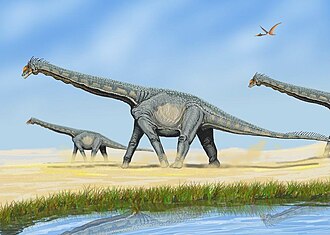
Camarasaurus was a large dinosaur with a body like an elephant. It had a long neck ending in a small skull, and its neck and trunk bones were very light but its legs were thick and strong. It was a bit wider than other similar dinosaurs, with a big ribcage. Its neck and tail were shorter than some others, and its skull was larger. Because its front legs were longer, it stood a little taller at the shoulders than at the hips.
Camarasaurus was a medium to large dinosaur. The most common type, C. lentus, was about 15 metres long. In 2020, a scientist named John Foster said that the latest type, C. supremus, had bones about 50% longer than the smaller types. Although C. supremus is not fully known, it might have been almost 23 metres long. In 2024, another scientist, Gregory S. Paul, estimated it to be 18 metres long.
The skull of Camarasaurus was bigger and stronger than other similar dinosaurs, with very strong upper and lower jaws. Like another dinosaur called Brachiosaurus, Camarasaurus had a large opening for the nose, which made its forehead look arched. Both had a defined front part of the face, but Camarasaurus had a more rounded and shorter skull. When viewed from above, the front of the face was rounded and tapered, unlike the square front of Diplodocus. The skull was almost square when viewed from behind and taller than it was wide.
The largest openings in the skull were the nose hole, the eye hole, and a hole behind and below the eye called the infratemporal fenestra. These three openings were about the same size. The nose hole was oval-shaped, and the eye hole was shaped like a teardrop. The eye had a ring of small bones around the pupil. The infratemporal fenestra was roughly triangle-shaped and tilted backwards. There was a small, pear-shaped hole between the nose hole and the eye hole. An even smaller hole was at the back corners of the skull roof, mostly facing upwards.
The skull had special features not found in related dinosaurs. One of these was the bone that formed the front edge of the eye hole, which was tilted forwards. Another feature was that a bone at the back of the skull did not reach the infratemporal fenestra because its upper part was short. The side of the lower jaw had a groove running from one bone forwards and downwards.
Known samples had teeth in the upper and lower jaws. The teeth were spoon-shaped and formed a continuous cutting edge. The teeth got longer towards the tip of the snout. The front edges of the teeth were more curved than the back edges.
The body of Camarasaurus had 12 neck bones, 12 back bones, and five hip bones. The tail had 53 tail bones in the two samples that had a complete tail. Most of the volume of the back and neck bones was made up by air sacs connected to the lungs. These air sacs filled big spaces in the bones, which gave Camarasaurus its name, meaning "chambered lizard". The neck and back bones were concave at the back and convex at the front and had big spaces on their sides.
The left and right parts of the shoulder area were probably connected at the front of the body by certain bones. The top end of the shoulder blade was wide. In the hip, one bone was massive, while the shaft of another bone was thin and curved. The front leg was thin, and the upper arm bone was shorter than the upper thigh bone. In contrast, the back leg was massive. Camarasaurus is one of few dinosaurs that show the wrist, which in this dinosaur had only two bones. The fingers were very small.
Footprints show that the back feet of these dinosaurs were supported by a large, fleshy pad like that of elephants. The skin impressions also show that the second to fourth fingers of the front foot were wrapped together in tissue. Patches of skin impressions are also preserved on the back legs, where they show scales.
Classification and species
Main article: Camarasauridae
In 1877, Edward Drinker Cope described Camarasaurus and thought it was related to other dinosaurs like Cetiosaurus. Later, scientists used different groups to sort these dinosaurs.
Camarasaurus has four recognized species: C. supremus, C. grandis, C. lentus, and C. lewisi. C. supremus was the first species named by Cope in 1877. The species differ mostly in size and shape of their vertebrae. Some scientists think C. supremus may have evolved from C. lentus.
A simple family tree shows Camarasaurus close to other sauropods.
Species
Most scientists agree that Camarasaurus has four species: C. grandis, C. lentus, C. lewisi, and C. supremus. These species are different mostly in size and the shape of their vertebrae. The species appeared one after another over millions of years, suggesting an evolutionary progression.
Synonyms and reassigned species
Fossils once named as different species like Camarasaurus leptodirus are now part of C. supremus. Other species once placed in Camarasaurus have been moved to different groups, such as Smitanosaurus and Lourinhasaurus.
Paleobiology
Feeding
Camarasaurus was a plant-eater that likely ate plants about 2 to 5 meters (6 feet 7 inches to 16 feet 5 inches) off the ground. It might have been able to stand on its back legs to reach higher plants. In 1998, a scientist named Anthony Fiorillo studied marks on the teeth of Camarasaurus and found that adult Camarasaurus ate tougher plants than another dinosaur called Diplodocus. Young Camarasaurus seemed to eat the same soft plants as young Diplodocus. Some scientists think that Camarasaurus had a stronger bite than other long-necked dinosaurs because of special bones in its jaw.
Camarasaurus continuously replaced its teeth, and each new tooth grew in about 62 days. In 2017, scientists found soft tissue on the jaw of a Camarasaurus specimen nicknamed "E.T." that might have been its gums. Some scientists think this tissue might have been covered by a beak that helped cut plants and protect the teeth. There were also small holes and grooves on the jaw that might have held blood vessels, possibly supporting lips like those in lizards today.
A young Camarasaurus specimen from Wyoming was found with 14 small, polished stones in its stomach. These stones were once thought to help grind food, but scientists now think they might have been swallowed by accident or for minerals.
Neck posture and function
Main article: Sauropod neck posture
The long necks of these dinosaurs might have evolved to reach high plants or to eat more without moving their bodies, saving energy. Scientists have debated how these necks were held. Some early reconstructions showed a straight, horizontal neck, while others suggested a more vertical, swan-like curve. Some complete skeletons show a vertical neck, but these might be special poses that happened when the dinosaur died, not how it normally held its neck. In 1998, some scientists argued that the necks were held horizontally, like a beam. Later studies suggested different postures, with some supporting a more vertical neck and others a downward slope. The shoulder blade’s angle also varied in different reconstructions, affecting how tall the dinosaur appeared at different parts of its body.
Sexual dimorphism
In a 1991 study, scientists noticed that in some Camarasaurus specimens, certain tail bones were fused together. This fusion was not a disease but might have helped stiffen the tail. Some scientists suggested this feature might have been used differently by male and female dinosaurs. In later studies, scientists found that Camarasaurus specimens could be classified as either robust (strongly built) or gracile (slender). These differences might reflect variations between males and females, though it is not fully certain which was which.
Life history
In 1883, a scientist named Marsh described a very small, incomplete dinosaur skeleton from Como Bluff. In 1994, this specimen was assigned to Camarasaurus grandis. In 1994, another tiny bone piece of Camarasaurus was found in Dry Mesa Quarry, suggesting it belonged to an embryo that had not yet hatched. This small embryo provided evidence that sauropods laid eggs.
As dinosaurs grew, they developed in several ways: juveniles had larger heads, shorter necks and tails, and shorter limbs compared to adults. As they matured, the bones of the spine fused together, and other changes occurred. Growth rings in the bones show that Camarasaurus grew quickly, like modern birds and mammals, and reached maturity before they were fully grown. Studies estimate that some Camarasaurus individuals lived to be about 26 to 40 years old.
Metabolism
For a long time, dinosaurs were thought to have cold blood, depending on the environment to control their temperature. But since the 1960s, evidence has suggested that dinosaurs might have been able to keep a constant body temperature, similar to modern birds and mammals. Young sauropods might have had higher metabolism, allowing them to grow quickly, while fully grown individuals might have kept their temperature up simply because of their large size. Studies of bone and tooth chemistry in Camarasaurus suggest their body temperatures were about 36–38 °C (97–100 °F), similar to modern mammals.
Pathologies
Scientists have found several injuries and diseases in Camarasaurus fossils. In one specimen, some tail bones did not fully develop. Other tail bones showed signs of arthritis, with extra bone growth around the joints. One specimen had damaged joints between its tail bones, showing signs of inflammation — the oldest known evidence of this condition in fossils. Another Camarasaurus had an injury on its upper arm bone, where a piece of bone appeared to have broken off or been torn, possibly from stress or heavy use. This injury healed but may have affected the dinosaur’s ability to move its arm. Another specimen showed several different bone abnormalities, possibly due to its advanced age.
Paleoecology
Distribution and abundance
Camarasaurus lived in what is now western North America during the Late Jurassic period, about 155 to 143 million years ago. Its fossils have been found in many places, from Montana in the north to New Mexico in the south. This dinosaur is one of the most common fossils found in these rock layers, called the Morrison Formation.
Paleoenvironment and migration
The Morrison Formation was a dry area with wet and dry seasons. Scientists think Camarasaurus may have traveled between this area and higher places to the west during the dry season. This travel was probably seasonal and covered a distance of about 300 kilometers or 190 miles. Many different kinds of dinosaurs and other animals lived in this ancient environment, including other large plant-eating dinosaurs and meat-eating predators.
Images
Related articles




This article is a child-friendly adaptation of the Wikipedia article on Camarasaurus, available under CC BY-SA 4.0.
Images from Wikimedia Commons. Tap any image to view credits and license.