 Safekipedia
Capitoline Hill
Adapted from Wikipedia · Adventurer experience
The Capitolium or Capitoline Hill, located between the Forum and the Campus Martius, is one of the famous Seven Hills of Rome. It is very important in ancient Roman history and culture. Earlier, the hill was called Mons Saturnius, named after the god Saturn.
The name Capitolium originally came from the grand Temple of Jupiter Optimus Maximus built on the hill. Over time, the name came to mean the whole hill and even inspired similar temples on other hills.
Today, the word Capitolium is the origin of the English word capitol. The well-known Capitol Hill in Washington, D.C. is thought to be named after the Capitoline Hill, showing how ancient Roman places still influence modern words and places.
Ancient history
The Capitoline Hill was very important in the history of Rome. The Sabines, a group of people, entered the city by tricking their way in. One woman named Tarpeia helped them and was punished. A steep cliff, later called the Tarpeian Rock, became a place where serious punishments happened.
Important temples were built on the Capitoline Hill. The Temple of Jupiter was one of the largest and most beautiful in Rome. Legends say that when the foundations for this temple were being dug, a human skull was found. The hill also had temples for Juno and Virtus.
When Gauls attacked Rome in 390 BC, the Capitoline Hill was the only part of the city the attackers could not capture. It was protected by Roman defenders. A story says that sacred geese warned the defenders of the attack.
The Capitoline Hill was the heart of ancient Rome, both geographically and in ceremonies. Later, it became a place with old, broken buildings.
Medieval history
The church of Santa Maria in Aracoeli stands next to the square, near where an old Roman citadel once stood. At the base of the hill, you can still see parts of an old Roman building that had more than four floors.
During the Middle Ages, the Capitoline Hill was important for Rome’s government. In the 1100s, the hill became a center for people who wanted more control over their city. In 1144, people stood up against those in charge, and a new leader, called a senator, began to live on the Capitoline Hill. This leader built a big house that faced away from the old Roman forum. A small open space was made in front of this house for community events. Later, a place for fair decisions was built at the south end of this space. By the 1500s, the area was surrounded by many buildings.
Michelangelo
The design of the Piazza del Campidoglio and its buildings was made by the famous Renaissance artist and architect Michelangelo Buonarroti between 1536 and 1546. The Pope Paul III asked Michelangelo to create a grand symbol of Rome for when an important visitor, Charles V, was expected in 1538. Michelangelo wanted to show Rome’s beauty in a new way.
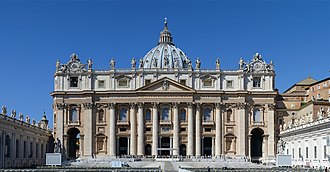
Michelangelo’s plan was very big. He wanted to change how the Capitoline Hill faced. Instead of looking toward the old Roman Forum, he turned it toward the new part of Rome with the Christian church, especially St. Peter's Basilica. In the middle of the square, he planned to place an equestrian statue of Marcus Aurelius. He also wanted to fix up old buildings and build new ones to make the area look better.
Even though Michelangelo started the work, it took many years to finish. When Charles V visited, the main stairs called the Cordonata Capitolina were not done yet. People had to climb a steep slope to see the progress. The work continued based on Michelangelo’s plans, and most of it was finished in the 1600s, except for the floor design, which was completed much later in 1940.
Piazza
The Piazza del Campidoglio has a special shape. The three buildings around it make a space that looks like a triangle but not a perfect one. The ground slopes, so Michelangelo made a wide, gentle staircase called the cordonata to lead people up. The floor has an oval shape with a diamond pattern, showing off beautiful Renaissance designs. In the middle, there is a feeling of standing on top of a huge egg in the heart of the city. There is also a star design that points to the stars, reminding people that Rome is called "Caput mundi", meaning “head of the world.” This floor design was only finished much later.
Michelangelo wanted the statue of Marcus Aurelius to be the center of the square. The buildings around it give the space a protected but open feel. Everything is planned with careful balance and direction, making the square feel like a large room under the sky. The square’s design draws people’s eyes to the statue. Michelangelo also added a tall tower to one building and made beautiful staircases and facades for the others.
Marcus Aurelius
Main article: Equestrian Statue of Marcus Aurelius
In the middle of the square stands the famous statue of the emperor Marcus Aurelius on his horse. Michelangelo made a simple base for it. People long thought the statue was of Emperor Constantine, the first Christian emperor. Today, we know it is Marcus Aurelius, and the bronze statue you see now is a copy. The original is kept nearby in the Palazzo dei Conservatori.
Palazzi
Main article: Capitoline Museums
Michelangelo designed new looks for the important buildings of Rome’s government: the Palazzo dei Conservatori, Palazzo Senatorio, and Palazzo Nuovo. He made a new front for the old Palazzo dei Conservatori and created the Palazzo Nuovo to match it, giving the area balance and beauty. These buildings now house the Capitoline Museums.
Palazzo Caffarelli Clementino
Next to the Palazzo dei Conservatori is the Palazzo Caffarelli Clementino, which is used for short exhibitions. It was built between 1576 and 1583. Some old ruins were removed to make space for it. After World War I, it was taken over by Rome’s city government, and part of it was torn down to make a terrace.
Palazzo dei Conservatori
The Palazzo dei Conservatori was built in the Middle Ages on top of an very old temple. Michelangelo changed its look, adding tall columns and beautiful designs. The front of the building has a porch with columns and a flat ceiling. The windows have special tops, and there is a railing on the roof. The building used to hold offices for groups that helped solve business problems. In the past, the main market of Rome was near here.
Palazzo Senatorio
The Palazzo Senatorio was built in the 1300s and 1400s on top of an old place that held Rome’s records. It now houses the mayor’s office. Michelangelo designed its big double staircase. The steps move gently up and meet in the middle. There is a fountain in front with statues of river gods. The top part of the building has tall columns, and the bell tower was built later.
Palazzo Nuovo
The Palazzo Nuovo was built to finish the square’s balance. It was made to look just like the Palazzo dei Conservatori, using Michelangelo’s old designs. It was finished in the 1600s and opened to the public in 1734.
Balustrade
A railing with statues on top of tall pillars finishes the design. Two very old statues of Castor and Pollux sit on the railing, though the ones Michelangelo planned are now elsewhere.
Cordonata
Next to the older, steeper stairs is the wide, gentle cordonata that Michelangelo designed. It makes it easy for people and even horse riders to go up the hill. The railings have statues of lions and the twins Castor and Pollux at the top. Nearby, there is a monument to Cola di Rienzo from 1886.
Influence
The word Capitolium from ancient Rome still affects us today. It is the root of the English word capitol, which means the building where a government meets. For example, Capitol Hill in Washington, D.C. is named after the Capitoline Hill in Rome.
Images
Related articles


This article is a child-friendly adaptation of the Wikipedia article on Capitoline Hill, available under CC BY-SA 4.0.
Images from Wikimedia Commons. Tap any image to view credits and license.