 Safekipedia
Charles Marion Russell
Adapted from Wikipedia · Adventurer experience
Charles Marion Russell, known as C. M. Russell or "Kid" Russell, was an American artist. He lived from March 19, 1864, to October 24, 1926. He is famous for his paintings and sculptures that show life in the American Old West. Russell made more than 2,000 paintings of cowboys, Native Americans, and beautiful landscapes from the western United States and Alberta, Canada.
Russell was also a storyteller and writer. He cared about Native Americans and helped support efforts to create a place for the landless Chippewa people in Montana. Because of his work, Congress passed a law in 1916 to create the Rocky Boy Reservation.
Today, many of Russell’s artworks are kept in museums, such as the C. M. Russell Museum Complex in Great Falls, Montana. His paintings are also found in other famous places like the Montana Historical Society in Helena, Montana and the Buffalo Bill Center of the West in Cody, Wyoming. In 1955, Russell was honored by being added to the Hall of Great Westerners in the National Cowboy & Western Heritage Museum in Oklahoma City, Oklahoma.
Childhood
Charles Marion Russell loved art from a very young age. He grew up in Missouri where he often drew and made clay animals. He was very interested in stories about the wild west and read a lot about it. Russell got to see real explorers and traders when they visited Missouri. He learned to ride horses at Hazel Dell Farm near Jerseyville, Illinois, using a famous Civil War horse named Great Britain. His teacher was Col. William H. Fulkerson, who was related to Russell’s family. When he was sixteen, Russell left school and went to Montana to work on a sheep ranch.
Montana and the West
Charles Marion Russell left his sheep ranch to work with Jake Hoover, a hunter, trapper, and rancher who owned land in the Judith Basin in Central Montana. Russell learned a lot about life in the West from Hoover, and they stayed friends for life. After visiting his family in Missouri in 1882, Russell returned to Montana and lived there forever.
Russell worked as a cowboy and painted many scenes of a very cold winter in 1886–1887. One of his paintings, Waiting for a Chinook, showed a thin cow watched by wolves under a gray sky. This painting became well-known and led to more people asking to see his art. Starting in 1888, Russell lived with the Blood Indians, a group of the Blackfeet nation, and learned about their culture. He later settled in Great Falls, Montana in 1892 and began working full-time as an artist.
In 1896, Russell married Nancy, who helped show his paintings to people all over the world. In 1913, he painted Wild Horse Hunters, showing people capturing wild horses. Russell's paintings of the Old West became popular and influenced many movies. He made many friends among famous people and other artists.
Depictions of Charles Marion Russell
Charles Marion Russell was shown in many ways by other artists and in photographs. An artist named A.O. Gregory painted his portrait. Photos show Russell working in his studio in Great Falls, Montana.
There are statues of Russell, made by an artist named John Weaver. You can find these statues in places like the National Statuary Hall Collection and the Montana Historical Society. One of Russell’s paintings appeared on a Montana U.S. Postage Stamp in 1989. He also made a self-portrait with a Christmas greeting in 1914.
Tributes
A collection of short stories called Trails Plowed Under was published after his death.
In 1960, Charles M. Russell Elementary School was built in Missoula, Montana. In 1965, a high school was built on the north side of the Missouri River in Great Falls, Montana and named Charles M. Russell High School, to honor Russell. Ian Tyson wrote a song called "The Gift" about Russell in 1987. Michael Nesmith of the Monkees recorded a song called "Laugh Kills Lonesome" inspired by a Russell painting. Native Blackfeet singer Jack Gladstone wrote a song called "When the Land Belonged to God" about Russell's painting.
In 1985, Russell was inducted into the Society of Illustrators Hall of Fame. In 1991, he was inducted into the St. Louis Walk of Fame.
Some of Russell's paintings were shown on the ABC television series How the West Was Won.
Russell was honored in the Montana Outdoor Hall of Fame in 2014. He is honored at the Stockmen's Memorial in Cochrane, Alberta, Canada.
The Charles M. Russell National Wildlife Refuge is named for him. A World War II Liberty Ship, SS Charles M. Russell, was named after him and launched in 1943 in Portland, Oregon.
The Bull Head Lodge and Studio, located off Going-to-the-Sun Road in Glacier National Park, was Russell's summer home and is listed on the National Register of Historic Places.
Auction
Charles Marion Russell’s artwork has sold for high prices over the years. In 2005, his painting Piegans sold for $5.6 million. In 2008, The Hold Up (20 Miles to Deadwood) sold for $5.2 million, and his bronze sculpture Buffalo Hunt sold for $4.1 million. In 2009, The Truce sold for $2.03 million.
In 2011, the prices for Russell’s work went even higher. Two of his paintings, Water for Camp and A Dangerous Sport, each sold for nearly $1.5 million. In 2014, a group of 30 pieces sold for several million dollars. One painting, Trail of the Iron Horse, sold for $1.9 million, and another, Dakota Chief, sold for $1.1 million. Even small pencil drawings sold for $25,000.
Notable works
See also: Paintings by Charles Marion Russell
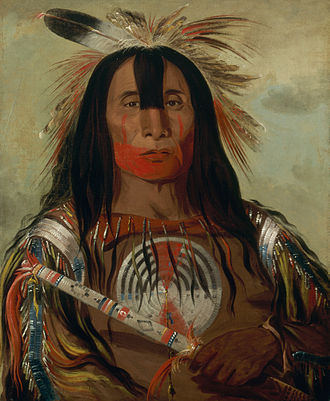
Charles Marion Russell made many paintings and sculptures about life in the American West. His art showed both big moments from history and everyday scenes. Russell often showed things from the Native American people's point of view, which was different from most artists at the time. He worked hard to make sure the clothes and tools in his paintings looked real.
Some of Russell’s most famous paintings are about cowboy life, like Laugh Kills Lonesome and Bronc to Breakfast. He also created many works about Native American people, such as The Cryer and Buffalo Hunt. His paintings of women included both Native American women and women from the Victorian era. Russell painted important historical events too, like the journey of Lewis and Clark and the Battle of the Little Bighorn, showing these from the Native American viewpoint.
Images
Related articles




This article is a child-friendly adaptation of the Wikipedia article on Charles Marion Russell, available under CC BY-SA 4.0.
Images from Wikimedia Commons. Tap any image to view credits and license.