
Cold War
The Cold War was a period of rivalry between the United States (US) and the Soviet Union (USSR), along with their friends. The US side was part of the capitalist Western Bloc, and the Soviet side was part of the communist Eastern Bloc. It began in the aftermath of the Second World War and ended when the dissolution of the Soviet Union happened in 1991. The term cold war is used because the two superpowers never fought each other directly. Instead, each supported opposite sides in regional conflicts, which were called proxy wars. The rivalry also included an arms race in both regular and nuclear weapons, and a competition for influence. There were also contests in technology, such as the Space Race. Other parts of the rivalry included espionage (spying), propaganda campaigns, embargoes, and sports diplomacy.
After the Second World War ended in 1945, the US and USSR, who had been allies, became rivals. By 1949, the USSR had set up satellite governments in its occupied territories in Eastern Europe and in North Korea. This divided Europe, and Germany, with an "Iron Curtain". The USSR tested its first nuclear weapon in 1949, four years after the US used its own on Hiroshima and Nagasaki. That same year, the USSR formed an alliance with the People's Republic of China, which had been founded in 1949. In 1947, the US announced the Truman Doctrine, a plan of "containment" against communism. In 1948, it started the Marshall Plan to help Western Europe recover economically. In 1949, the US also founded the NATO military alliance. In 1955, the Soviet-led Warsaw Pact formed as a response. Early confrontations included the Berlin Blockade from 1948 to 1949 and the Korean War from 1950 to 1953, which ended in a stalemate.
Both sides became involved in conflicts around the world. US involvement in regime change during the Cold War included support for First World anti-communist and right-wing dictatorships and uprisings. Soviet involvement included funding Second World left-wing parties, wars of independence, and dictatorships. As nearly all the colonial states went through decolonization, many of them became Third World battlefields of the Cold War. Both powers offered economic aid to try to win the friendship of non-aligned countries. In 1959, the Cuban Revolution brought the first communist government in the Western Hemisphere. In 1962, the Cuban Missile Crisis began after the US placed missiles in Europe and the USSR placed missiles in Cuba. It is widely seen as the closest the Cold War came to turning into nuclear war. Another major proxy conflict was the Vietnam War, from 1955 to 1975, which ended in a North Vietnamese victory.
The USSR kept its control over Eastern Europe by stopping the Hungarian Revolution in 1956 and by the Warsaw Pact invasion of Czechoslovakia in 1968. Relations between the USSR and China had broken down by 1961. The Sino-Soviet split brought the two countries close to war during a border conflict in 1969. In 1972, the US initiated diplomatic contacts with China. That same year, the US and USSR signed a series of treaties limiting their nuclear weapons. This period was known as détente. In 1979, governments allied with the US were overthrown in Iran and Nicaragua, and the Soviet–Afghan War began. These events raised tensions again. In 1985, Mikhail Gorbachev became leader of the USSR and expanded political freedoms. This helped lead to the revolutions of 1989 in the Eastern Bloc and the collapse of the USSR in 1991, which ended the Cold War.
This article is about the state of political tension in the 20th century. For the general term, see Cold war (term). For other uses, see Cold War (disambiguation). The phrase "Cold Warrior" also leads to Cold Warrior (disambiguation).
Terminology
Writer George Orwell used the words cold war in his essay "You and the Atomic Bomb," published on 19 October 1945. He wrote about a world living under the threat of nuclear warfare. He also talked about ideas from James Burnham about a world split into two powerful sides. In The Observer on 10 March 1946, Orwell wrote that Russia had started a "cold war" against Britain and the British Empire.
The term was first used to describe the rivalry between the Soviet Union and the United States after the post-war period in a speech by Bernard Baruch on 16 April 1947. Baruch was an advisor to Democratic presidents. The speech was written by journalist Herbert Bayard Swope. Walter Lippmann helped the term spread widely through his book The Cold War. In 1947, Lippmann was asked where the term came from. He linked it to a French phrase from the 1930s, la guerre froide.
Background
Main article: Origins of the Cold War
For a chronological guide, see Timeline of the Cold War.
Friendship among the Allies of World War II was already fading before the war ended. When Franklin D. Roosevelt died in April 1945, Harry Truman became president. His government took a firmer approach toward the Soviet Union. American and Soviet leaders disagreed about what had been agreed at the Yalta Conference. Truman's government also could not agree on who should be part of the Polish government. Truman and some of his advisers wanted more democratic groups included. A 1944 agreement between Churchill and Stalin also added tension in Eastern Europe.
Disagreements grew again when the United Nations was created in 1945. The Soviets worried that many Latin American countries, which were friendly with the United States, would work against them. They opposed Argentina joining the UN. They also wanted a bigger Security Council veto. In the end, Stalin agreed to the American positions on the veto and the Polish government. This allowed Oskar Lange and Stanisław Mikołajczyk to join it. Tensions rose further when the lend-lease program was suddenly cancelled in May. They rose again in August, when the atomic bombings of Japan took place just days before a planned Soviet entry into the Pacific war.
Containment, Truman Doctrine, Korean War (1947–1953)
In 1946, the United States became more strongly opposed to the Soviet Union. American leaders believed the Soviets were not keeping their promises about Europe and Iran. In 1947, US President Harry S. Truman announced the Truman Doctrine. The US then adopted a policy called containment, which aimed to stop the spread of communism. Later that year, the US began the Marshall Plan, which offered economic help to countries in Europe. Stalin did not allow Eastern European countries to accept this help.
In 1948, Communists took power in Czechoslovakia in a coup d'état. From June 1948 to May 1949, the Soviets blocked Western supplies from reaching West Berlin. This was called the Berlin Blockade. The Western countries answered by flying supplies into the city. In 1949, the North Atlantic Treaty Organization (NATO) was formed, and Germany was split into two states. That same year, Mao Zedong's Communists won control of China from the US-supported Nationalist Government. In June 1950, North Korea invaded South Korea, and the Korean War began. The United Nations supported South Korea, and the fighting lasted a long time. It ended with the Korean Armistice Agreement in July 1953.
Nuclear arms race and escalation (1953–1962)
In 1953, leaders changed on both sides, and this shifted the Cold War. Dwight D. Eisenhower became the American president that January. He cut military spending but kept fighting the Cold War. After Joseph Stalin died that year, Nikita Khrushchev became the most powerful leader in the Soviet Union. In 1956, he criticized Stalin and loosened control over the government and people in a process called de-Stalinization. That same year, Khrushchev told Western guests, "We will bury you." He later explained that he meant communism would win over capitalism, not that there would be a nuclear war. The American government relied on nuclear weapons for containment. It promised "massive retaliation" if the Soviets attacked. In 1955, the Soviets formed the Warsaw Pact, an alliance that opposed NATO. In 1956, a popular uprising against communism began in Hungary. The Soviet Army invaded, and many Hungarians were harmed or arrested. Many others left the country. In 1958, Khrushchev wanted to make Berlin a demilitarized "free city," but NATO refused his ultimatum.
When John F. Kennedy became president, he continued containment. He chose a plan called flexible response, which relied mostly on regular forces for limited goals. He also increased defense spending and quickly built up nuclear weapons. Meanwhile, the United States and the Soviet Union competed for influence in the Third World. The US used the CIA to help overthrow a government in Iran in 1953 (Operation Ajax) and in Guatemala in 1954 (1954 Guatemalan coup d'état). After the Soviets launched Sputnik 1 in 1957, a Space Race began between the two countries. The Cuban Revolution brought Fidel Castro to power in 1959. In 1961, a CIA-organized invasion of Cuba failed. In August 1961, East Germany built a wall that later became the Berlin Wall. In October 1962, the Cuban Missile Crisis brought the world closer to nuclear war than ever before. Khrushchev backed down, and in 1964 his colleagues removed him from power.
From confrontation to détente (1962–1979)
In the 1960s and 1970s, Cold War countries had to adjust to a more complicated world. Countries were no longer clearly split into two opposing groups. With American help, Western Europe and Japan recovered quickly from World War II and grew strongly, while Eastern Bloc economies stagnated. In Indonesia, the anti-communist General Suharto took control from Sukarno and tried to establish a "New Order". From 1965 to 1966, with the aid of the US and other Western governments, the military harmed many members and supporters of the Indonesian Communist Party and other leftist groups. The Vietnam War was very difficult for the United States, which lost standing in the world and faced unrest at home. After this, the US chose a policy of détente with China and the Soviet Union. In 1978, Vietnam, backed by the Kampuchean United Front for National Salvation, invaded Cambodia and removed Pol Pot from power. Then came the 1973 oil crisis, when OPEC cut its oil output. This hurt Western economies but brought a large flow of money to the Soviet Union. Meanwhile, the Soviet Union had its own economic problems, and leaders such as Leonid Brezhnev and Alexei Kosygin supported détente.
Relations between the superpowers began to ease. In 1968, the Prague Spring reforms in Czechoslovakia were followed by a Soviet-led invasion on 20 August 1968, joined by most of the Warsaw Pact allies. In 1972, US President Richard Nixon visited China, and the two countries moved closer, because the Sino-Soviet split had caused tension. Nixon and Brezhnev met, which led to the Strategic Arms Limitation Talks and arms control treaties. The Helsinki Accords were signed in 1975. However, the Soviet government still limited civil liberties, and human rights activists were treated very badly. In the late 1970s, relations worsened again. Jimmy Carter tried to limit the arms race with the SALT II agreement in 1979, but his efforts were held back by other events that year, including the Iranian Revolution, and the Soviet coup in Afghanistan in December.
Renewal of tensions (1979–1985)
Main articles: Soviet–Afghan War, Carter Doctrine, Foreign policy of the Ronald Reagan administration, Operation Cyclone, Saur Revolution, and Afghan Civil War (1989–1992)
Further information: Reagan Doctrine and Thatcherism
Main articles: Solidarity (Polish trade union) and Martial law in Poland
Further information: Soviet reaction to the Polish crisis of 1980–1981
Further information: Era of Stagnation, Strategic Defense Initiative, RSD-10 Pioneer, and MGM-31 Pershing
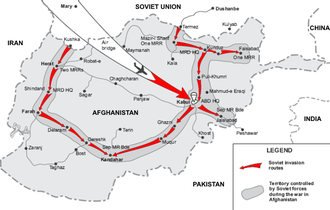
The late 1970s and early 1980s saw Cold War tensions and conflicts grow strong again, and both sides became more forceful. Diggins says, "Reagan went all out to fight the second cold war, by supporting counterinsurgencies in the third world." Cox says, "The intensity of this 'second' Cold War was as great as its duration was short." In April 1978, the communist People's Democratic Party of Afghanistan (PDPA) took power in Afghanistan in the Saur Revolution. Opponents soon started an uprising. It grew into a civil war fought by mujahideen guerrillas against government forces. The Islamic Unity of Afghanistan Mujahideen received training and weapons in neighboring Pakistan and China. The Soviet Union sent thousands of military advisers to support the PDPA government. The party was split between the Khalq and the more moderate Parcham factions. In September 1979, Khalqist President Nur Muhammad Taraki was killed in a takeover led by fellow Khalq member Hafizullah Amin, who became president. The Soviets did not trust Amin. In December 1979, he was killed by Soviet special forces during Operation Storm-333. The Soviets then installed Babrak Karmal, a leader of the Parcham faction, in his place. Veterans of the Soviet Alpha Group have said the operation was one of the most successful in the unit's history. Papers released after the dissolution of the Soviet Union in the 1990s suggested that Soviet leaders believed Amin had secret contacts within the American embassy in Kabul, but these claims have been widely discredited. Soviet troops then entered Afghanistan in larger numbers. The Soviets were now directly involved in what had been a war inside one country. In response, Carter withdrew the SALT II treaty from ratification, placed limits on grain and technology shipments to the USSR, and asked for a large increase in military spending. He also announced a boycott of the 1980 Summer Olympics in Moscow, which 65 other nations joined. He called the Soviet move "the most serious threat to the peace since the Second World War."
In January 1977, four years before becoming president, Ronald Reagan told Richard V. Allen that his basic idea about the Cold War was simple: "We win and they lose." In 1980, Reagan won the 1980 presidential election and promised to increase military spending and confront the Soviets everywhere. Reagan and new British Prime Minister Margaret Thatcher both spoke out against the Soviet Union and its ideas. Reagan called the Soviet Union an "evil empire" and said communism would end up on the "ash heap of history." Thatcher said the Soviets were "bent on world dominance." By early 1985, Reagan's position had grown into the Reagan Doctrine, which added a right to weaken existing communist governments. The CIA also tried to weaken the Soviet Union by promoting Islamism in the majority-Muslim Central Asian Soviet Union. It encouraged Pakistan's ISI to train Muslims from around the world to take part in the jihad against the Soviet Union. In 1979, Pope John Paul II gave a moral focus to anti-communism during a visit to his native Poland. This helped spark a movement centered on the Solidarity movement trade union. He was later the target of an attempted assassination. In December 1981, Wojciech Jaruzelski responded to the crisis by imposing a period of martial law, and Reagan placed economic sanctions on Poland. Mikhail Suslov, the Kremlin's top ideologist, advised Soviet leaders not to step in if Solidarity took control of Poland.
The Soviet Union built a military that used a large share of its national output, which came at the cost of consumer goods and investment in civilian areas. Spending on the arms race and other Cold War commitments added to deep problems. The Soviet system went through a decade of economic stagnation during the late Brezhnev years. Soviet defense investment was driven in large part by the interests of the nomenklatura, which depended on the sector for its power and privileges. The Soviet Armed Forces became the largest in the world in weapons, troops, and the size of their military–industrial base. However, these advantages often hid areas where the Eastern Bloc fell far behind the West. The Persian Gulf War showed that the armor, fire control systems, and firing range of the Soviet T-72 tank were much weaker than those of the American M1 Abrams. This was true even though the USSR had almost three times as many T-72s as the US had M1s. By the early 1980s, the USSR had built an arsenal and army larger than that of the United States. After the Soviet invasion of Afghanistan, President Carter began a large buildup of US forces, which Reagan sped up. Reagan revived the B-1 Lancer program, produced LGM-118 Peacekeeper missiles, and announced the experimental Strategic Defense Initiative, called "Star Wars" by the media. The Soviets deployed RSD-10 Pioneer missiles aimed at Western Europe. NATO later placed MGM-31 Pershing missiles in Europe. The Soviet Union did not respond by building up its military further. Its huge military costs, along with planned manufacturing and collectivized agriculture, were already a heavy burden on the Soviet economy. At the same time, Saudi Arabia increased oil production, which helped cause the 1980s oil glut. Since oil was the main source of Soviet export money, this hurt the USSR. Problems with command economics, falling oil prices, and large military spending slowly brought the Soviet economy to a standstill.
In 1983, the Soviet Union shot down Korean Air Lines Flight 007, a Boeing 747 carrying many people, including Congressman Larry McDonald. The plane had flown into Russian prohibited airspace after a navigation mistake. The Soviet Air Force treated it as a spy plane and destroyed it with air-to-air missiles. Later that year, the 1983 Soviet nuclear false alarm incident happened. Systems in Serpukhov-15 showed that several intercontinental ballistic missiles were heading toward Russia. Officer Stanislav Petrov correctly judged it to be a false alarm, so the Soviets did not respond to an attack that did not exist. The Able Archer 83 exercise that November was a realistic simulation of a coordinated NATO nuclear release. It may have been the most dangerous moment since the Cuban Missile Crisis, because Soviet leaders feared a nuclear attack might be coming. American public concern about foreign conflicts had lasted since the Vietnam War. The Reagan administration relied on quick, low-cost counterinsurgency tactics. In 1983, it took part in the Lebanese Civil War, invaded Grenada, bombed Libya, and backed the Contras, anti-communist fighters trying to overthrow the Sandinista government in Nicaragua. The Grenada and Libya actions were popular at home. The support for the Contras was mired in controversy. Its backing of the military government of Guatemala during the Guatemalan Civil War, especially the rule of Efraín Ríos Montt, was also controversial. The Soviets also paid high costs for their own interventions. Although Brezhnev believed in 1979 that the Soviet war in Afghanistan would be short, Muslim guerrillas fought fiercely. A senior US State Department official predicted in 1980 that the invasion was partly caused by a "domestic crisis within the Soviet system." The official said the Soviet system might be experiencing entropy and "a period of foreign movement at a time of internal decay."
Final years (1985–1991)
Further information: Mikhail Gorbachev, Perestroika, and Glasnost
When Mikhail Gorbachev became General Secretary in 1985, the Soviet economy was weak. The country was also earning much less money from oil sales. In 1987, he announced perestroika, a plan to change the economy. It loosened the production quota system, let small businesses run as cooperatives, and opened the way for foreign investment. He also introduced glasnost, which means openness. It gave the press more freedom and was meant to reduce corruption in the Communist Party and the abuse of power in the Central Committee. Glasnost also helped people in the Soviet Union have more contact with the Western world. This supported a growing détente between the two nations. Gorbachev and the US leader met at several summits, including in Geneva, Reykjavík, and Washington. Talks at Reykjavík failed over the Strategic Defense Initiative. However, the Intermediate-Range Nuclear Forces Treaty was signed in 1987. In 1989, Soviet forces withdrew from Afghanistan, the Berlin Wall fell, and the Iron Curtain came down. At the Malta Summit that December, Gorbachev and George H. W. Bush declared the Cold War over.
Main article: Revolutions of 1989
In 1989, the Revolutions of 1989 brought peaceful changes that removed communist governments in East Germany, Poland, Hungary, Czechoslovakia, and Bulgaria. Romania was the only Eastern Bloc country to remove its communist government through violence. Its leader was executed. Soon after, the Soviet republics began moving toward independence. In 1990, Russia declared its sovereignty, and Boris Yeltsin was elected chairman of its congress. Lithuania declared its independence. Soviet forces tried to stop this movement, but it only gained more support around the world. In August 1991, an attempted takeover by hardline members of the government and the KGB failed. This weakened Gorbachev's power. Gorbachev resigned as general secretary, and the activities of the Communist Party were suspended. On 25 December 1991, the Soviet Union broke apart. Fifteen states came out of it. The Russian Federation took over the Soviet Union's international rights and responsibilities. In 1993, Bush and Yeltsin agreed to START II, which added further cuts to nuclear weapons.
Aftermath
Main articles: Effects of the Cold War, International relations since 1989, Post-Soviet states, Post-Soviet conflicts, Yugoslav Wars, Second Cold War, and East–West dichotomy
Vladislav Zubok said that the fall of the Soviet empire was a very important event. It changed world politics, the military, ideas, and the economy. After the dissolution of the Soviet Union, Russia cut its military spending a lot. Changes to the economy left millions of people without jobs. Western analysts said that Russia's reforms caused a recession in the early 1990s. It was worse than the Great Depression in the United States and Germany. They also suggested that only five or six former communist countries were likely to become rich, capitalist countries. Stephen Holmes of the University of Chicago said in 1996 that decommunization, the effort to remove communist influence, mostly failed. East Germany was the main exception. There, thousands of former Stasi informers lost their public jobs. Holmes explained that almost every family had some link to the government. Many people also felt that money problems were more urgent than the past. In Russia, decommunization was limited. The Communist Party of the Soviet Union was banned, and the Communist Party of the Russian Federation was created. Some cities got back their names from before the October Revolution, such as Saint Petersburg.
In Ukraine, decommunization began during and after the dissolution of the Soviet Union in 1991. After the Revolution of Dignity in 2014, the Ukrainian government passed laws against communist symbols. In 2015, Petro Poroshenko signed laws that led to many Lenin monuments being removed and streets being renamed. The Yugoslav Wars began after Slovenia and Croatia declared independence in 1991. Serbia, led by Slobodan Milošević, opposed these moves. The Bosnian War (1992–1995) was one of the most harmful of these wars. Many families were forced to leave their homes to find safety. NATO eventually used airstrikes in Bosnia as part of Operation Deliberate Force. It also used airstrikes in Kosovo as part of Operation Allied Force.
Influence
The world after the Cold War is often called unipolar, with the United States as the only remaining superpower. The Cold War shaped the role the United States played after World War II. By 1989, the United States had military alliances with 50 countries. It had about 526,000 troops stationed in other countries, including about 326,000 in Europe, most of them in West Germany, and about 130,000 in Asia, mainly in Japan and South Korea. This was also a time when military–industrial complexes grew to their largest size in peacetime, and military funding of science was very large.
The United States spent a very large amount of money on its military during the Cold War. Many Americans lost their lives in the Korean and Vietnam Wars. The Soviet Union also spent a great deal compared to the size of its economy. Many people were hurt in proxy wars around the world, especially in eastern Asia, and most of these wars ended with the Cold War. Some of the economic and social tensions that fed the Cold War rivalry still exist today. When communist governments lost control in some areas, new conflicts broke out, especially in the former Yugoslavia. Central and Eastern Europe have seen economic growth and more liberal democracies. In other places, such as Afghanistan, becoming independent was followed by state failure. Some scholars have suggested that the dissolution of the Soviet Union and the end of communism as a global force allowed neoliberal capitalism to become the main economic system in the world. This has led to rising economic inequality.
In popular culture
See also: The Cold War in popular culture
The Cold War is still a popular subject in entertainment. Movies, books, TV shows, and web series about this time are still being made today.
Historiography
Main article: Historiography of the Cold War
Historians, political scientists, and journalists do not agree about how the Cold War began or what it was really about. They have argued about who was to blame for the breakdown of relations between the Soviet Union and the United States after the Second World War. They have also wondered whether the conflict could have been avoided.
Historians often describe three main ways of studying the Cold War. "Orthodox" accounts blame the Soviet Union and its spread into Europe. "Revisionist" writers put more blame on the United States, saying it tried to limit and challenge the Soviet Union even before World War II ended. "Post-revisionists" see the events as more complicated and try to be fair to both sides. Many writers mix two or even all three of these approaches.
Pictures
Keep exploring


This article is a child-friendly adaptation of the Wikipedia article on Cold War, available under CC BY-SA 4.0.
Images from Wikimedia Commons. Tap any image to view credits and license.