 Safekipedia
Cotonou Agreement
Adapted from Wikipedia · Adventurer experience
The Cotonou Agreement (French: Accord de Cotonou) is a treaty between the European Union (EU) and the African, Caribbean and Pacific Group of States (ACP). It was signed in June 2000 in Cotonou, Benin's largest city, by 78 ACP countries (except Cuba) and the then fifteen EU member states. It entered into force in 2003 and was later changed in 2005 and 2010.
After the 2010 change, the agreement was set to end on 29 February 2020. However, it was extended temporarily to no later than 31 October 2023. This was done while waiting for a new agreement, called the Samoa Agreement, to be created. The Cotonou Agreement aimed to help partner countries develop and work together with the EU.
Aims
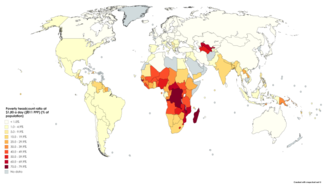
The Cotonou Agreement was made to help reduce and end poverty. It also aims to support sustainable development and help ACP countries join the world economy slowly. The updated agreement also works to stop impunity and support criminal justice using the International Criminal Court.
Main principles
The Cotonou Agreement replaced the Lomé Convention, which helped countries work together on development since 1975. The Cotonou Agreement is much bigger and lasts for 20 years. It has four main ideas.
First, countries decide how they want to grow and improve. Second, many groups can help, not just the central government, like civil society, the private sector, and local governments. Third, countries agree to work together and follow important rules, like human rights. Last, help given to countries changes based on what they need and how they are doing. Special help goes to least developed countries or those that are landlocked or island states.
Political dimension
The Cotonou Agreement aimed to build stronger cooperation between the European Union and African, Caribbean, and Pacific countries. It included discussions on peace, security, and migration.
The agreement stressed the importance of fair and honest government. If a country did not follow these rules, the EU could pause its support. Serious problems could lead to talks and possible pauses in aid.
New actors
The Cotonou Agreement let groups that are not governments, like local groups and community leaders, help with development projects in Africa, the Caribbean, and the Pacific. These groups work with the main governments to plan and do projects. They also get help to learn new skills and get money for their work.
The agreement also helped the private sector, which means businesses and companies, to grow and stay strong. New tools were made to help these businesses, including support from the European Investment Bank.
Trade cooperation
The Cotonou Agreement changed how the European Union and African, Caribbean, and Pacific countries trade. Before this, the EU helped these countries without asking for anything back. Now, both sides agree to trade fairly. The EU lets these countries sell their goods without extra fees, and these countries also let EU goods in without extra fees.
Not every country follows this new rule the same way. Less developed countries can keep the old rules or use a special plan called "Everything But Arms." Other countries can choose a different trading system if they are not ready for the new rules.
Programming
The Cotonou Agreement changed how help is given to countries. The European Union now looks at how well a country is doing before deciding how much help to give. This means countries that do a good job can get more support.
Help is given out every five years. In the years 2002 to 2007, about €13.5 billion was shared among these countries. For the years 2008 to 2013, the amount grew to €22.7 billion, with some of it used for projects to improve infrastructure in Africa. The agreement also allows more help to go to countries that improve their rules and systems.
Fight against impunity
See also: Anti-impunity
The Cotonou Agreement helps countries work together to make sure people are held responsible for very serious wrongdoings. Countries in Africa, the Caribbean, and the Pacific, along with the European Union, promised to support justice through the International Criminal Court. This means they will try to punish serious crimes in their own countries or by working together worldwide. The Agreement also encourages countries to share ideas on changing their laws to support the International Criminal Court and to cooperate to stop international crimes using international rules.
Revision
The Cotonou Agreement was updated twice to work better. The first update happened in Luxembourg on June 25, 2005, and it started being used on July 1, 2008.
The second update was signed in Ouagadougou, Burkina Faso, on June 22, 2010, and it began working on November 1, 2010.
Samoa Agreement
The Cotonou Agreement was planned to be replaced by the Samoa Agreement. This new agreement has three parts. It keeps European money for the Organisation of African, Caribbean and Pacific States and lets the EU decide where to send its development funds. The new agreement was agreed upon in April 2021, but Hungary and Poland delayed its approval in the EU. In November 2023, 44 ACP states signed the agreement in Samoa.
Criticism
Some people think that even though the Cotonou Agreement aimed to reduce poverty, the money sent to Africa through a special fund did not help most poor people very much.
Related articles


This article is a child-friendly adaptation of the Wikipedia article on Cotonou Agreement, available under CC BY-SA 4.0.