 Safekipedia
Cryptanalysis of the Enigma
Adapted from Wikipedia · Adventurer experience
The Cryptanalysis of the Enigma was a very important part of World War II. It helped the western Allies read secret messages sent by the Axis powers. These messages were coded using special machines called Enigma.
Enigma machines were used by Germany and other Axis countries for their secret communications. In 1932, a mathematician named Marian Rejewski in Poland figured out how to break the Enigma code. By 1939, Poland shared their methods with Britain and France just before the war started.
When Germany invaded Poland, Polish experts moved to France and kept working with the British. Later, Britain built a big team at Bletchley Park to break these codes. A mathematician named Alan Turing helped create better tools to solve the Enigma puzzles. Breaking these codes gave the Allies important information.
General principles
Main article: Cryptanalysis
Enigma machines used special parts called rotors and cables to make very tricky secret codes. These codes changed each letter of a message, making them hard to understand.
Breaking these secret codes has three steps. First, you need to know which machine was used. Second, you must find out how the machine changes the letters. Third, you need to learn the special setting used for each message. Because Enigma machines had many possible setups, it was very hard to solve them.
The Enigma machine
Main articles: Enigma machine and Enigma rotor details
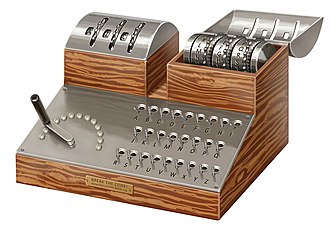
The Enigma machine was a clever way to hide messages. It changed letters into other letters, making messages hard to read.
Structure
The Enigma machine had a keyboard to type messages. Inside, parts changed each letter as you typed. These parts moved when you pressed a key, so the same letter could look different in different places of the message.
There were many ways to set up the machine, which made it hard to break. But some secrets about how it worked helped people try to read hidden messages.
Security properties
The Enigma machine could be set up in many ways, which helped hide messages. But some rules about how it worked made it easier for experts to try to read the messages.
Key setting
When sending secret messages, people using the Enigma machine used special ways to make sure both sender and receiver had the same settings. They used sheets with settings for each day and changed them often to keep messages safe.
| Ciphertext | O | H | J | Y | P | D | O | M | Q | N | J | C | O | S | G | A | W | H | L | E | I | H | Y | S | O | P | J | S | M | N | U |
|---|---|---|---|---|---|---|---|---|---|---|---|---|---|---|---|---|---|---|---|---|---|---|---|---|---|---|---|---|---|---|---|
| Position 1 | K | E | I | N | E | B | E | S | O | N | D | E | R | E | N | E | R | E | I | G | N | I | S | S | E | ||||||
| Position 2 | K | E | I | N | E | B | E | S | O | N | D | E | R | E | N | E | R | E | I | G | N | I | S | S | E | ||||||
| Position 3 | K | E | I | N | E | B | E | S | O | N | D | E | R | E | N | E | R | E | I | G | N | I | S | S | E | ||||||
| Positions 1 and 3 for the possible plaintext are impossible because of matching letters. The red cells represent these clashes. Position 2 is a possibility. | |||||||||||||||||||||||||||||||
| Left | Middle | Right |
|---|---|---|
| I | II | III |
| I | III | II |
| II | I | III |
| II | III | I |
| III | I | II |
| III | II | I |
British efforts
In 1927, the United Kingdom bought an Enigma machine to learn how it worked. A skilled codebreaker named Dilly Knox tried to break the codes. He had experience from World War I and the Room 40 team. When Germany started using changed versions of these machines during the Spanish Civil War and the Italian Navy used a simpler version, Britain began to understand some of these messages. By April 1937, Knox broke some Enigma codes using smart methods. But Britain still could not read the more advanced military Enigma messages used by Germany.
Polish breakthroughs
Main article: Cipher Bureau (Poland)
In the 1920s, Germany started using a special machine called the Enigma to make secret codes. Poland wanted to understand these codes because Germany was a danger to them. Some smart students and teachers from Poznań University helped Poland's code-breaking team.
One student, Marian Rejewski, found smart ways to understand the Enigma codes without knowing all the secret parts of the machine. He noticed that German code workers sometimes made simple mistakes. These mistakes helped Rejewski and his team figure out some of the codes.
Before Rejewski began, a person in Germany who worked with secret codes gave some information to France. France then shared this with Poland. This information helped Rejewski learn how the Enigma machine worked.
Rejewski and his team made copies of the Enigma machine to practice breaking the codes. They used many different ways to keep solving the codes, even when Germany changed how they used the Enigma.
| First letter | A | B | C | D | E | F | G | H | I | J | K | L | M | N | O | P | Q | R | S | T | U | V | W | X | Y | Z |
|---|---|---|---|---|---|---|---|---|---|---|---|---|---|---|---|---|---|---|---|---|---|---|---|---|---|---|
| Fourth letter | N | S | Y | Q | T | I | C | H | A | F | E | X | J | P | U | L | W | R | Z | K | G | O | V | M | D | B |
World War II
Polish disclosures
As war became more likely in 1939, Britain and France promised to support Poland. In April, Germany ended a pact with Poland. Poland decided to share its work on breaking the Enigma code with its allies because of the growing threat.
In July 1939, near Warsaw, Poland told France and Britain that they had broken the Enigma code. They gave each ally a copy of the Enigma machine and details of their methods. Britain agreed to make special tools for solving the code. A British expert thought the Polish method might become useless if Germany changed its rules, which happened later.
After this, two Polish-made Enigmas were sent to Paris. One was taken to London and given to a British intelligence officer.
A British expert wrote that without Poland’s help, their success in breaking Enigma would have taken much longer.
PC Bruno
In September 1939, Poland began moving its code-breaking team and equipment out of Warsaw. By September 17, they had crossed into Romania and destroyed sensitive materials. The team reached Britain with help from French and British embassies and continued their work near Paris, working with British code-breakers.
Operating shortcomings
The Enigma machine had some weaknesses that made it easier to break. These included:
- Using repeated letters at the start of messages, like “AAA” or “BBB”.
- Reusing the same letter patterns in messages.
- Having only a few different parts that could be swapped around.
- Sometimes using simple or predictable settings for the machine.
These mistakes helped the Allies break the code more easily.
Crib-based decryption
Code-breakers used known pieces of plaintext — called “cribs” — to help solve the encrypted messages. They kept records of common phrases, names, and locations to identify these pieces in the encrypted messages.
British bombe
The British built a machine called the “bombe” to help break Enigma codes faster. It tested many possible settings of the Enigma machine to find the right one. This machine was important in speeding up decoding messages.
Luftwaffe Enigma
The German Air Force was the first to have its Enigma codes broken regularly. The messages were decoded quickly, helping the Allies plan their strategies.
Abwehr Enigma
In 1941, British experts broke the code used by the German intelligence service. This allowed the Allies to control German spies in Britain, turning them into double agents who worked for the Allies instead.
German Army Enigma
Breaking the German Army’s Enigma codes took longer. It wasn’t until early 1941 that progress was made, and it became reliable only in the spring of 1942.
German Naval Enigma
The German Navy used a more complex version of Enigma starting in 1937. This version included extra parts that made it harder to break. However, the British still managed to decode many messages by using captured materials and clever methods.
Italian naval Enigma
In 1940, British experts confirmed that the Italian Navy was using the same Enigma system they had broken before. Breaking these codes helped the Allies win important battles, like the Battle of Cape Matapan in 1941.
American bombes
The United States also built its own versions of the bombe machines. These American machines were faster and helped break Enigma codes more efficiently, supporting the British efforts.
After World War II
The work on solving the Enigma code was kept secret until 1974. Some countries still used Enigma machines in the 1960s.
In 1995, a new way was found to guess the settings for many Enigma messages, but it was not perfect. Today, computers help solve Enigma puzzles, and some people work together to decode old messages.
On May 8, 2020, to mark the 75th anniversary of VE Day, GCHQ shared the last Enigma message decoded by experts at Bletchley Park. The message, sent by a German radio operator in Cuxhaven on May 7, 1945, said that British troops had entered Cuxhaven and that radio broadcasts would stop. The next message said goodbye.
Images
Related articles


This article is a child-friendly adaptation of the Wikipedia article on Cryptanalysis of the Enigma, available under CC BY-SA 4.0.
Images from Wikimedia Commons. Tap any image to view credits and license.