 Safekipedia
Environmental issues in Kenya
Adapted from Wikipedia · Adventurer experience
Main article: Environmental issues
Environmental issues in Kenya have become more important as the country grows. More people, bigger cities, and a developing economy put pressure on Kenya's natural resources.
Some big problems Kenya faces include:
- Cutting down too many trees
- Problems with water supplies
- Harm to animals from hunting
- Frequent floods
- Difficulties in managing waste
These issues are especially noticeable in fast-growing cities, where systems to manage resources and infrastructure have had a hard time keeping up with increasing needs. The pressure on natural habitats and wildlife causes both environmental and economic worries.
Water resources
Further information: Kenya water crisis, Water supply and sanitation in Kenya, and Njoro River
In Kenya, water is very important but has many problems. Chemicals from farms, waste from cities, and factories pollute the water. Water is also used to make electricity, which adds more pressure.
One big problem is a plan to build a dam on the Omo river. This could take a lot of water and hurt the environment. It might also reduce the water in Lake Turkana.
The quality of water in Kenya's big lakes, like Lake Victoria and Lake Naivasha, is getting worse. Too many plants and tiny organisms called water hyacinths and phytoplankton are growing. This makes it harder to catch fish and threatens many fish species.
Animal poaching
Further information: Elephant hunting in Kenya and Wildlife of Kenya
Kenya has many wild animals, but their homes are being taken over by people building and growing cities. Poachers are a big danger to animals like lions, elephants, gazelles, and rhinos. Some animals are at risk because people want their horns, ivory, or meat.
In the past, hunting animals was common. Today, laws help protect wildlife, but poaching is still a problem. Some people turn to poaching because they need money and have few other choices. While some say trophy hunting helps protect animals, others think it does more harm than good. Many local people feel left out of efforts to protect animals.
Deforestation
Main article: Deforestation in Kenya
Kenya has had big problems with its forests. Over many years, people have cut down too many trees for wood and land. Because of this, only a small part of Kenya’s land has trees left, and forests keep disappearing.
Losing forests can cause problems. Soil can wash away, and dams can fill with mud. This can lead to more floods and makes life hard for animals that live in the forests.
Many people in Kenya work to protect the forests. In 2004, a Kenyan woman named Wangari Maathai won an important award called the Nobel Peace Prize. She helped people plant many trees and spoke up to stop forests from being cut down. She showed how these problems affect everyone, especially women who need wood and water.
Some people cut down trees because they need land to grow food or to sell charcoal for money. This hurts the environment, especially in places like Murang'a, Bondo, and Meru.
Littering and solid waste collection
Littering and illegal dumping are big problems in both cities and the countryside in Kenya. Many places do not have good systems to pick up waste regularly, so only a small part of the trash is collected by the government. The rest is often just left out or burned by people living there. Eldoret has struggled with poor waste management. This includes improper dumping and delays in picking up trash. Many people do not want to separate their waste for proper disposal and instead burn it.
Kenya has rules to help manage waste, but these rules are hard to follow because there are not enough resources. There is also a problem with old electronic devices, like broken phones or computers. Many of these devices are handled by people who are not trained, and only a small amount gets recycled properly.
Flooding
During July to late August, there is a risk of seasonal flooding. In September 2012, floodwaters in parts of Kenya’s Rift Valley Province covered houses and schools and destroyed crops. The floods also made latrines overflow, which dirty water sources.
Flooding is often worse in fast-growing cities like Nairobi, Mombasa, and Kisumu because of poor planning. Unplanned development uses surfaces that don’t let water soak in, which makes flooding more likely. In March and April 2024, a flash flood in Nairobi and East Africa forced many people to leave their homes.
Climate change
Climate change is affecting Kenya. It is changing weather patterns and putting stress on the environment. This leads to problems like deforestation, water shortages, and loss of wildlife. As Kenya grows, these challenges become more important. Learning about climate change helps us find ways to protect Kenya's natural resources.
Sustainability and Conservation Efforts
Kenya is working to protect its wildlife and nature. The country uses new technology to stop animals from being taken illegally. It has set aside land for national parks. Fences around parks keep animals safe.
Efforts to stop forests from being cut down include fixing damaged forests and watching over large areas to keep them safe. Kenya has built large dams, like the Idhidho Dam in Marsabit and the Thwake Dam in Makueni, to store water. These dams will give water to many people and help grow crops. The country is also improving water and cleaning services in cities. Schools and health centers are getting reliable water supplies.
Related articles
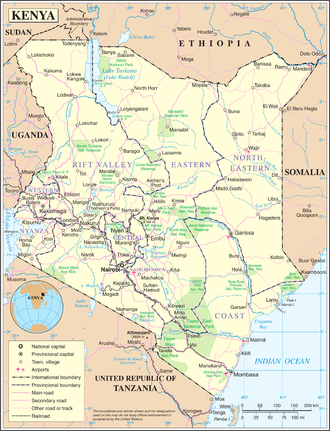

This article is a child-friendly adaptation of the Wikipedia article on Environmental issues in Kenya, available under CC BY-SA 4.0.
Images from Wikimedia Commons. Tap any image to view credits and license.