 Safekipedia
Event horizon
Adapted from Wikipedia · Adventurer experience
In astrophysics, an event horizon is a special boundary in space and time. Beyond this boundary, no signal — not even light — can ever reach an observer. The idea was first named by Wolfgang Rindler in the 1950s.
Long before that, in 1784, John Michell thought that gravity could be so strong near very massive objects that even light could not escape. He used older ideas about gravity and light to explain this. Later, in 1958, David Finkelstein used modern ideas about space and time, called general relativity, to give a stricter meaning to the event horizon around a black hole.
When something moves toward the event horizon from an observer's view, it seems to slow down and never quite cross the boundary. Also, because of how gravity affects light, the object looks redder and redder as it gets closer to the horizon. In the expanding universe, there are also cosmic event horizons that stop signals — even gravitational waves — from reaching faraway places.
Cosmic event horizon
Main article: Cosmological horizon
In space, an event horizon is the farthest place from which light can ever reach us. This is different from the particle horizon, which is the farthest place from which light could have reached us so far. For places beyond the event horizon, the light has not had enough time to travel to us, even if it started when the universe began.
The event horizon changes based on how the universe grows. If the universe grows in certain ways, some parts will never be visible to us, no matter how long we wait. This boundary is what we call the event horizon.
If something moves very fast but not at a steady speed, some events might never be seen by that thing. This is because the paths of light from those events do not cross the thing's path. This makes an apparent horizon, a boundary beyond which events cannot be seen. For example, if something speeds up in a steady way, it gets closer to the speed of light but never quite reaches it. There is a limit to how far back the thing can see, creating an apparent horizon.
In empty space, a horizon seen by something moving very fast stays the same distance away. Changing how fast it moves can make the horizon seem to move or even disappear. The observer never actually reaches this horizon. In some ideas about the universe, the horizon always stays the same distance away and can never be reached, even by something moving very fast.
Event horizon of a black hole
Main article: Black hole
Far away from a black hole, anything can move in any direction, limited only by the speed of light. As you get closer, space and time change shape.
Once you reach the event horizon, all paths lead closer to the black hole’s center. It’s impossible to escape from inside the event horizon, no matter which way you try to go. This is because the pull of gravity becomes very strong.
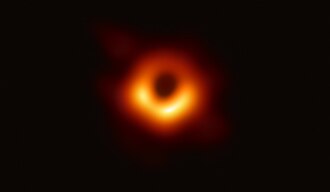
The event horizon is like an invisible boundary around a black hole. We can’t actually see anything falling into a black hole; instead, we see bright disks of hot material around them.
Images
Related articles


This article is a child-friendly adaptation of the Wikipedia article on Event horizon, available under CC BY-SA 4.0.
Images from Wikimedia Commons. Tap any image to view credits and license.