 Safekipedia
Fast Ethernet
Adapted from Wikipedia · Adventurer experience
Fast Ethernet is a way to send information quickly between computers and other devices on a network. It can carry data at a speed of 100 million bits per second, which is ten times faster than the older Ethernet speed.
The most common type of Fast Ethernet is called 100BASE-TX.
Fast Ethernet was introduced in 1995. It was the fastest way to connect devices on a network for three years until Gigabit Ethernet came along. Some devices that work with both Fast Ethernet and Gigabit Ethernet are sometimes called GE/FE.
Nomenclature
Further information: Ethernet physical layer § Naming conventions
The number "100" in the name shows that it sends data at 100 million bits every second. The word "BASE" means it uses a special way to send signals. The letter after the dash, like "T" or "F", tells us if it uses wires or light to send the signals. The last letter, such as "X" or "4", shows the exact method used. Fast Ethernet is often called 100BASE-X, where "X" stands for the different types like FX and TX. The IEEE group calls all Fast Ethernet 100BASE-T, which includes the types that use light.
General design
Fast Ethernet improves on the older 10-megabit Ethernet standard, making it faster and better for today's needs. It can use special wires called twisted pair or thin glass strands called optical fiber cable, arranged in a pattern known as a star wired bus topology. Most devices that support Fast Ethernet can automatically work with older 10-megabit equipment, which makes upgrading simpler.
Fast Ethernet has parts that handle different tasks. One part decides when to send data, and another part manages the actual sending. These parts usually communicate using a special connection. While Fast Ethernet can reach speeds of up to 100 million bits per second, real-world speeds are a little slower because of extra bits used for addressing and checking errors.
Copper
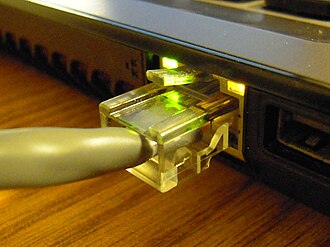
Fast Ethernet has different ways to work with twisted-pair cable. One common way is called 100BASE-TX. It sends data at 100 Mbit/s using two-pair Cat5 or better cable. It works up to 100 metres, like older Ethernet types. 100BASE-TX became the most used type.
100BASE-TX uses two pairs of wires in a Category 5 or better cable. Each pair sends data in one direction. Devices on a local area network are usually linked to a hub or switch.
Other types like 100BASE-T4 and 100BASE-T2 were made but did not become popular. They used different cables and ways but were not used much.
100BASE-TX
100BASE-T1
You can read more about this in Ethernet over twisted pair § Single-pair.
100BASE-T1 sends data over one copper pair, reaching 100 Mbit/s. It uses special methods. It is made for use in cars or other special places. It was made as Open Alliance BroadR-Reach (OABR) before it became an IEEE standard.
100BASE-T2
100BASE-T4
100BASE-T4 was an early Fast Ethernet type. It used four twisted copper pairs of voice grade twisted pair (Category 3). It was not used much, but some of its ideas were used in later types.
100BaseVG
Main article: 100BaseVG
Made by Hewlett-Packard, 100BaseVG was another design using category 3 cabling. It stopped being used when switched 100BASE-TX became popular. The IEEE standard was later taken away.
| Name | Added in amendment | Status | Speed | Pairs required | Lanes per direction | Bits per hertz | Line code | Symbol rate per lane | Bandwidth | Max distance | Cable | Cable rating | Usage |
|---|---|---|---|---|---|---|---|---|---|---|---|---|---|
| (Mb/s) | (MBd) | (MHz) | (m) | (MHz) | |||||||||
| 100BASE-TX | 802.3u-1995 | current | 100 | 2 | 1 | 3.20 | 4B5B MLT-3 NRZI | 125 | 31.25 | 100 | Cat 5 | 100 | LAN |
| 100BASE-T1 | 802.3bw-2015 (CL96) | 1 | 1 | 2.66 | PAM-3 4B/3B | 75 | 37.5 | 15 | Cat 5e | 66 | Automotive, IoT, M2M | ||
| 100BASE-T2 | 802.3y-1997 | obsolete | 2 | 2 | 4.00 | LFSR PAM-5 | 25 | 12.5 | 100 | Cat 3 | 16 | Market failure | |
| 100BASE-T4 | 802.3u-1995 | 4 | 3 | 2.66 | 8B6T PAM-3 Half-duplex only | 25 | 12.5 | 100 | Cat 3 | 16 | |||
| 100BaseVG | 802.12-1995 | 4 | 4 | 1.66 | 5B6B Half-duplex only | 30 | 15 | 100 | Cat 3 | 16 |
| 8P8C wiring (ANSI/TIA-568 T568A) | 8P8C wiring (ANSI/TIA-568 T568B) | |||||||
| Pin | Pair | Wire | Color | Pin | Pair | Wire | Color | |
|---|---|---|---|---|---|---|---|---|
| 1 | 3 | +/tip |  white/green white/green | 1 | 2 | +/tip |  white/orange white/orange | |
| 2 | 3 | −/ring |  green green | 2 | 2 | −/ring |  orange orange | |
| 3 | 2 | +/tip | white/orange | 3 | 3 | +/tip | white/green | |
| 4 | 1 | +/ring |  blue blue | 4 | 1 | +/ring | blue | |
| 5 | 1 | −/tip |  white/blue white/blue | 5 | 1 | −/tip | white/blue | |
| 6 | 2 | −/ring | orange | 6 | 3 | −/ring | green | |
| 7 | 4 | +/tip |  white/brown white/brown | 7 | 4 | +/tip | white/brown | |
| 8 | 4 | −/ring |  brown brown | 8 | 4 | −/ring | brown | |
| Symbol | Line signal level |
|---|---|
| 000 | 0+0 |
| 001 | 0+1 |
| 010 | 0−1 |
| 011 | 0−2 |
| 100 (ESC) | 0+2 |
Fiber optics
Fiber variants use fiber-optic cable with different kinds of connections. These connections can be fixed or can be changed, often using Small Form-factor Pluggable (SFP) ports.
Fast Ethernet speed does not work on all SFP ports, but some devices can support it. An SFP port for Gigabit Ethernet might not always work with Fast Ethernet.
To make sure different systems can work together, certain things must match, such as line encoding, wavelength, duplex mode, and the type of material used. 100BASE-X Ethernet will not work with older 10BASE-F versions or newer 1000BASE-X versions.
100BASE-FX is a kind of Fast Ethernet that uses optical fiber. It is still used in places like factories where higher speeds are not needed.
100BASE-LFX is a name for Fast Ethernet that can go longer distances—up to 4–5 km—using special lasers.
100BASE-SX is another kind that is cheaper and works for shorter distances, up to 300 m. It can also work with older 10 Mbit/s systems.
100BASE-LX10 and 100BASE-BX10 are kinds that can travel up to 10 km over single-mode fibers.
100BASE-EX can go even further—up to 40 km—using very good optics.
100BASE-ZX is a name for Fast Ethernet that uses a special wavelength to reach distances of at least 70 km, and some systems can go up to 160 km.
| Name | Added in Amendment | Status | Media | Connector | Transceiver Module | Reach in m | # Media (⇆) | # Lambdas (→) | # Lanes (→) | |
|---|---|---|---|---|---|---|---|---|---|---|
| Fast Ethernet – (Data rate: 100 Mbit/s – Line code: 4B5B × NRZI – Line rate: 125 MBd – Full-Duplex / Half-Duplex) | ||||||||||
| 100BASE-FX | 802.3u-1995 (CL24/26) | current | fiber 1300 nm | ST SC MT-RJ MIC (FDDI) | —N/a | FDDI: 2k (FDX) | 2 | 1 | 1 | |
| OM1: 4k | ||||||||||
| 50/125: 5k | ||||||||||
| 100BASE-LFX | proprietary (non IEEE) | current | fiber 1310 nm | LC (SFP) ST SC | SFP | OM1: 2k | 2 | 1 | 1 | |
| OM2: 2k | ||||||||||
| 62.5/125: 4k | ||||||||||
| 50/125: 4k | ||||||||||
| OSx: 40k | ||||||||||
| 100BASE-SX | TIA-785 (2000) | legacy | fiber 850 nm | ST SC LC | —N/a | OM1: 300 | 2 | 1 | 1 | |
| OM2: 300 | ||||||||||
| 100BASE-LX10 | 802.3ah-2004 (CL58) | phase-out | fiber 1310 nm | LC | SFP | OSx: 10k | 2 | 1 | 1 | |
| 100BASE-BX10 | phase-out | fiber TX: 1310 nm RX: 1550 nm | OSx: 40k | 1 | ||||||
Related articles



This article is a child-friendly adaptation of the Wikipedia article on Fast Ethernet, available under CC BY-SA 4.0.
Images from Wikimedia Commons. Tap any image to view credits and license.