 Safekipedia
Gravitational constant
Adapted from Wikipedia · Adventurer experience
The gravitational constant is a special number that helps us understand how strong the pull of gravity is between any two objects that have mass. It is important for scientists when they calculate how much gravitational force exists between objects, like planets, stars, or everyday things.
In Newton’s ideas about gravity, the gravitational constant connects the force of gravity between two objects to how heavy they are and how far apart they are. In Einstein’s more advanced work, it helps explain how mass and energy change the shape of space and time.
Scientists have measured the gravitational constant and found its value to be about 6.6743×10⁻¹¹ m3⋅kg−1⋅s−2. This number is very small, which shows that gravity is a weaker force compared to other forces in the universe. The constant was first measured carefully by Henry Cavendish in a famous 1798 experiment, and we use the capital letter G to represent it.
Definition
The gravitational constant shows how strong the pull of gravity is between two objects. According to Sir Isaac Newton, the force of gravity between two objects depends on their masses and the distance between them. The bigger the objects and the closer they are, the stronger the gravitational pull. This constant, usually called "Big G," helps us calculate this force.
In Albert Einstein's theory of general relativity, the gravitational constant also plays an important role. It helps describe how mass and energy shape the space around us, influencing how objects move. This constant connects the simple ideas of Newton’s gravity with the more complex ideas of Einstein’s theory.
Meaning
The gravitational constant, written as G, helps us learn about gravity in space. It is measured in units of m3 kg−1 s−2. Think of it like this: it shows how much pull there is between two things based on how heavy they are and how far apart they are. It also tells us how much a heavy object can pull on something far away, making it move faster.
Value and uncertainty
The gravitational constant is a number that helps scientists understand how strong gravity is. It is hard to measure very precisely because gravity is a very weak force.
In SI units, which are the standard units scientists use, the CODATA-recommended value of the gravitational constant is:
G = 6.67430(15)×10−11 m3⋅kg−1⋅s−2
Scientists know the value of G very well, but there is still a tiny bit of uncertainty in the measurement.
History of measurement
Further information: Earth mass, Schiehallion experiment, and Cavendish experiment
The idea of a gravitational constant comes from Newton's law of universal gravitation. This law explains how objects pull each other together with gravity. Newton thought we could measure gravity by watching how a pendulum swings near a big hill, but he believed the change would be too tiny to see.
In 1776, scientists did the Schiehallion experiment. This was the first successful way to measure Earth's density, which also helped us learn about the mass of the Sun, the Moon, and planets. Later, in 1798, Henry Cavendish did another experiment. He used a special tool called a torsion balance to measure how lead balls attract each other with gravity. His numbers are still very close to what we use today.
Measuring the gravitational constant is hard because gravity is a very weak force. Many scientists have tried to measure it better over the years, but their results have been different. Today, scientists keep working to measure it more accurately, with help from the National Institute of Standards and Technology.
| Year | G [10−11 m3⋅kg−1⋅s−2] | Relative standard uncertainty |
|---|---|---|
| 1969 | 6.6732(31) | 460 ppm |
| 1973 | 6.6720(49) | 730 ppm |
| 1986 | 6.67449(81) | 120 ppm |
| 1998 | 6.673(10) | 1500 ppm |
| 2002 | 6.6742(10) | 150 ppm |
| 2006 | 6.67428(67) | 100 ppm |
| 2010 | 6.67384(80) | 120 ppm |
| 2014 | 6.67408(31) | 46 ppm |
| 2018 | 6.67430(15) | 22 ppm |
| 2022 | 6.67430(15) | 22 ppm |
Constancy
Further information: Time-variation of fundamental constants
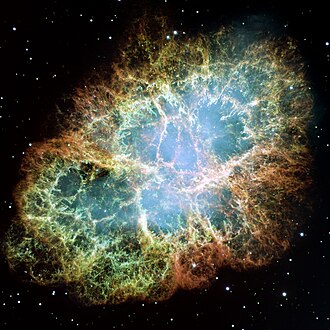
Studies of very bright stars called type Ia supernovae show that the gravitational constant has stayed almost the same for a very long time. Over the last nine billion years, it has changed very little. This shows how steady this important science number is.
Related articles



This article is a child-friendly adaptation of the Wikipedia article on Gravitational constant, available under CC BY-SA 4.0.
Images from Wikimedia Commons. Tap any image to view credits and license.