 Safekipedia
Green's theorem
Adapted from Wikipedia · Adventurer experience
Green's theorem is an important idea in mathematics, especially in a part called vector calculus. It helps us connect two types of integrals: line integrals and double integrals. A line integral looks at something along a curve, like the edge of a shape, while a double integral looks at something spread out over an area.
This theorem tells us that we can often change a tricky line integral around a closed curve into a simpler double integral over the area inside that curve. This can make solving problems much easier!
Green's theorem is a special case of a bigger idea called Stokes' theorem, which works in three dimensions. It's also closely related to the divergence theorem and the fundamental theorem of calculus. The theorem is named after George Green, a mathematical physicist who did important work in this area.
Theorem
Green's theorem helps us connect two types of integrals. It says that a line integral around a closed curve in a plane is the same as a double integral over the area inside that curve. This theorem is useful in vector calculus and links ideas from two dimensions to more general theories in higher dimensions.
Application
Green's theorem helps us understand how things move around and through shapes on a flat surface. It connects two types of calculations. One follows the edges of a shape (called a line integral). The other covers the area inside the shape (called a double integral).
The theorem has two main uses. The first, called the circulation form, helps measure how something spins or moves around the edge of a shape. The second, called the flux form, helps measure how much of something flows out through the edge of the shape. These ideas are useful for studying movement and flow in two dimensions.
Proof when D is a simple region
Green's theorem shows how two kinds of math sums are connected. One sum follows a path, called a line integral. The other covers an area, called a double integral. This theorem helps us see how these sums relate to each other.
For a simple shape called a "type I region," we can prove part of Green's theorem by looking at a special area. We split the path around this area into four smaller paths and study each one. By adding the results from these paths, we can show they match the area sum. This idea also works for other shapes, helping us prove Green's theorem for more complex areas.
| ∮ C L d x = ∬ D ( − ∂ L ∂ y ) d A {\displaystyle \oint _{C}L\,dx=\iint _{D}\left(-{\frac {\partial L}{\partial y}}\right)dA} | 1 |
| ∮ C M d y = ∬ D ( ∂ M ∂ x ) d A {\displaystyle \oint _{C}\ M\,dy=\iint _{D}\left({\frac {\partial M}{\partial x}}\right)dA} | 2 |
| ∬ D ∂ L ∂ y d A = ∫ a b ∫ g 1 ( x ) g 2 ( x ) ∂ L ∂ y ( x , y ) d y d x = ∫ a b [ L ( x , g 2 ( x ) ) − L ( x , g 1 ( x ) ) ] d x . {\displaystyle {\begin{aligned}\iint _{D}{\frac {\partial L}{\partial y}}\,dA&=\int _{a}^{b}\,\int _{g_{1}(x)}^{g_{2}(x)}{\frac {\partial L}{\partial y}}(x,y)\,dy\,dx\\&=\int _{a}^{b}\left[L(x,g_{2}(x))-L(x,g_{1}(x))\right]\,dx.\end{aligned}}} | 3 |
| ∮ C L d x = ∫ C 1 L ( x , y ) d x + ∫ C 2 L ( x , y ) d x + ∫ C 3 L ( x , y ) d x + ∫ C 4 L ( x , y ) d x = ∫ a b L ( x , g 1 ( x ) ) d x − ∫ a b L ( x , g 2 ( x ) ) d x . {\displaystyle {\begin{aligned}\oint _{C}L\,dx&=\int _{C_{1}}L(x,y)\,dx+\int _{C_{2}}L(x,y)\,dx+\int _{C_{3}}L(x,y)\,dx+\int _{C_{4}}L(x,y)\,dx\\&=\int _{a}^{b}L(x,g_{1}(x))\,dx-\int _{a}^{b}L(x,g_{2}(x))\,dx.\end{aligned}}} | 4 |
Proof for rectifiable Jordan curves
Green's theorem is a special case of Stokes' theorem that helps us understand how integrals along a closed curve relate to integrals over the area it encloses. It says that for certain well-behaved curves and functions, the total along the curve can be found by looking at the area inside instead.
The theorem works for curves that are smooth enough and enclose a region in the plane. It connects line integrals around the edge to double integrals over the area inside, making calculations easier in many situations. This idea is important in physics and engineering for understanding flow and other quantities around boundaries.
Validity under different hypotheses
Green's theorem can work under different conditions. One common set of conditions needs two functions, called A and B. These functions must be continuous and have special types of derivatives at every point. This means we can measure how the functions change in different directions.
Because of these conditions, we get a special result called the Cauchy Integral Theorem. This theorem says that if we have a special kind of curve and a function that changes smoothly inside that curve, the integral of that function around the curve will be zero. This helps us learn about how functions act in complex planes.
Multiply-connected regions
Green's theorem can also help us with more complex shapes that have "holes" or empty spaces inside them. Picture a shape with one large outer edge and several smaller inner edges that create holes. The theorem still works, but we need to take away the line integrals around each of these inner edges from the outer edge.
The result shows that the total of these changed line integrals around the outer and inner edges is the same as a double integral over the area between them, just like with simpler shapes. This helps us learn how integrals act around more complicated, multiply-connected regions.
Relationship to Stokes' theorem
Green's theorem is a special version of the Kelvin–Stokes theorem. It works when we look at a flat shape in a two-dimensional space.
It helps us connect two math ideas. One idea looks at paths around the edge of the shape. The other idea looks at the area inside the shape. Green’s theorem shows how we can learn about the outside of a shape by studying what’s inside it.
Relationship to the divergence theorem
Green's theorem is closely related to the divergence theorem in two dimensions. It connects a line integral around a closed curve to a double integral over the area enclosed by that curve.
The theorem shows that calculations involving curves can sometimes be easier done by looking at the area they surround. This idea is useful in many areas of physics and engineering.
Area calculation
Green's theorem helps us find the area of a shape by using a line around it. Picture tracing the edge of a flat region with a pencil; the theorem lets us work out the area inside by looking at this path.
One way to do this is by picking two special values, L and M, that follow a rule. With these, the area can be found using a loop around the shape. There are also easy formulas that use the positions along the edge to work out the area.
History
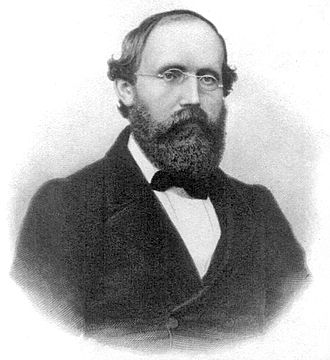
William Thomson, also known as Lord Kelvin, named this theorem after George Green. Green shared his idea in a paper in 1828, but almost no one noticed it. Thomson found it again in 1845. In 1846, Augustin-Louis Cauchy wrote about the theorem in one of his papers. Finally, Bernhard Riemann proved the theorem in 1851.
Related articles


This article is a child-friendly adaptation of the Wikipedia article on Green's theorem, available under CC BY-SA 4.0.