Harry Chandler
Harry Chandler was an American newspaper publisher and investor.
He was born on May 17, 1864. He died on September 23, 1944.
Chandler lived from 1864 to 1944.
Early life
Harry Chandler was born in Landaff, New Hampshire. He was the oldest of four children born to Emma Jane (née Little) and Moses Knight Chandler.
He went to Dartmouth College. One day, he jumped into a tub of cold starch as a dare. He became very sick with pneumonia. He left Dartmouth and moved to Los Angeles to get better.
Career
Harry Chandler started out in Los Angeles working in the fruit fields. Then he started a small delivery company, which soon delivered many of the city's morning newspapers. This led him to meet Harrison Gray Otis, the publisher of the Los Angeles Times. Otis hired him as the paper's general manager. In 1894, Chandler married Otis's daughter, Marian Otis. When Otis died in 1917, Chandler became publisher. He helped turn the Times into the leading newspaper in the West. For three years in a row in the 1920s, the paper had more advertising space and classified ads than any other American newspaper.
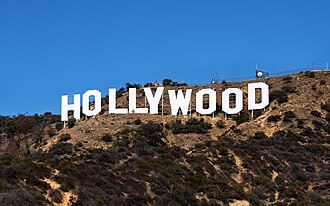
Chandler was also a community builder and a large-scale real estate investor. He became one of the most important people in Los Angeles in the first half of the 20th century. He helped start the Los Angeles Coliseum and helped bring the 1932 Summer Olympics to the city. He was also involved with many other places and groups, including the Biltmore Hotel, the Douglas Aircraft Company, the Hollywood Bowl, The Ambassador Hotel, the California Institute of Technology, the Automobile Club of Southern California, the KHJ radio station, Trans World Airlines, San Pedro Harbor, the Los Angeles Athletic Club, the California Club, the Pacific Electric Cars, Santa Anita Park, the Ahwahnee Hotel in Yosemite National Park, and the restoration of Olvera Street. As a real estate investor, he helped own and develop much of the San Fernando Valley and the Hollywood Hills. The Hollywoodland sign was put up to promote the development there. At one point, his land holdings made him the largest private landowner in the United States.
While leading the Times, Chandler was a strong supporter of eugenics. He was also a member of the Human Betterment Foundation, which was led by Ezra Gosney. He was a Congregationalist and a favorite supporter of the Salvation Army. In 1938, he was found guilty of contempt of court because of his comments about certain labor cases. However, the United States Supreme Court overturned the conviction. Chandler and the Times won their first Pulitzer Prize for their role in that decision.
Personal life
In 1888, Harry married Magdalena Schlador. Her brother worked at the Los Angeles Times. They had two daughters, Francesca and Alice May. Magdalena, whom Harry called "May," died at age 29 of puerperal fever. This happened two weeks after Alice May was born.
Chandler married Marian Otis in 1894. Soon, Francesca and Alice May had more brothers and sisters: Constance, Ruth, Norman, Harrison Gray Otis, and twins Helen and Philip. Many years later, his mansion in Los Feliz was owned by Father Yod. Yod's The Source Family used it.
Death and legacy
Harry Chandler died on September 23, 1944, from a heart attack. He and Marian are buried at Hollywood Forever Cemetery on Santa Monica Boulevard, near Harrison Gray Otis's memorial. His oldest son, Norman Chandler, took charge of the Los Angeles Times after his death.
Chandler Boulevard, a major street in the San Fernando Valley, is named after Harry Chandler. In 1960, a dining hall was named in his honor at the California Institute of Technology. In 2021, the Caltech Board of Trustees voted to remove his name from the building. This was because of his connection to the Human Betterment Foundation, which treated people unfairly. In November 2021, the dining hall was renamed to honor the educator Lee F. Browne.

Quiz time!
4 questions about Harry Chandler
What did young Harry Chandler do as a dare at Dartmouth College?
Keep exploring



This article is a child-friendly adaptation of the Wikipedia article on Harry Chandler, available under CC BY-SA 4.0.
Images from Wikimedia Commons. Tap any image to view credits and license.