 Safekipedia
Helicopter
Adapted from Wikipedia · Adventurer experience
A helicopter is a special kind of aircraft called a rotorcraft. Unlike regular airplanes, helicopters can take off and land straight up, hover in one place, and fly in any direction. This makes them very useful in places where regular airplanes can’t land, like crowded cities or remote areas without runways.
The first practical helicopter was the Focke-Wulf Fw 61, which flew successfully in 1936. A few years later, in 1942, the Sikorsky R-4 became the first helicopter to be made in large numbers for regular use. During this time, a man named Igor Sikorsky developed a model called the VS-300, which helped shape how most helicopters look and work today.
Most helicopters today have one big main rotor on top and a smaller tail rotor on the side. This design helps the helicopter spin and control its movement. But there are also helicopters with two main rotors, either next to each other or one behind the other, which can carry heavier loads. Other types, like those with tilting rotors or no tail rotor at all, are also used for special jobs.
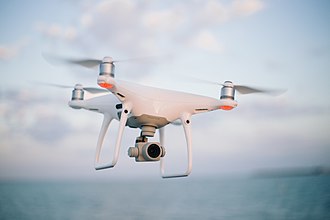
Small helicopters with four rotors, known as quadcopters, were first tried out in France as early as 1907. These and other similar designs are now often used as unmanned aerial vehicles, or drones, for things like aerial photography and even some military tasks.
Etymology
The word helicopter comes from a French term made in 1861 by Gustave Ponton d'Amécourt. It mixes Ancient Greek words for "spiral" and "wing." In English, people sometimes think the word is made of "heli-" and "-copter." This has led to words like helipad and quadcopter. Some fun nicknames for helicopters are "chopper," "copter," "heli," and "whirlybird." In the United States military, soldiers often call them "helo."
Design
A helicopter is a type of rotorcraft that uses one or more horizontally-spinning rotors to stay in the air. Unlike some other flying machines, helicopters can take off and land straight up, hover in one place, and fly in any direction. This makes them useful for reaching tight spaces or remote areas without runways.
The main part of a helicopter is the rotor system, which creates the lift that keeps the helicopter in the air. Most helicopters have a main rotor on top and a smaller tail rotor at the back. The tail rotor helps balance the helicopter and keep it pointing in the right direction. Some helicopters use different designs, like two main rotors spinning in opposite directions, to balance without a tail rotor.
Helicopters also need engines to power their rotors. Early helicopters used simple engines, but today they mostly use powerful turbine engines that are strong and lightweight. The engine’s power is sent to the rotors through a transmission, a system of gears and shafts. Pilots control the helicopter using controls that change the angle of the rotor blades, letting them move up, down, and turn in different directions.
Flight
There are three main ways a helicopter can fly: hovering, moving forward, and changing between these two.
Hovering is when a helicopter stays still in the air. This is tricky because the pilot must adjust the controls often to keep the helicopter steady. The pilot uses a stick to control moving forward, backward, left, or right, and a pedal to point the nose in the right direction. Keeping the helicopter in one place needs many quick changes to these controls.
When a helicopter starts to move forward, it leaves the swirling air that was pushing it down while hovering. This change lets the helicopter get more lift without using more power. In forward flight, controlling the helicopter is more like flying a regular airplane. Pushing forward on the stick makes the helicopter go faster and lower, while pulling back slows it down and makes it rise. The pedals are usually not needed when moving forward, even when turning. If the engine stops, the helicopter can still glide safely because the spinning blades catch the air and keep it moving.
Uses
Helicopters are special airplanes that can take off and land straight up. They can also stay in one place in the air for a long time. This makes them very useful for jobs that other airplanes cannot do.
Some of these jobs include carrying people and things, helping build things, fighting fires, and helping doctors move patients quickly. Helicopters can carry heavy things with long ropes. They help put big pieces of equipment on tall buildings or in places where cars cannot go. Some helicopters fight big fires by dropping water from the sky. They can also take doctors and patients to places where ambulances cannot reach. Police use helicopters to look for people from the air, and the military uses them to carry soldiers and equipment. Helicopters have many important jobs!
History
Early design
The earliest ideas about flying straight up came from China. Around 400 BC, Chinese children played with simple toys made of bamboo that spun when you rolled a stick on them. These toys could lift into the air when spun fast enough.
Later, famous inventors like Leonardo da Vinci drew ideas for machines that could fly straight up. In the 1700s and 1800s, scientists in Europe built small models inspired by the Chinese toys.
It wasn’t until 1877 that an Italian inventor named Enrico Forlanini built a small unmanned helicopter that could fly for a short time. Other inventors tried similar designs, using new technologies of the time.
First flights
The first real flights with people on board happened in the early 1900s. In 1907, a French inventor named Paul Cornu built a helicopter with two large rotors that lifted him a few feet off the ground for about 20 seconds.
Other inventors like Jacob Ellehammer in Denmark also built helicopters that could fly short distances. During World War I, some countries tested early helicopter designs for special jobs.
Early development
In the 1920s and 1930s, inventors made big steps forward. They found new ways to control the rotors so the helicopter could move forward and backward easily. Others built helicopters with two sets of rotors that spun in opposite directions to balance out the spinning feeling.
Birth of an industry
World War II helped helicopters develop faster. Countries like Nazi Germany used small helicopters for special jobs. In the United States, Igor Sikorsky built the first helicopter that could be made in large numbers. His design became very important for military and later civilian use.
After the war, helicopters became more common. Companies like Bell Aircraft made models that were easy to use and could fly longer distances.
Turbine age
In the 1950s, a new kind of engine called a turboshaft engine made helicopters faster and stronger. These engines were lighter and more powerful than older engines, allowing helicopters to fly higher and carry more weight. Today, most helicopters use these turbine engines, though smaller ones might still use older engine designs.
Safety
Helicopters have special safety rules because they can’t fly as fast as airplanes. When a helicopter moves forward, the front rotor blade moves faster through the air than the back blade. If it goes too fast, it can make the helicopter hard to control. Designers set a maximum speed, called VNE, to keep this from happening.
Helicopters can make a lot of noise, especially in cities. Designers work to make them quieter and more comfortable. They also adjust the rotors to reduce shaking, which can be uncomfortable. Pilots need to be very careful, especially when flying low or in bad weather. Safety teams study accidents to help make flying safer for everyone.
World records
Helicopters have done some amazing things! They can fly very high, very far, and carry heavy loads. These records show how strong and useful these flying machines are. Some records include the highest altitude a helicopter has reached and the longest distance it has flown without stopping.
| Record type | Record | Helicopter | Pilot(s) | Date | Location | Note |
|---|---|---|---|---|---|---|
| Speed | 400.87 km/h (249.09 mph) | Westland Lynx | John Trevor Egginton (UK) | 11 August 1986 | UK | |
| Distance without landing | 3,561.55 km (2,213.04 mi) | Hughes YOH-6A | Robert G. Ferry (USA) | 6 April 1966 | United States | |
| Around-the-world speed | 136.7 km/h (84.9 mph) | Agusta A109S Grand | Scott Kasprowicz (USA) | 18 August 2008 | From and to New York City via Europe, Russia, Alaska, Canada | No in-flight refueling |
| Highest altitude without payload | 12,442 m (40,820 ft) | Aerospatiale Lama | Jean Boulet (France) | 21 June 1972 | France | |
| Highest level flight altitude | 11,010 m (36,120 ft) | Sikorsky CH-54 Tarhe | James K. Church | 4 November 1971 | United States | |
| Altitude with 40-tonne payload | 2,255 m (7,398 ft) | Mil V-12 | Vasily Kolochenko, et al. | 6 August 1969 | USSR | |
| Highest takeoff (turbine) | 8,848 m (29,029 ft) | Eurocopter AS350 | Didier Delsalle | 14 May 2005 | Nepal | Mount Everest |
| Highest takeoff (piston) | 4,300.7 m (14,110 ft) | Robinson R44 | Mark Young | 12 October 2009 | United States | Pike's Peak, Colorado |
| First manned electric flight | Purely electric hover | Solution F Prototype | Pascal Chretien | 12 August 2011 | France | Venelles |
| Longest human-powered lift | Pedalling, lift 64 s endurance, 3.3 m height; diagonal width: 46.9 m | AeroVelo Atlas, 4 rotors | Todd Reichert | 13 June 2013 | Canada | Indoor soccer stadium; Igor I. Sikorsky Competition winner |
Images
Related articles


This article is a child-friendly adaptation of the Wikipedia article on Helicopter, available under CC BY-SA 4.0.
Images from Wikimedia Commons. Tap any image to view credits and license.