 Safekipedia
Hertz
Adapted from Wikipedia · Adventurer experience
The hertz (symbol: Hz) is the unit we use to measure frequency. It tells us how many times something happens in one second. For example, if something happens once every second, its frequency is one hertz. The hertz is part of the International System of Units, which is the way scientists around the world measure things.
The unit is named after Heinrich Rudolf Hertz, a scientist who showed that electromagnetic waves exist. These are waves of energy that include things like radio waves and light. When we talk about very high frequencies, we use bigger units like kilohertz (kHz), megahertz (MHz), gigahertz (GHz), and terahertz (THz).
Hertz is very important in many areas. It helps us describe sounds, like musical tones, and signals used in radios. It also tells us how fast computers and other electronic devices work. In fact, the speed of a computer’s processor is often measured in gigahertz. This unit even helps scientists understand the energy of tiny particles of light called photons.
Definition
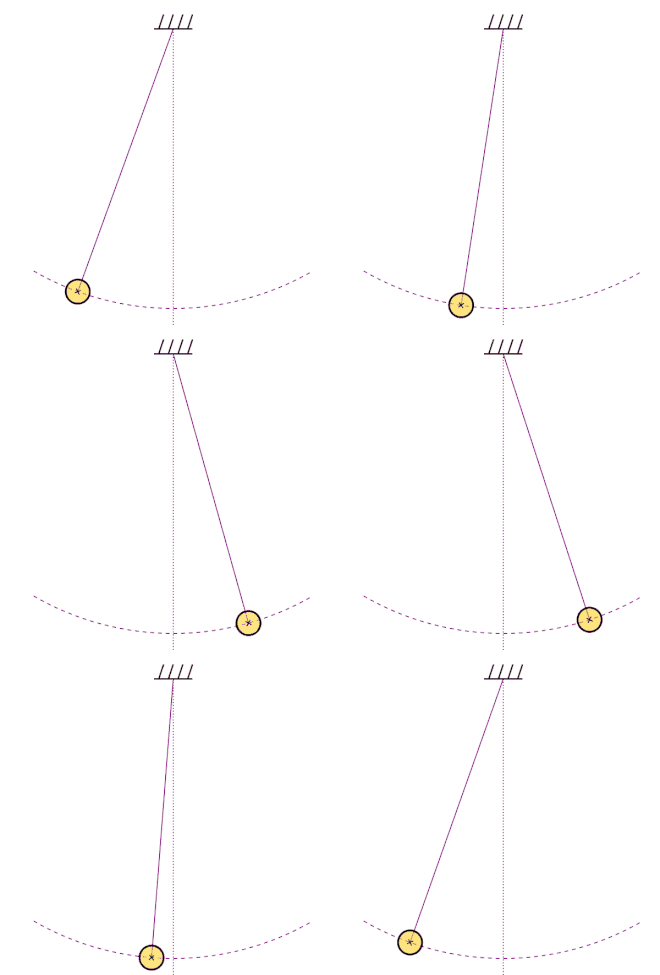
The hertz is a unit that measures how often something happens in one second. If something happens once every second, its frequency is 1 hertz. If it happens 100 times every second, the frequency is 100 hertz.
We also use smaller or larger units, like kilohertz (kHz), which is 1,000 hertz, or megahertz (MHz), which is 1,000,000 hertz. The hertz helps us describe many repeating events, such as the ticking of a clock or the beating of a heart.
The unit is named after Heinrich Hertz, a scientist who studied radio waves. Like other units named after people, we write it with a capital letter (Hz) but use lowercase when we write the word “hertz” in a sentence.
Main article: International Committee for Weights and Measures
Main articles: caesium, prefixed, beat, rate of aperiodic, stochastic, reciprocal second, radioactivity, becquerels, angular velocity, angular frequency, frequency of rotation, radians, Heinrich Hertz, SI, upper case, common noun
History
The hertz is named after the German scientist Heinrich Hertz. He studied how electricity and magnetism work together. In 1935, an international group chose the name hertz for this unit. In 1960, hertz became the official name, replacing older names like "cycles per second." By the 1970s, most people used "hertz" instead of the old terms.
Further information: Cycle per second
Applications
Sound is a wave that travels through air or other materials. We hear sounds as high or low pitches based on their frequency. Humans can typically hear sounds ranging from about 20 hertz to around 16,000 hertz.
Electromagnetic radiation, such as radio waves and light, is also described by its frequency. Radio waves are measured in kilohertz, megahertz, or gigahertz. Light has much higher frequencies, ranging from tens of terahertz to a few petahertz.
In computers, the speed of the central processing unit (CPU) is often described in megahertz or gigahertz. This number tells us how many times per second the CPU's main clock signal switches between two levels. However, this number doesn't always perfectly show how fast a computer can actually work.
SI multiples
For examples of different frequency levels, see Orders of magnitude (frequency).
Very high frequencies, higher than those the International System of Units describes with special names, happen naturally. These are linked to tiny movements of particles at the quantum level. We usually don’t measure these in hertz. Instead, we look at their energy, which relates to frequency through a scientific value called the Planck constant.
Unicode
The Unicode system has special characters for units of frequency. These characters are used mostly with East Asian writing. They are for older technology and not often used today. People usually use Latin letters like "MHz" instead.
- U+3339 ㌹ SQUARE HERUTU (ヘルツ, herutsu)
- U+3390 ㎐ SQUARE HZ (Hz)
- U+3391 ㎑ SQUARE KHZ (kHz)
- U+3392 ㎒ SQUARE MHZ (MHz)
- U+3393 ㎓ SQUARE GHZ (GHz)
- U+3394 ㎔ SQUARE THZ (THz)
Related articles


This article is a child-friendly adaptation of the Wikipedia article on Hertz, available under CC BY-SA 4.0.
Images from Wikimedia Commons. Tap any image to view credits and license.