 Safekipedia
Honeycomb
Adapted from Wikipedia · Adventurer experience
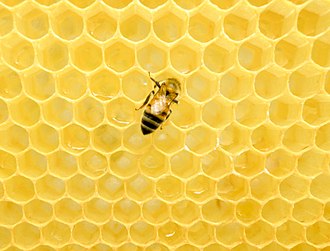
A honeycomb is a special structure made by honey bees from beeswax. Bees build tiny, six-sided cells in their nests. They use these cells to hold their eggs, baby bees, honey, and pollen. The cells fit together neatly, like pieces of a puzzle, so bees can use space well.
Beekeepers sometimes take out honeycombs to collect the honey. Bees work hard to make wax. They need about 8.4 pounds of honey to make just one pound of wax. After collecting the honey, beekeepers can give the wax back to the bees. The bees can then use it to build new combs. Sometimes, the old wax is used to make sheets with a six-sided pattern. This helps bees build new combs more easily.
Over time, the part of the honeycomb where baby bees grow can become dark from old cocoons. Honeycomb in special sections called "supers" that don’t have baby bees stays light-colored. Some other insects, like certain wasps, also build similar structures from paper instead of wax, but we usually don’t call these “honeycombs.”
Geometry
Further information: Patterns in nature
Honeycomb cells are built in a special way that makes them strong and uses less material. The cells are shaped like hexagons, which lets bees fit many cells together while using the least amount of wax. This is why honeycombs have this pattern — it’s the best way for bees to build their nests.
The ends of the honeycomb cells are shaped in a smart way. They are made of three flat surfaces that meet at good angles, which helps save space and material. Even though the cells look perfect, sometimes they are a little different if bees have to go around something or if they are building cells for different types of bees.
As human food
Honeycomb can be eaten as a sweet treat. It contains honey and other natural ingredients from bees, making it a tasty and healthy snack.
Images
Related articles


This article is a child-friendly adaptation of the Wikipedia article on Honeycomb, available under CC BY-SA 4.0.
Images from Wikimedia Commons. Tap any image to view credits and license.