 Safekipedia
Hubert Humphrey
Adapted from Wikipedia · Adventurer experience
Hubert Horatio Humphrey Jr. (May 27, 1911 – January 13, 1978) was an American politician. He served as the 38th vice president of the United States from 1965 to 1969. He also served in the United States Senate, representing Minnesota from 1949 to 1964 and again from 1971 to 1978.
Humphrey was born in Wallace, South Dakota. He studied at the University of Minnesota. He became mayor of Minneapolis in 1945 and later helped create the Minnesota Democratic–Farmer–Labor Party. In 1948, he was elected to the U.S. Senate.
As vice president under Lyndon B. Johnson, Humphrey supported the country's involvement in the Vietnam War. He ran for president in 1968 but lost to Richard Nixon. He kept working in the Senate until his death in 1978. He always fought for fair treatment and better opportunities for all Americans.
Early life and education
Hubert Horatio Humphrey Jr. was born in Wallace, South Dakota, the son of a pharmacist and a Norwegian immigrant. He grew up in Doland, South Dakota, a small town. His family had hard times when banks closed.
Humphrey went to high school in Doland but had to leave the University of Minnesota after one year because of money problems. He got a pharmacist’s license from a college in Denver and helped his father. Later, he returned to the University of Minnesota, earning a Bachelor of Arts in 1939 and a master’s degree from Louisiana State University in 1940. He started working as a teacher but got busy with politics instead.
Marriage and early career
In 1934, Hubert Humphrey started dating Muriel Buck, a bookkeeper. They married in 1936 and stayed together for almost 42 years. They had four children named Nancy Faye, Skip Humphrey, Robert Andrew, and Douglas Sannes. Humphrey sometimes had trouble with money and took speaking jobs to help his family. He and his wife lived in Chevy Chase, Maryland and later had a home in Waverly, Minnesota.
During World War II, Humphrey wanted to join the military but could not because of health issues. He worked for government agencies and taught political science at Macalester College in Saint Paul, Minnesota. In 1943, he tried to become mayor of Minneapolis but was not elected. He helped bring political parties together in Minnesota and worked on President Roosevelt’s campaign in 1944.
Mayor of Minneapolis (1945–1948)
Hubert Humphrey was the mayor of Minneapolis from 1945 to 1948. He was elected in June 1945 with lots of votes. As mayor, he worked to keep the city safe and fair for all. He helped start a group called the Council on Human Relations to bring people together. He also made sure that city jobs were open to everyone, no matter where they came from. His work helped make Minneapolis a better home for everyone.
1948 Democratic National Convention
The Democratic Party in 1948 was divided. Some members wanted to protect the rights of all people equally. Others thought each state should decide its own rules.
At the 1948 Democratic National Convention, Hubert Humphrey and others wanted the party to support fairness more strongly. They suggested adding a plan called a "minority plank" to the party's ideas. This plan asked for laws to stop unfair treatment and make sure everyone had equal chances.
Humphrey gave a famous speech saying it was time for the party to support everyone's rights. The convention voted and agreed to support the minority plank. After this vote, some people from Mississippi and Alabama left the meeting. They started their own group called the Dixiecrat party. But President Harry S. Truman won the election.
United States Senate (1949–1964)
Hubert Humphrey was elected to the United States Senate in 1948. He started his service on January 3, 1949, becoming the first Democrat elected senator from Minnesota since before the Civil War. He was re-elected twice and was known for supporting liberal causes.
Humphrey was a leader in important areas, including civil rights, arms control, and food stamps. He also supported peaceful solutions and worked on ideas like the Peace Corps and a national peace agency. His cheerful attitude earned him the nickname "The Happy Warrior" from his colleagues.
Presidential and vice-presidential ambitions (1952–1964)
Hubert Humphrey wanted to be the Democratic candidate for president twice before he became vice president in 1964. The first time was in 1952, but he only got 26 votes. The second time was in 1960, when he competed against Senator John F. Kennedy. Kennedy won in Wisconsin and West Virginia, so Humphrey’s hopes for the nomination ended.
Humphrey won some primaries that Kennedy didn’t enter, like in South Dakota and the District of Columbia. He received some votes at the 1960 convention even though he wasn’t a candidate anymore.
Vice presidential campaign
Further information: 1964 Democratic Party vice presidential candidate selection and Lyndon B. Johnson 1964 presidential campaign § Democratic national convention
After losing in 1960, Humphrey thought his best chance to become president was to first serve as vice president. When the 1964 presidential campaign began, he said he wanted to be Lyndon Johnson’s running mate. At the 1964 Democratic National Convention, Johnson chose Humphrey as his vice president.
Humphrey gave an energetic acceptance speech, criticizing his opponent, Barry Goldwater. He spoke about important issues like tax cuts and civil rights. Humphrey traveled across the country, speaking to many groups. His speeches helped build support for the Johnson-Humphrey ticket, which won the election by a large margin.
Vice President-elect of the United States
After the election, Humphrey and Johnson went to Johnson’s ranch in Texas. Humphrey took a vacation in the Virgin Islands before preparing to begin his new role. He announced he would leave his Senate seat so that Walter Mondale could take his place. Johnson assigned Humphrey to help with civil rights programs. On the day before the inauguration, Humphrey spoke to the Democratic National Committee about the party’s unity after the election.
Vice presidency (1965–1969)
Humphrey became Vice President on January 20, 1965, after Lyndon B. Johnson became President. He was not happy about the Vietnam War and tried to stop it from getting worse. When an attack happened on a U.S. base in Vietnam, Humphrey told President Johnson that bombing might not be enough.
As Vice President, Humphrey often supported Johnson’s policies, even when many of his friends disagreed. This made some people upset with him. He also appeared often on TV shows and made friends with famous people like Frank Sinatra.
In 1965, Humphrey spoke about important laws to help the country. He traveled to different places, sometimes facing protests. He talked about helping poorer countries and creating groups to keep peace in communities.
Civil rights
In 1965, Humphrey helped lead efforts to improve equal rights. He suggested plans to fight poverty and racial problems, including special groups to help bring peace.
Foreign trips
Humphrey traveled to many countries to talk about peace, especially in the Vietnam War. He visited Japan, Europe, and Africa, meeting leaders and discussing ways to solve problems.
1968 presidential campaign
In 1968, Humphrey decided to run for President. He had support from many workers and Democratic groups but faced challenges. The year was difficult because of many sad events, including the deaths of Robert F. Kennedy and Martin Luther King Jr. Humphrey lost the election to Richard Nixon.
Post-vice presidency (1969–1978)
After leaving his job as vice president, Hubert Humphrey taught at Macalester College and the University of Minnesota. He also worked with the Encyclopædia Britannica Educational Corporation.
Humphrey went back to the U.S. Senate in 1971 after winning an election. He served in many Congresses and had important jobs, including chairman of the Joint Economic Committee.
In 1972, Humphrey tried to become president but did not win. He wanted to end the Vietnam War and help improve the economy. Later, he worked on issues like education, voting rights, and health care. Sadly, Humphrey died in 1978 after being diagnosed with a serious illness.
Death and funeral
Hubert Humphrey spent his last weeks talking with old friends and cheering up other patients in the hospital. He passed away from bladder cancer at his home in Waverly, Minnesota on January 13, 1978, when he was 66 years old.
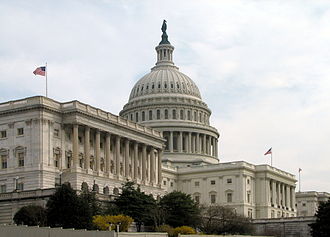
His body was honored in the rotundas of the U.S. Capitol and the Minnesota State Capitol before being buried at Lakewood Cemetery in Minneapolis. Many important people, including Richard Nixon, Gerald Ford, President Carter, and Vice President Walter Mondale, came to show their respect. His wife Muriel was appointed by Minnesota governor Rudy Perpich to serve temporarily in the U.S. Senate until a special election. She later married Max Brown and became Muriel Humphrey Brown. When she passed away in 1998, she was buried next to Hubert at Lakewood Cemetery.
Honors and legacy
Hubert Humphrey received several important awards. In 1978, he got the U.S. Senator John Heinz Award for his work. After he died, he was given the Congressional Gold Medal in 1979 and the Presidential Medal of Freedom in 1980. The United States Postal Service made a special stamp for him in 1980.
Many places and programs are named after Humphrey. These include the Hubert H. Humphrey Fellowship Program, which helps people learn and share ideas. There is also the Hubert H. Humphrey Terminal at Minneapolis-Saint Paul International Airport, the Hubert H. Humphrey Metrodome stadium in Minneapolis, and the Hubert H. Humphrey School of Public Affairs at the University of Minnesota, along with many other schools and buildings named for him.
Portrayals
Hubert Humphrey has been played by actors in films and television shows. Franklin Cover played him in a 1982 TV film. Bradley Whitford played him in a 2016 TV film. And Doug McKeon acted as Humphrey in a 2017 film.
Electoral history
Main article: Electoral history of Hubert Humphrey
Hubert Humphrey was a well-known American politician. He was the 38th vice president of the United States from 1965 to 1969. Before that, he was a senator for Minnesota from 1949 to 1964 and again from 1971 until he died in 1978. People in Minnesota and the country trusted him to help make important decisions for the nation.
Images
Related articles


This article is a child-friendly adaptation of the Wikipedia article on Hubert Humphrey, available under CC BY-SA 4.0.
Images from Wikimedia Commons. Tap any image to view credits and license.