 Safekipedia
Inflorescence
Adapted from Wikipedia · Adventurer experience
In botany, an inflorescence is a way that flowers grow together on a plant. It is a group of flowers arranged on a plant's stem. This group has a main branch or several branches holding the flowers.
Inflorescences differ by how flowers are arranged on the main stem, called the peduncle, and by when they bloom. Some open all at once, while others open one at a time.
Morphologically, an inflorescence is part of the plant's shoot changed to make flowers. These changes can affect the space between leaves, how leaves are arranged, and the shape and size of plant parts that normally grow flowers. This special part helps the plant reproduce.
General characteristics
Inflorescences are groups of flowers on a plant’s stem. They can be described by how the flowers sit on the stem, the order they bloom in, and how they cluster together. Because flowers help plants reproduce, their shape has changed over time due to nature.
The stem that holds all the flowers is called a peduncle. The main stem above the peduncle that carries the flowers or smaller branches is called the rachis. Each flower in the inflorescence has a tiny stem called a pedicel. When flowers grow right from the main stem or trunk of a plant, this is called cauliflory. Some plants have long branches from the trunk that reach the ground, with flowers forming right on these branches.
Organization
There are many ways to describe how flowers grow on a plant stem. We can group them by how branches form and how flowers open.
Inflorescences can be simple or compound. Simple inflorescences have flowers arranged directly on a main stem. Examples include:
- Raceme: Flowers on short stalks along a stem.
- Spike: Flowers without stalks on a stem.
- Corymb: Flat-topped flowers with outer stalks longer than inner ones.
- Umbel: Flowers on equal-length stalks from a common point.
- Spadix: Dense flowers enclosed by a specialized leaf.
- Flower head: Many small flowers on a rounded stem.
- Catkin: Scaly, drooping flowers.
Compound inflorescences replace single flowers with smaller groups of flowers, creating more complex patterns. Examples include:
- Panicle: A branched flower cluster with terminal flowers.
- Double umbel: Smaller umbels replacing individual flowers in an umbel.
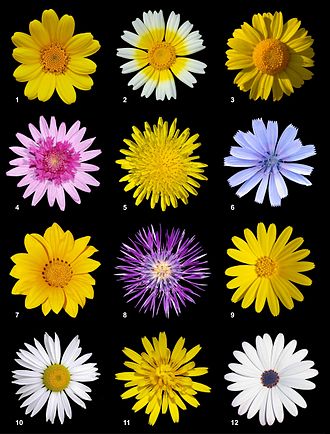
Certain plant families have special types of inflorescences. For example, the Asteraceae family has specialized heads called calathids, while the Poaceae family has small spikes called spikelets arranged in panicles or spikes.
Development and patterning
Plants have special parts called inflorescences where flowers grow. These inflorescences develop because of genes, which are like tiny instructions inside the plant. In a plant called Arabidopsis, a gene named LFY helps decide where flowers will form. If this gene changes, the plant might grow shoots instead of flowers. Other genes, like TFL, stop flowers from growing in certain places, helping the plant decide where to make flowers.
The environment can also affect how inflorescences grow. Temperature matters too—some plants grow flowers faster when it’s warm, while others might have trouble growing flowers in high heat.
The way inflorescences are arranged depends on special plant parts called meristems. Some meristems become flowers, while others become shoots. This arrangement can affect how well the plant’s flowers get pollinated and how many seeds it produces.
Images
Related articles


This article is a child-friendly adaptation of the Wikipedia article on Inflorescence, available under CC BY-SA 4.0.
Images from Wikimedia Commons. Tap any image to view credits and license.