
Introduction to systolic geometry
Systolic geometry is an exciting part of differential geometry, a field in mathematics. It studies the relationship between the area inside a closed curve and the length or perimeter of that curve. Sometimes, an area can be small while the perimeter is large, especially if the curve looks stretched out. Systolic geometry looks at this relationship using inequalities. It gives an upper bound for the area based on the length.
The idea of connecting length and area is very old. Mikhail Gromov said that the isoperimetric inequality, which finds the maximum area for a given perimeter, was known even to the Ancient Greeks. This idea appears in the story of Dido, Queen of Carthage.
In systolic geometry, a systole is the shortest distance around a loop in a space that cannot be shrunk to a point. This helps us learn about special shapes and spaces. The field tries to find lower bounds for some properties of a space using the idea of the systole. There is also a connection to quantum mechanics through the Fubini–Study metric and Gromov's inequality for complex projective space.
Surface tension and shape of a water drop
Have you ever seen how a drop of water looks? It usually looks like a nice, round shape. This happens because of something called surface tension. Surface tension makes the water drop try to use as little surface area as possible. Since the amount of water in a drop does not change, the best way to do this is to form a round sphere. This round shape is an example of a math idea called the isoperimetric inequality.
Isoperimetric inequality in the plane
The isoperimetric inequality helps us understand the relationship between the length of a closed curve and the area of the shape it encloses. It tells us that for any shape, the area ( A ) is always smaller than or equal to the square of its length ( L ) divided by ( 4\pi ). In simple terms, this means that among all shapes with the same perimeter, a circle will always have the largest area.
This inequality shows us an important upper limit: no matter how strange or stretched out a shape may be, its area can't exceed this value based on its perimeter. The circle is the perfect example where this equality is reached, making it the most efficient shape in terms of enclosing space.
Central symmetry
Central symmetry means a shape looks the same when you flip it through its center point. Picture turning a shape upside down and flipping it over. If it looks exactly the same, it has central symmetry. For example, an ellipse, which is like a stretched circle, has this property. This idea helps mathematicians study the shapes and sizes of objects in space.
Main article: antipodal map
Property of a centrally symmetric polyhedron in 3-space
A special rule in geometry connects the surface area of certain shapes to the length of paths on their edges. For any smooth shape that is balanced around a center, there is a limit on how long the shortest path between two opposite points on its surface can be, compared to the area of that surface.
This idea is linked to an important rule called Pu's inequality. Thinking about oval-shaped objects, like ellipsoids, can help imagine how this property works.
Notion of systole
The systole of a compact metric space is the shortest loop that cannot be shrunk to a point. This idea helps mathematicians learn about the shape and size of spaces. The word systole was first used by Marcel Berger. Since then, many new discoveries have been made about these properties, and they connect to other areas of mathematics.
The real projective plane
In projective geometry, the real projective plane is a special shape made from lines that all meet at one point. You can imagine it as a surface where opposite points are the same.
This shape has some cool features. For example, the distance between two points on this surface is the smallest angle between the lines going through those points. It is also a simple shape that is not orientable, meaning it doesn’t have a clear “up” and “down” like a sphere does.
Pu's inequality
Pu's inequality for the real projective plane is an important rule in a part of math called systolic geometry. It helps us understand how the size of shapes relates to their edges.
This inequality was proven by a mathematician named Pao Ming Pu in 1950. It says that for some shapes, the area inside the shape has a special connection to a measurement called the systole. The systole is like the shortest loop you can draw on the shape. The inequality shows that the square of the systole cannot be larger than a certain part of the area. This helps mathematicians learn more about the shapes of spaces!
Loewner's torus inequality
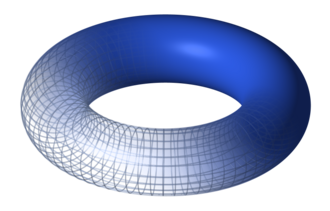
Loewner's torus inequality is a special rule about a torus, which is like a donut shape. It connects the area of the torus to the shortest loop you can draw on it that can't be shrunk to a point. This shortest loop is called the systole. The inequality says that if you take the area of the torus and subtract a certain amount based on the length of this loop, the result is always zero or more.
This special case where the result equals zero only happens when the torus has a very specific shape, similar to a flat torus made from a special kind of grid on a flat plane.
Bonnesen's inequality
The Bonnesen's inequality is a special rule in math. It connects the size of a shape to how long its edge is.
This rule helps us see how close a shape is to being a perfect circle. A circle gives the most area for a given edge length. The difference between a shape and a perfect circle is called the "isoperimetric defect."
Loewner's inequality with a defect term
The strengthened version of Loewner's inequality adds more detail. It includes a term called "variance," which helps measure how much something varies or spreads out. This version of the inequality looks at the area of a shape. It compares this area to a special measurement called the systolic length. The comparison is adjusted by a number from geometry.
The proof of this inequality uses clever math. It combines a formula for variance with a concept called Fubini's theorem. This makes the inequality more precise and useful for some geometric problems.
Keep exploring


This article is a child-friendly adaptation of the Wikipedia article on Introduction to systolic geometry, available under CC BY-SA 4.0.
Images from Wikimedia Commons. Tap any image to view credits and license.