 Safekipedia
John McCain
Adapted from Wikipedia · Adventurer experience
McCain was an American politician and naval officer who worked for more than 35 years in the United States Congress for Arizona. He was first a U.S. representative and later a U.S. senator. He belonged to the Republican Party and ran for president in the 2008 presidential election.
McCain was born into a military family in the Panama Canal Zone. He went to the U.S. Naval Academy and became a naval aviator. During the Vietnam War, his plane was shot down. He was captured and held until 1973, but he refused to leave early even though he was hurt.
After leaving the Navy, McCain moved to Arizona and started working in politics. He was known for working with people from different parties on important issues such as campaign finance reform. He also helped improve diplomatic relations with Vietnam. Many remember him for his service in the Senate and his dedication to what he thought was right.
Early life and military career (1936–1981)
Main article: Early life and military career of John McCain
John Sidney McCain III was born on August 29, 1936, at Coco Solo Naval Air Station in the Panama Canal Zone, to naval officer John S. McCain Jr. and Roberta Wright McCain. He had an older sister, Sandy, and a younger brother, Joe. At that time, the Panama Canal was under U.S. control.
His father and his paternal grandfather, John S. McCain Sr., were also Naval Academy graduates and both became four-star admirals in the United States Navy. The McCain family moved often because of his father's naval jobs. He went to about 20 different schools. In 1951, the family moved to Northern Virginia, and McCain went to Episcopal High School in Alexandria. He was good at wrestling and graduated in 1954.
McCain followed his family’s tradition and went to the United States Naval Academy, graduating in 1958. McCain began his early military career as an ensign, training to be a naval aviator. He finished flight school in 1960 and became a naval pilot.
McCain was taken prisoner of war on October 26, 1967. He was flying his 23rd mission over North Vietnam when his A-4E Skyhawk was shot down by a missile near Hanoi. He was injured when he ejected from the plane. He was held for over five years as a prisoner of war.
After the war, McCain returned to the United States. He left the Navy in 1981 as a captain and moved to Arizona. He received a disability pension.
House and Senate elections and career (1982–2000)
Main article: U.S. House and Senate career of John McCain (until 2000)
U.S. Representative
John McCain wanted a new challenge and decided to run for the U.S. House of Representatives. He worked for a big beer company and met many local leaders. In 1982, he ran for a seat in Arizona and won.
In 1983, McCain became a leader of new Republican representatives and joined a committee about land and nature. He changed his mind about a holiday for civil rights leader Martin Luther King Jr. after first opposing it.
Growing family
In 1984, McCain and his wife Cindy had their first child, a daughter named Meghan. Two years later, they had a son named John IV, and in 1988, another son named James. In 1991, they adopted a baby girl named Bridget from Bangladesh.
First two terms in the U.S. Senate
McCain started in the U.S. Senate in 1987 after winning the election. He joined committees about the military, business, and Native American affairs. He helped make rules for Native American gambling and supported laws to save government money.
McCain became well-known and was talked about as a possible helper for the president in 1988. He also led a group that helped democratic elections in other countries.
Keating Five
McCain was part of a situation in the 1980s where he met with people about a savings and loan company. He later said it was a mistake to meet with them, but he was found not to have done anything wrong.
Political independence
In the 1990s, McCain became known for thinking for himself. He worked to find out if any American soldiers were still missing from the Vietnam War. He also voted to confirm judges chosen by President Clinton.
Campaign finance reform
McCain worked with a senator from Wisconsin to try to limit big donations to political campaigns. Many people did not agree with their idea, but McCain thought it was important to try.
Start of third term in the U.S. Senate
In 1998, McCain was re-elected to the Senate. In 1999, he published a book about his family and his time in the military, which became very popular.
2000 presidential campaign
John McCain announced he wanted to be president on September 27, 1999, in Nashua, New Hampshire. He wanted to take the government back from powerful groups and give it to the people. At that time, George W. Bush, the governor of Texas, was the leading candidate for the Republican nomination.
McCain focused on the New Hampshire primary and won it on February 1, 2000. He got 49% of the vote, while Bush got 30%.
McCain faced challenges, especially in the South Carolina primary. He lost there on February 19. After winning in Arizona and Michigan, he still had difficulties. He criticized some Christian leaders for being divisive and lost more primaries. On March 9, 2000, McCain stopped his campaign and later supported Bush.
Senate career (2000–2008)
Main article: U.S. Senate career of John McCain (2001–2014)
John McCain began 2001 by disagreeing with the new administration on several issues, like health rules, the environment, and laws about guns. In May 2001, he was one of two Republican senators to vote against a plan to change taxes. He also had strong feelings with the leader of the country from past work together.
After the attacks on September 11, 2001, McCain supported the country's leader and the war in Afghanistan. He worked with another senator to create a special group to look back on the attacks. He also helped pass a law to make airport safety better.
In March 2002, a very important law about campaign money was passed, and it was McCain’s biggest success in making laws.
McCain also supported going to war in Iraq and voted for it in 2002. But later, he said more soldiers were needed there. He also worked on laws to help protect the environment and supported better rules for people from other countries living in the United States.
In 2004, McCain was mentioned as a possible running mate for the Democratic candidate, but he said he was not asked and would not have accepted. He also won his race to stay in the Senate with a big majority.
In 2005, McCain helped make a deal about choosing judges for the highest court in the country. He also worked on laws to change how Native American gaming worked and helped expose some wrongdoings.
McCain spoke out against unfair treatment of people captured during wars and pushed for better rules to make sure they were treated right. He also kept talking about how the war in Iraq was going and supported sending more soldiers there in 2007, which helped reduce violence later on.
2008 presidential campaign
Further information: 2008 Republican Party presidential primaries and 2008 United States presidential election
John McCain said he wanted to be President of the United States on April 25, 2007, in Portsmouth, New Hampshire. He wanted to do important work.
McCain was known for his work on big issues. He had served in the military and was a former prisoner of war. At first, he had trouble getting support, but later he got stronger, especially in New Hampshire, and won some early votes.
McCain kept working and won many votes on Super Tuesday, becoming a leading candidate for the Republican nomination. If he had been elected president, he would have been the first president born outside the United States, but there were questions about whether he met the rules.
McCain chose Alaska Governor Sarah Palin as his running mate, making her the first woman to be a major party’s vice presidential candidate. They became the Republican nominees in September 2008.
During the campaign, McCain faced questions about his age and health. He also had to deal with changes in his team and talked about important issues like the economy with his opponent, Barack Obama.
McCain talked about his experience and tried to show he could lead better than Obama. But Obama usually led in polls. McCain stopped his campaign for a short time to help with a plan for the economy, but Obama did not join him.
In the debates, Obama was often thought to do better. Near the end of the campaign, McCain talked about small business owners and spoke up when someone said bad things about Obama, saying Obama was a good person even if they disagreed.
The election was held on November 4, and Obama was chosen as president. McCain gave a speech saying that, even with differences, they were all Americans.
Senate career after 2008
Main article: US Senate career of John McCain (2001–2014)
Remainder of fourth Senate term
After losing an election, McCain returned to the Senate. He planned to run again in 2010. During this time, he worked with the new president on many issues.
McCain spoke out against some of the new president’s plans, like a big project to help the economy and a plan for health care. He also talked about supporting the war in Afghanistan and criticized some defense decisions.
In 2010, McCain faced a challenge in his re-election but won. He continued to speak up on many issues, including laws about immigration and working with other senators on different topics.
Fifth Senate term
McCain kept working in the Senate and spoke up about many world events, like what was happening in the Middle East. He visited places like Libya and Syria to show support for people there.
He also talked about the need to change some laws in the U.S. and worked with other senators to try to fix problems, like the government shutting down.
Sixth and final Senate term
McCain kept working hard in the Senate. In 2017, he had to have surgery for a health problem but came back to help with important votes.
Sadly, McCain faced health issues again in 2018 and had to stop voting in the Senate. He passed away later that year.
Committee assignments
- Committee on Armed Services (Chair)
- as chair of the full committee may serve as an ex officio member of any subcommittee
- Committee on Homeland Security and Governmental Affairs
- Committee on Indian Affairs
- Committee on Intelligence (ex officio)
Caucus memberships
- International Conservation Caucus
- Senate Diabetes Caucus
- Senate National Security Caucus (Co-chair)
- Sportsmen's Caucus
- Senate Wilderness and Public Lands Caucus
- Senate Ukraine Caucus
- Republican Main Street Partnership
Death and funeral
On August 24, 2018, John McCain's family announced he would stop cancer treatment. He passed away the next day at his home in Cornville, Arizona.
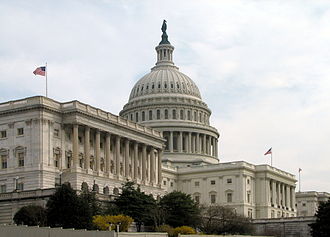
McCain was honored with several services. His body lay in state at the Arizona State Capitol on what would have been his 82nd birthday. Later, his remains were moved to Washington, D.C., where they also lay in state in the United States Capitol rotunda. A service followed at the Washington National Cathedral. McCain planned his own funeral and chose who would carry his casket, including leaders and friends like Joe Biden and actor Warren Beatty.
Many important people from around the world attended the services. Leaders such as Barack Obama and George W. Bush spoke at the memorial. McCain was finally buried at the United States Naval Academy Cemetery after a private service.
Political positions
Main article: Political positions of John McCain
See also: Comparison of the 2008 United States presidential candidates
John McCain had many views on important issues. Groups that watch politicians gave him scores to show how his ideas matched theirs. One group gave him a score showing he was in the middle—not very liberal or very conservative.
As a senator, McCain often voted with a mix of liberal and conservative ideas. Sometimes he agreed with other senators, and sometimes he did not. After losing a big election in 2008, he began to support more traditional conservative ideas.
McCain believed in keeping taxes low, having a strong military, and supporting free markets and trade. He also valued important American values and the rights of people to live freely.
Cultural and political image
Main article: Public image of John McCain
John McCain was known for his strong character and special way of doing things. People remembered him for his time in the military and his independent style in politics. He was also known for his quick temper and sometimes saying things he later regretted.
McCain was liked by many for his courage, both in war and in politics. Over time, his political views changed, especially after running for president in 2008. Even so, many respected him for his service and strong beliefs.
McCain was open about his mistakes and apologized when needed. He had close friendships with some fellow senators, and his family stayed close to him. Some of his children joined the military, and others became well-known public figures. McCain also appeared in several TV shows and movies during his time as a senator.
Awards and honors
See also: Early life and military career of John McCain § Military awards
John McCain received many important awards and honors during his career. In 1997, Time magazine named him one of the "25 Most Influential People in America". In 1999, he and Senator Russ Feingold won an award for their work on fair voting laws. He also received many other awards, including the Paul H. Douglas Award and the Eisenhower Leadership Prize.
McCain was given special awards from leaders around the world. He also received honorary degrees from many universities, such as Colgate University and the University of Southern California. In 2018, a ship was named after him, and in 2019, an airport terminal in Phoenix was dedicated in his honor.
Commemoration
In 2019, a street in Kyiv, Ukraine, was renamed "John McCain Street" to honor him. Other cities in Ukraine, such as Kryvyi Rih, Vinnytsia, and Sumy, also have streets named after Senator McCain. A memorial for McCain was built in Hanoi, Vietnam.
Electoral history
Main article: Electoral history of John McCain
John McCain ran for office several times. He was elected to the U.S. Senate in 1986 and served there for many years. McCain also ran for president twice. His first presidential run was in 2000, but he did not win. He ran again in 2008 and was nominated by his party. However, he lost the election to Barack Obama.
Works
John McCain wrote many books with his friend Mark Salter. Some of his well-known books are Faith of My Fathers, Worth the Fighting For, and Why Courage Matters. These books tell stories about courage and big choices.
McCain also wrote articles and introductions for other books. He talked about his time as a prisoner during the Vietnam War and shared his ideas about peace and safety. His writings have appeared in magazines and books, where he shared his thoughts on many important subjects.
Images
Related articles




This article is a child-friendly adaptation of the Wikipedia article on John McCain, available under CC BY-SA 4.0.
Images from Wikimedia Commons. Tap any image to view credits and license.