 Safekipedia
Leipzig
Adapted from Wikipedia · Adventurer experience
Leipzig is the biggest city in the German state of Saxony. As of 2025, it has 633,592 people, making it the eighth-largest city in Germany. It lies in the Central German Metropolitan Region, about 150 km southwest of Berlin, in the North German Plain, in an area called the Leipzig Bay.
Leipzig has a long history as a trade city, going back to the time of the Holy Roman Empire. Important old trade routes, the Via Regia and the Via Imperii, crossed here. The Leipzig Trade Fair started in 1190. After the Second World War, Leipzig stayed important in East Germany. Events in 1989, especially demonstrations from St. Nicholas Church, helped bring changes in Europe.
Today, Leipzig is a modern and lively city. It is home to one of the oldest universities in Europe, the Leipzig University. The city has many important buildings, including around 12,500 from the late-19th century called Gründerzeit architecture. Leipzig's main train station, Leipzig Hauptbahnhof, is the largest in Europe by floor area. The city also has a beautiful and modern Leipzig Zoo, ranking first in Germany and second in Europe.
Leipzig is famous for its music. The Thomanerchor, a boys' choir, was founded in 1212. The Leipzig Gewandhaus Orchestra, started in 1743, is one of the oldest symphony orchestras in the world. Well-known composers like Johann Sebastian Bach, Felix Mendelssohn, and Richard Wagner lived and worked in Leipzig. The city also has a famous opera house, the Oper Leipzig, founded in 1693.
Names
Leipzig has had many names over time. In English, it was once spelled Leipsic, and in Latin, it was called Lipsia. The name Leipzig likely comes from a word for linden trees.
The city is often called Lindenstadt or Stadt der Linden, meaning "City of Linden Trees," because it has many linden trees. It has also been called Pleiß-Athen, or "Athens on the Pleiße River," because of its history with learning and books. Some people even call it "Little Paris" after a famous line from a play. Today, Leipzig is known as a lively city with many new businesses.
Main article: Linden trees
Main articles: Monday demonstrations, startups
Geography
Leipzig is in the Leipzig Bay, the southernmost part of the North German Plain. The city is along the White Elster river. This river starts in the Czech Republic and joins the Saale river. Two smaller rivers, the Pleiße and the Parthe, also meet the White Elster in Leipzig. The land around Leipzig is mostly flat with some swampy areas, like the Leipzig Riparian Forest. There are also some limestone areas to the north.
Leipzig has a climate that is mostly oceanic but with some effects from continental weather. Winters are cold, around 1 °C (34 °F), and summers are warm, about 19 °C (66 °F). The city gets more sunshine in the summer than in the winter.
| Stadtbezirk | Pop. (2020) | Area km2 | Pop. per km2 | Ortsteile |
|---|---|---|---|---|
| Mitte | 65,912 | 13.96 | 4,721 | Zentrum, Zentrum-Ost, Zentrum-Südost, Zentrum-Süd, Zentrum-West, Zentrum-Nordwest, Zentrum-Nord |
| Nordost | 48,227 | 26.31 | 1,833 | Schönefeld-Abtnaundorf, Schönefeld-Ost, Mockau-Süd, Mockau-Nord, Thekla, Plaußig-Portitz |
| Ost | 85,519 | 40.73 | 2,100 | Neustadt-Neuschönefeld, Volkmarsdorf, Anger-Crottendorf, Sellerhausen-Stünz, Paunsdorf, Heiterblick, Engelsdorf/Sommerfeld, Althen, Baalsdorf, Kleinpösna/Hirschfeld, Mölkau |
| Südost | 62,506 | 34.72 | 1,800 | Reudnitz-Thonberg, Stötteritz, Probstheida, Meusdorf, Holzhausen, Liebertwolkwitz |
| Süd | 67,079 | 16.95 | 3,957 | Südvorstadt, Connewitz, Marienbrunn, Lößnig, Dölitz-Dösen |
| Südwest | 55,742 | 46.56 | 1,197 | Schleußig, Plagwitz, Kleinzschocher, Großzschocher, Knautkleeberg-Knauthain, Hartmannsdorf-Knautnaundorf |
| West | 54,190 | 14.69 | 3,689 | Schönau, Grünau-Ost, Grünau-Mitte, Grünau-Siedlung, Lausen-Grünau, Grünau-Nord, Miltitz |
| Alt-West | 59,643 | 26.21 | 2,276 | Lindenau, Altlindenau, Neulindenau, Leutzsch, Böhlitz-Ehrenberg, Burghausen, Rückmarsdorf |
| Nordwest | 34,710 | 39.07 | 888 | Möckern, Wahren, Lindenthal, Breitenfeld, Lützschena, Stahmeln |
| Nord | 71,878 | 38.61 | 1,862 | Gohlis-Süd, Gohlis-Mitte, Gohlis-Nord, Eutritzsch, Seehausen, Göbschelwitz, Hohenheida, Gottscheina, Wiederitzsch |
History
Main article: History of Leipzig
For a chronological guide, see Timeline of Leipzig.
Origins
See also: Margraviate of Meissen and Electorate of Saxony
Leipzig was first written about in 1015. It got special rights in 1165. A famous fair began in the Middle Ages and is still held today. The city grew because of its fairs and trade.
There were many monasteries near Leipzig, and a university started in 1409. Leipzig became important for law and publishing.
19th century
The Battle of Leipzig in 1813 was a big fight between Napoleon's army and other European countries. It helped end Napoleon's rule in Germany. Later, Leipzig became a major railway hub and was important for new ideas and workers' rights.
20th century
See also: History of Leipzig from 1933 to 1939, Bombing of Leipzig in World War II, and University of Music and Theatre Leipzig
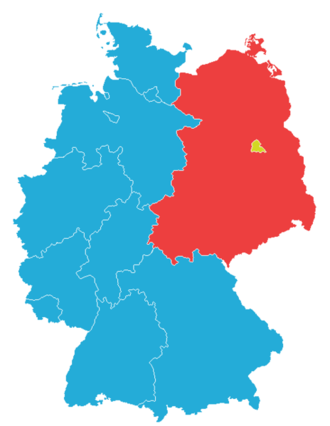
During World War II, Leipzig was bombed many times. After the war, the city was part of East Germany. In 1989, peaceful protests in Leipzig helped bring about changes in East Germany.
21st century
Leipzig has grown a lot and is now known as a lively city with many new businesses and good living conditions. The city has many modern transport links and continues to be an important place in Germany.
Politics
Leipzig has had several mayors since the country reunited. The first mayor chosen after this was Hinrich Lehmann-Grube from the Social Democratic Party, serving from 1990 to 1998. Since 1994, the mayor is directly voted on by people. Wolfgang Tiefensee served from 1998 until 2005, and then Burkhard Jung took over in 2006.
Elections for the city council happen regularly to help decide how the city is run. Leipzig also has representatives in the state Landtag and the Bundestag, which are important groups that help make laws for the area.
| Constituency | Area | Member | |
|---|---|---|---|
| 25 Leipzig 1 | City centre | Left | Nam Duy Nguyen |
| 26 Leipzig 2 | Southeast | CDU | Ronald Pohle |
| 27 Leipzig 3 | Inner north (Gohlis) | CDU | Wolf-Dietrich Rost |
| 28 Leipzig 4 | Central south | Left | Juliane Nagel |
| 29 Leipzig 5 | Southwest | CDU | Andreas Nowak |
| 30 Leipzig 6 | Inner west (Lindenau) | Grüne | Claudia Maicher |
| 31 Leipzig 7 | Northwest | CDU | Rick Ulbricht |
| 32 Leipzig 8 | Northeast/inner east | CDU | Holger Gasse |
| Constituency | Area | Member | |
|---|---|---|---|
| 151 Leipzig I | Alt-West, Nord, Nordost, Nordwest, and Ost | CDU | Jens Lehmann |
| 152 Leipzig II | Mitte, Süd, Südost, Südwest, and West | Left | Sören Pellmann |
Demographics
Leipzig has about 620,000 people. The number of people in the city changed a lot over time. It was biggest in 1930, with over 700,000 people. After that, the number went down. By 1998, there were about 437,000 people because many moved away. But in 1999, the city grew by including nearby towns, and the population started to rise again.
In recent years, more people have moved to Leipzig, making it one of the fastest-growing cities in Germany. The city now has more families and children. Today, Leipzig is a lively place where people from many different backgrounds live together.
| Year | Pop. | ±% |
|---|---|---|
| 1507 | 9,000 | — |
| 1600 | 20,000 | +122.2% |
| 1750 | 35,000 | +75.0% |
| 1852 | 66,686 | +90.5% |
| 1875 | 127,387 | +91.0% |
| 1890 | 295,025 | +131.6% |
| 1900 | 456,124 | +54.6% |
| 1910 | 589,850 | +29.3% |
| 1920 | 620,000 | +5.1% |
| 1930 | 718,200 | +15.8% |
| 1935 | 699,300 | −2.6% |
| 1940 | 709,100 | +1.4% |
| 1945 | 581,528 | −18.0% |
| 1955 | 613,707 | +5.5% |
| 1960 | 589,632 | −3.9% |
| 1965 | 595,660 | +1.0% |
| 1970 | 583,885 | −2.0% |
| 1980 | 562,480 | −3.7% |
| 1990 | 511,079 | −9.1% |
| 1995 | 470,778 | −7.9% |
| 2001 | 493,052 | +4.7% |
| 2011 | 502,979 | +2.0% |
| 2022 | 598,899 | +19.1% |
| Population size may be affected by changes in administrative divisions. Source for 2001–2022: | ||
Culture, sights, and cityscape
In the 2010s, Leipzig was often called Hypezig, as people made big comparisons to Berlin from the 1990s and early 2000s. The city's affordability, diversity, and openness have attracted many young people from across Europe, creating a lively atmosphere with innovative music, dance, and art scenes.
Architecture
See also: Architecture of Leipzig and List of arcade galleries in Leipzig
The historic center of Leipzig has a Renaissance-style group of buildings from the sixteenth century, including the old city hall in the marketplace. There are also several baroque period trading houses and former homes of rich merchants. As Leipzig grew a lot during the late-nineteenth century economic boom, the city has many buildings in the historicist style from the Gründerzeit era. About 35% of Leipzig's apartments are in buildings of this type. The new city hall, finished in 1905, is built in the same style.
About 90,000 apartments in Leipzig were built in Plattenbau buildings during the time when East Germany was ruled by a different government. Though some of these have been torn down and fewer people live in them now, many still do. Grünau, for example, had about 43,600 people living in this type of home in 2016.
The St. Paul's Church was taken down by that government in 1968 to make space for a new main building for the university. After some discussion, the city decided to build a new, mostly modern building at the same spot, called Paulinum, which was finished in 2012. Its design reminds us of the old church, and it includes space for religious activities, along with the original altar from the old church and two new organs.
Many commercial buildings were built in the 1990s because of tax benefits after Germany reunited.
Tallest buildings and structures
Main article: List of tallest buildings in Leipzig
The tallest structure in Leipzig is the chimney of the Stahl- und Hartgusswerk Bösdorf GmbH, standing 205 m (673 ft) tall. The tallest building in Leipzig is the City-Hochhaus Leipzig, which is 142 m (466 ft) tall. From 1972 to 1973, it was Germany's tallest building.
Museums and the arts
One of the highlights of the city's contemporary arts was the Neo Rauch show that opened in April 2010 at the Leipzig Museum of Fine Arts. This display focuses on the father of the New Leipzig School of artists. There are also eleven galleries in the so-called Spinnerei.
The Grassi Museum complex has three of Leipzig's major collections: the Ethnography Museum, Applied Arts Museum, and Musical Instrument Museum (run by the University of Leipzig). The university also runs the Museum of Antiquities.
Started in March 2015, the G2 Kunsthalle houses the Hildebrand Collection. This private collection focuses on the so-called New Leipzig School. Leipzig's first private museum for contemporary art after the year 2000 is in the city center near the famous St. Thomas Church, on the third floor of the former processing center of the old government. The Galerie für Zeitgenössische Kunst Leipzig is also dedicated to contemporary art.
Other museums in Leipzig include:
- The German Museum of Books and Writing is the world's oldest museum of its kind, started in 1884.
- The Bach Museum at the St. Thomas Church Square.
- The Egyptian Museum of the University of Leipzig located in the Kroch High-rise has about 7,000 items from many years ago.
- The Schillerhaus is where Schiller lived in the summer of 1785.
- The Zeitgeschichtliches Forum Leipzig (Forum of Contemporary History) shows the history of Germany's division and everyday life in the old government area.
- Naturkundemuseum Leipzig is the city's natural history museum.
- The Leipzig Panometer is a big painting shown inside a former gas holder, with a special exhibition.
- The "Museum in der Runden Ecke" is a well-known museum in the city. It talks about the old government's secret police.
- Johann Sebastian Bach lived in Leipzig from 1723 until he passed away. The Bach Archive records and studies his life and work.
- Mendelssohn House, home of Felix Mendelssohn from 1845 to 1847.
- Schumann House, home of Robert and Clara Schumann from 1840 to 1844.
- The Museum of Antiquities of Leipzig University and a small museum about the young life of Richard Wagner in the Old St Nicholas School.
- The Saxon Psychiatric Museum is a small museum about the history of mental health care.
- The Unikatum Children's Museum, Leipzig opened in 2010 in Plagwitz.
Main sights
- Leipzig Zoological Garden is one of the most modern zoos in Europe, with about 850 different kinds of animals. It has the world's largest zoo area for primates (Pongoland). Gondwanaland is the world's biggest indoor rainforest hall.
- Monument to the Battle of the Nations (Völkerschlachtdenkmal): one of the largest monuments in Europe, built to honor the battle against Napoleonic forces.
- Bundesverwaltungsgericht: Germany's federal administrative court was where the Reichsgericht, the highest state court from 1888 to 1945, used to be.
- New Town Hall: the city's main building was built on the remains of the Pleissenburg, a castle where the 1519 debate between Johann Eck and Martin Luther happened. It is also Germany's tallest town hall.
- Old Town Hall on the Market square was built in 1556 and has a museum about the city's history.
- City-Hochhaus Leipzig: built in 1972, the city's tallest building you can live in is one of the top 25 tallest buildings in Germany.
- The Augusteum and Paulinum at Augustusplatz are now the main campus of the University of Leipzig.
- Leipzig Trade Fair center in the north of the city has the world's largest levitated glass hall.
- Leipzig Hauptbahnhof is the world's largest railway station by floor space and a place to shop.
- Auerbach's Cellar: young Goethe used to visit this restaurant while studying in Leipzig; it is where a scene from his play Faust happens.
- The Old Leipzig bourse at Naschmarkt with the Goethe Monument.
- South Cemetery (Südfriedhof) is, with an area of 82 hectares (200 acres), the largest cemetery in Leipzig.
- The German National Library has two places, one of them in Leipzig.
- Leipzig Bayerischer Bahnhof is Germany's oldest railway station that is still kept.
- Gohlis Palace (Gohliser Schlösschen)
- Leipzig Synagogue was damaged by a cruel group in 1938. Now a memorial of 140 bronze chairs stands where the seats used to be.
Churches
- St. Thomas's Church (Thomaskirche): famous because Johann Sebastian Bach worked here as a music leader and home to the well-known boys choir Thomanerchor. A statue of Felix Mendelssohn stands in front of this church.
- St. Nicholas's Church (Nikolaikirche), where Bach was also in charge. The weekly Montagsgebet (Monday prayer) here started the peaceful Monday demonstrations against the old government in the 1980s.
- St. Peter's has the tallest tower of any church in Leipzig, at 87 m (285 ft).
- The new Propsteikirche, opened in 2015.
- The Continental Reformed Church of Leipzig (Evangelisch-reformierte Kirche) is one of the most noticeable buildings on the Leipzig Innercity ring.
- The Russian Memorial Church of Leipzig
- St. Michael's Church is one of the landmarks of Gohlis district.
Parks and lakes
Leipzig is famous for its big parks. The Leipziger Auwald (riparian forest) is mostly inside the city limits. Neuseenland is an area south of Leipzig where old mines are being turned into a huge lake area. It is planned to be finished in 2060.
- Leipzig Botanical Garden is the oldest of its kind in Germany. It has about 7,000 plant kinds, with nearly 3,000 species in ten special groups.
- Johannapark and Clara-Zetkin-Park are the most famous parks in the Leipzig city center (Leipzig-Mitte).
- Leipziger Auwald covers about 2,500 hectares. The Rosental is a park in the north of the forest and is next to Leipzig Zoo.
- The Leipzig Wildlife Park in Connewitz, showing 25 kinds of animals.
- The Lene Voigt Park on the rebuilt site of the old train station Leipzig Eilenburger Bahnhof opened in 2004.
Music
Baroque to Modern
Johann Sebastian Bach spent the longest time of his career in Leipzig, from 1723 until he passed away in 1750, leading the Thomanerchor (St. Thomas Church Choir), at the St. Thomas Church, the St. Nicholas Church, and the Paulinerkirche, the university church of Leipzig (taken down in 1968). The composer Richard Wagner was born in Leipzig in 1813, in the Brühl. Robert Schumann was also part of Leipzig's music, having been asked by Felix Mendelssohn when the latter started Germany's first music conservatoire in the city in 1843. Gustav Mahler was second conductor (working under Artur Nikisch) at the Leipzig Opera from June 1886 until May 1888, and got his first big recognition there by finishing and publishing Carl Maria von Weber's opera Die Drei Pintos. Mahler also finished his own 1st Symphony while living in Leipzig.
Today the conservatoire is the University of Music and Theatre Leipzig. They teach many subjects, including artistic and teacher training for all orchestra instruments, voice, acting, coaching, piano chamber music, orchestra conducting, choir conducting, and musical composition in different music styles. The drama departments teach acting and scriptwriting.
The Bach-Archiv Leipzig, a place for recording and studying the life and work of Bach (and also the Bach family), was started in Leipzig in 1950 by Werner Neumann. The Bach-Archiv organizes the big International Johann Sebastian Bach Competition, started in 1950 as part of a music festival for the 200th anniversary of Bach's passing. The competition is now held every two years in three changing groups. The Bach-Archiv also organizes shows, especially the international festival Bachfest Leipzig and runs the Leipzig Bach Museum.
The city's music tradition is also shown in the world fame of the Leipzig Gewandhaus Orchestra, under its leader Andris Nelsons, and the Thomanerchor.
The MDR Leipzig Radio Symphony Orchestra is Leipzig's second biggest symphony orchestra. Its current leader is Kristjan Järvi. Both the Gewandhausorchester and the MDR Leipzig Radio Symphony Orchestra play in the Gewandhaus concert hall.
For over sixty years Leipzig has offered a "school concert" program for children in Germany, with over 140 shows every year in places like the Gewandhaus and over 40,000 children attending.
Contemporary
Leipzig is known for its independent music and subcultural events. Leipzig has been home to the Wave-Gotik-Treffen (WGT) for thirty years, which is now the world's biggest Gothic festival, where thousands of fans of goth music meet in early summer. The first Wave Gotik Treffen was at the Eiskeller club, today known as Conne Island, in the Connewitz area.
Leipzig Pop Up was an annual music trade fair for independent music as well as a music festival happening on Pentecost weekend. Its most famous indie-labels are Moon Harbour Recordings (House) and Kann Records (House/Techno/Psychedelic). Several places offer live music often, including the Moritzbastei, Tonelli's, and Noch Besser Leben.
Die Prinzen ("The Princes") is a German band started in Leipzig. With almost six million records sold, they are one of the most successful German bands.
The cover photo for the Beirut band's 2005 album Gulag Orkestar, according to the notes, was taken from a Leipzig library by Zach Condon.
The city of Leipzig is also where Till Lindemann, the main singer of Rammstein was born and where Bill Kaulitz and Tom Kaulitz, the main members of Tokio Hotel were born.
Annual events
- Auto Mobil International (AMI) motor show
- AMITEC, trade fair for vehicle maintenance, care, servicing, and repairs in Germany and Central Europe
- A cappella: vocal music festival, organized by the ensemble amarcord
- Bachfest: Johann Sebastian Bach festival
- Leipzig Christmas Market (since 1458)
- Dok Leipzig: international festival for documentary and animated film
- Jazztage, contemporary jazz festival
- Ladyfest Leipzig (August) Emancipatoric, feminist punk and electro festival
- Leipzig Book Fair: the second largest German book fair after Frankfurt
- Lichtfest Leipzig, festival celebrating the shows that led to the end of the old government
- OPER unplugged with Music Dance Theatre by Heike Hennig & Co
- Stadtfest: city festival
- Wave-Gotik-Treffen at Pentecost: world's largest goth or "dark culture" festival
- Leipzig Pop Up
- Chaos Communication Congress
Food and drink
- An all-season local dish is Leipziger Allerlei, a mix of seasonal vegetables and crayfish.
- Leipziger Lerche is a shortcrust pastry filled with crushed almonds, nuts, and strawberry jam; the name ("Leipzig lark") comes from a lark pâté which was a Leipzig specialty until hunting songbirds was stopped in Saxony in 1876.
- Gose is a locally made top-fermenting sour beer that started in the Goslar region and became popular in 18th-century Leipzig.
| Buildings and structures | Image | Height in metres | Year |
|---|---|---|---|
| Chimney of Stahl- und Hartgusswerk Bösdorf GmbH | 205 | 1984 | |
| Funkturm Leipzig | 191 | 2015 | |
| DVB-T-Sendeturm | 190 | 1986 | |
| 4 x Wind turbine Nordex N100 |  | 190 | 2013 |
| City-Hochhaus Leipzig | 142 | 1972 | |
| Fernmeldeturm Leipzig | 132 | 1995 | |
| Tower of New Town Hall | 115 | 1905 | |
| Wintergartenhochhaus | 106.8 | 1972 | |
| The Westin Leipzig | 96 | 1981 | |
| Monument to the Battle of the Nations | 91 | 1913 | |
| St. Peters' | 88.5 | 1885 | |
| MDR-Hochhaus |  | 65 | 2000 |
| Hochhaus Löhr's Carree | 65 | 1997 | |
| Center Torgauer Platz |  | 63 | 1995 |
| Europahaus | 56 | 1929 |
Sports
Leipzig is a city with many sports clubs—over 300 of them! These clubs play many different kinds of sports, and there are lots of places where people can play and practice.
Football is very popular in Leipzig. The German Football Association started here in 1900, and the city hosted some games during the 2006 FIFA World Cup. Two well-known teams are VfB Leipzig and RB Leipzig.
Other sports you can find in Leipzig include ice hockey, handball, and American football. The city also has places for speedway racing, fencing, and rugby. Every year on May 1st, Leipzig celebrates the start of the horse racing season at the Racecourse Scheibenholz.
| Club | Founded | League | Level | Home ground | Capacity |
|---|---|---|---|---|---|
| RB Leipzig | 2009 | Bundesliga | 1 | Red Bull Arena | 47,069 |
| RB Leipzig (women) | 20161 | 2. Frauen-Bundesliga | 2 | Sportanlage Gontardweg | 1,300 |
| 1. FC Lokomotive Leipzig | 2003 | Regionalliga Nordost | 4 | Bruno-Plache-Stadion | 7,000 |
| BSG Chemie Leipzig | 19972 | Regionalliga Nordost | 4 | Alfred-Kunze-Sportpark | 4,999 |
| FC International Leipzig | 2013 | NOFV-Oberliga Süd | 5 | Sportpark Tresenwald | 1,500 |
| Roter Stern Leipzig | 1999 | Landesklasse Sachsen Nord | 7 | Sportpark Dölitz | 1,200 |
Education
Leipzig is an important city for learning. Leipzig University, started in 1409, is one of the oldest universities in Europe. Many famous people have studied or taught there. The university has around 30,000 students today.
The city also has schools for art, music, and special kinds of learning. The Academy of Visual Arts and the University of Music and Theatre offer classes in painting, design, acting, and more. There is also a business school called the Leipzig Graduate School of Management. Leipzig has many research centers studying topics like mathematics, the brain, and the environment.
Economy
Leipzig is a big city for making cars, with factories for BMW and Porsche. The city is also a center for air travel, with DHL moving many of its European flights to Leipzig/Halle Airport. Leipzig is home to important companies like the European Energy Exchange, which helps manage energy for much of Europe, and VNG – Verbundnetz Gas, a major natural gas supplier in Germany.
Leipzig has many jobs in technology, education, and medicine. The University of Leipzig brings in money each year and is very old. The city is also known for its research in medicine and biotechnology. With many shops, restaurants, and places to visit, Leipzig attracts lots of tourists.
Companies with operations in or around Leipzig include:
-
Blüthner: piano-manufacturing
-
BMW
-
DHL
-
Porsche Diamond, the customer centre building of Porsche Leipzig
-
BMW production facility in Leipzig
-
Amazon in Leipzig
-
Leipzig is the hub of DHL.
-
Headquarters of the Sparkasse Leipzig bank
-
Leipzig is the seat of the Development Bank of Saxony.
-
Höfe am Brühl shopping mall, situated on the former route of Via Regia, an ancient trade road
Socio-ecological infrastructure
Leipzig has many helpful places for people and nature. There are special sharing boxes called Fairteiler and farms where people can help grow food, called community-supported agricultures. In Plagwitz, there is a place where you can get clothes for free. There are also workshops to fix bikes, called Radsfatz, and computer clubs like Hackerspace Die Dezentrale. You can visit places to fix broken items, such as Café kaputt.
Media
Leipzig is home to MDR, one of Germany's public broadcasters. It has its main television studios there and makes programmes for TV and radio. It also has its own symphony orchestra, choir, and ballet. The city's daily newspaper is Leipziger Volkszeitung (LVZ), started in 1894. It has been published under many different governments. The monthly magazine Kreuzer talks about culture, festivals, and arts in Leipzig. Leipzig was also where the world's first daily newspaper, the Einkommende Zeitungen, was first published in 1650.
Leipzig has an online English magazine called The Leipzig Glocal. It is for both international and local readers. It writes about lifestyle, arts, culture, politics, entertainment, and local events. The German Library (Deutsche Bücherei) in Leipzig is part of Germany's National Library. It collects a copy of every book published in German.
Quality of life
Leipzig is a very livable city. In 2013, it was named the most livable city in Germany. It is also a great place for students, ranking second-best in the country in 2015 and 2016.
The city has many nice shops, good food, and beautiful places to visit. It was named European City of the Year in 2019 and has great future prospects. Leipzig Hauptbahnhof is one of the best railway stations in Germany and Europe.
Transport
Leipzig has been an important place for travel and trade since medieval times, where big roads crossed. After Germany reunited, the city improved its roads, railways, and airports.
Air
Leipzig/Halle Airport is the main airport for the area. It has flights to big cities in Germany and Europe, and also to places where people like to go on holiday. The airport is also important for cargo planes, especially for a big company called DHL. A train station near the airport connects it to the city.
Railways
Leipzig Hauptbahnhof is one of the biggest train stations in Europe. Many fast trains stop here, going to cities like Berlin, Munich, and Dresden. The station is part of a big network that helps people travel quickly across Germany. New tracks have been built to make trains go even faster.
Suburban trains
Leipzig is the center of a train network called S-Bahn Mitteldeutschland. These trains stop at many places around Leipzig, helping people get around the city and nearby towns easily.
Tramway and buses
The city has many trams and buses that help people move around. The tram network is one of the longest in Germany. There are also special night buses and trams for when shops are closed.
Bicycle
Leipzig is a friendly place for people who ride bikes. There are many paths for bikes, and special rules that make it easier to ride in traffic. The city even has a bike-sharing system where you can borrow a bike using a phone.
Road
Several big highways go around Leipzig, and there are many roads for cars to use. The city also has services where you can book a car or a ride using a phone.
Long-distance buses
A new bus station opened in 2018, with buses going to many cities in Europe. This makes it easier for people to travel far away without changing trains.
Water
In the past, people tried to build canals in Leipzig to connect to other waterways, but this work stopped during the Second World War. Today, small boats can still use some of the city's rivers and canals for fun.
Quotations
Here are some famous quotes about Leipzig:
- "I praise my Leipzig! It is a small Paris and educates its people." – Frosch, a university student in Goethe's Faust, Part One
- "I'm coming to Leipzig, to the place where one can see the whole world in miniature." – Gotthold Ephraim Lessing
- "To live outside Leipzig is to live miserably." – Benedikt Carpzov the Younger
- "The pleasurable Pleiss-Athens, earns its fame above all, appealing to every one, too, for it is mightily beauteous." – Johann Sigismund Scholze
Twin towns – sister cities
See also: List of twin towns and sister cities in Germany
Leipzig is twinned with several cities around the world. This means these cities work together. They share ideas and support each other in friendly ways. Twin cities often celebrate cultural exchanges and partnerships.
Notable people
Politicians
Leipzig has been home to many important leaders and thinkers. Famous politicians from Leipzig include Nikolaus Krell, who served a leader in Saxony, and August Bebel, who helped start Germany’s SPD. Other well-known figures include Louise Otto-Peters, who worked for women’s rights, and Walter Ulbricht, a leader in the GDR.
Philosophers and theologians
Leipzig has a long history of great thinkers. Philosophers and theologians such as Gottfried Wilhelm Leibniz, known for his work in philosophy and math, and Christian Thomasius, a jurist and philosopher, were born or lived in Leipzig. The city was also home to theologians like Johann Friedrich Mayer and Franz Delitzsch, who helped grow religious studies.
Writing and arts
Many writers, musicians, and artists have lived in Leipzig. Johann Sebastian Bach, one of the greatest composers, lived and worked in Leipzig. Other famous people include Felix Mendelssohn, a composer and conductor, and Richard Wagner, a well-known composer. The city has also been home to writers like Bruno Apitz and painters such as Max Beckmann.
Science and business
Leipzig has produced many important scientists and business leaders. Carl Gustav Carus, a doctor, painter, and thinker about nature, and Paul Mendelssohn Bartholdy, a chemist, were among those who helped grow science in Leipzig. Business leaders like Karl Wittgenstein, an entrepreneur, have also made their mark in the city.
Sport
Leipzig has seen many athletes do great things. Kristin Otto, a swimmer who won six Olympic gold medals, and René Müller, a famous footballer, are examples of the city’s sports talent. Other athletes such as Marvin Kirchhöfer, a racing driver, have also come from Leipzig.
Images
Related articles




This article is a child-friendly adaptation of the Wikipedia article on Leipzig, available under CC BY-SA 4.0.
Images from Wikimedia Commons. Tap any image to view credits and license.