 Safekipedia
Liber Abaci
Adapted from Wikipedia · Adventurer experience
The Liber Abaci or Liber Abbaci (Latin for "The Book of Calculation") was a 1202 Latin book about arithmetic written by Leonardo of Pisa, who is now called Fibonacci. This book was very important because it showed people in Europe new ways to work with numbers.
One big idea in the book was the use of base-10 positional notation. This is the way we count today, using digits from 0 to 9. The book also introduced the Arabic numerals, the numbers we use every day, instead of Roman letters like I, V, X, and L.
Because of this book, many people in Europe learned easier ways to add, subtract, multiply, and divide. It helped change how math was done and made calculations simpler.
Premise
Liber Abaci was one of the first books in the West to talk about the Hindu–Arabic numeral system and to use symbols that look like the numbers we use today, called "Arabic numerals". The book showed how useful this system was for both business people and math experts.
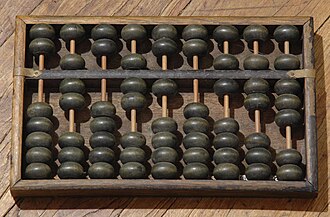
Even though the book’s name is sometimes translated as "The Book of the Abacus", it does not really talk about the abacus as a tool for counting. Back then, the word "abacus" just meant any kind of calculation. The book actually teaches ways to do math without using an abacus.
Summary of sections
The first section talks about the Hindu–Arabic numeral system. It shows how to do arithmetic and change between different number systems. It also describes a way to test if a number can be broken down into smaller numbers.
The second section gives examples from business, like changing money and measurements, and calculating profit and interest. The third section covers many math problems, such as the Chinese remainder theorem, perfect numbers, and special primes called Mersenne primes. It also includes formulas for adding numbers in a row and for shapes made of squares. One famous example is about how rabbit numbers grow, which leads to what we now call the Fibonacci sequence.
The fourth section explains how to find close guesses for numbers that can’t be written perfectly, like square roots. The book also has proofs using Euclidean geometry and shows methods for solving equations, influenced by an Egyptian mathematician from the 10th century.
Fibonacci's notation for fractions
In his book Liber Abaci, Fibonacci had a unique way to write fractions, different from today’s method. He would place the fraction to the left of the whole number. For example, he wrote "1 3 2" instead of "2 1/3".
Fibonacci also had a special way to write several numbers together to show a sum of fractions. For instance, he might write "1 4 1 3 2" to mean the same as "2 7/12". This made calculations simpler, especially when working with units like yards, feet, and inches.
Modus Indorum
In his book Liber Abaci, Fibonacci introduced a new way of writing numbers called the Modus Indorum (the method of the Indians). Today, we know this as the Hindu–Arabic numeral system or base-10 positional notation. He also showed digits that look like the Arabic numerals we use today.
Fibonacci learned about this method during his travels to places like Egypt, Syria, Greece, Sicily, and Provence. He thought this way of writing numbers was better than the Roman numerals used in Europe at the time, because it made math easier. By teaching this method, Fibonacci helped people do math more easily. It took many years for this system to become widely used across Europe. It wasn’t until the later part of the 16th century, with the help of printing, that the Hindu-Arabic system became common everywhere.
Textual history
The book was first written in 1202, but no copies are known today. A newer version came out in 1228. There are at least nineteen old copies with parts of the book. Three full versions exist from the 1200s and 1300s. There are also nine incomplete copies from that time, and maybe more that haven’t been found yet.
The book wasn’t printed until 1857. The first full English translation came in 2002.
Related articles



This article is a child-friendly adaptation of the Wikipedia article on Liber Abaci, available under CC BY-SA 4.0.
Images from Wikimedia Commons. Tap any image to view credits and license.