 Safekipedia
March on Washington
Adapted from Wikipedia · Adventurer experience
The March on Washington for Jobs and Freedom, commonly known as the March on Washington, was a large gathering in Washington, D.C. on August 28, 1963. People gathered to ask for equal rights and better jobs for African Americans. It was a very important event in the civil rights movement.
Many famous singers like Mahalia Jackson and Marian Anderson performed, and leaders gave speeches. The most remembered speech was by Martin Luther King Jr., who stood in front of the Lincoln Memorial and shared his dream of a world without racism or racial segregation.
The march was organized by Bayard Rustin and A. Philip Randolph. They brought together many groups to support the idea of "jobs and freedom." About 250,000 people attended, making it one of the largest political rallies in U.S. history. The event helped lead to important laws, like the Civil Rights Act of 1964 and the Voting Rights Act of 1965.
Background
Main article: Civil rights movement
African Americans were freed from slavery and given the right to vote after the American Civil War. But they still faced unfair rules and treatment, especially in the South. These rules were called Jim Crow laws. They stopped black people from voting and treated them poorly.
In the 1960s, leaders of the civil rights movement planned a big march in Washington, D.C. They wanted to ask for equal rights for everyone. Small marches like this had happened before, in the 1940s. The big march in 1963 took place when many people were protesting for change. It also happened just before new laws were about to be made to protect people's rights.
Planning and organization
A. Philip Randolph and Bayard Rustin began planning the March on Washington in December 1961. They wanted to focus on jobs and asked for a public works program to help black people find work. In early 1963, they announced plans for a big march on Washington for jobs.
In June 1963, leaders from different groups formed the Council for United Civil Rights Leadership. This group included important figures like Martin Luther King Jr. and Roy Wilkins. They worked together to organize the march and set goals like passing civil rights laws, ending school segregation, and creating jobs for unemployed people.
The march aimed to bring attention to civil rights and economic issues. Organizers planned carefully, with Bayard Rustin handling details and many volunteers helping. Despite some disagreements, the group worked together for these important goals.
Convergence
Many people came to Washington, D.C., on August 28, 1963, for the March on Washington. They traveled by road, rail, and air from cities such as Boston, Milwaukee, Little Rock, and St. Louis. Some participants took long bus rides, with one group from Birmingham, Alabama, traveling a great distance. Despite worries, the trip was peaceful, and many sang songs of freedom during the ride.
The event needed careful planning for safety. Police officers, National Guard members, and soldiers were there to keep everyone safe. Hospitals were ready for any emergencies, and liquor sales were stopped in Washington, D.C., for the day. The march was held at the Lincoln Memorial so that everyone could hear the speeches and music.
March
The March on Washington for Jobs and Freedom happened on August 28, 1963, in Washington, D.C. It was a large gathering where many people came together to support equal rights and fair jobs for African Americans. The march was shown on television, which made it very famous. People traveled by bus, train, and plane to join.
The march began at the Washington Monument and finished at the Lincoln Memorial. Famous speakers and musicians shared their words and music there. Even though some people were nervous, the event stayed peaceful. Many participants held signs with messages about freedom and equality.
Speakers
Leaders from different groups spoke to the crowd at the Lincoln Memorial during the March on Washington. They came from civil rights groups, religious groups, and labor unions.
No women were among the official speakers. But dancer and actress Josephine Baker spoke earlier in the day.
The speakers included A. Philip Randolph, Daisy Bates, Dr. Eugene Carson Blake, John Lewis, Walter Reuther, Floyd McKissick, Rabbi Uri Miller, Whitney Young, Mathew Ahmann, Roy Wilkins, Rabbi Joachim Prinz, and Dr. Martin Luther King Jr. Dr. King's "I Have a Dream" speech became famous. He spoke about ending racism in the United States.
Singers
Gospel singer Mahalia Jackson sang songs like "I've been 'buked, and I've been scorned" and "How I Got Over". Marian Anderson sang "He's Got the Whole World in His Hands", remembering her famous concert at the Lincoln Memorial in 1939.
Joan Baez led the crowd in songs such as "We Shall Overcome" and "Oh Freedom". Musician Bob Dylan performed "When the Ship Comes In" and "Only a Pawn in Their Game". Peter, Paul and Mary sang "If I Had a Hammer" and Dylan's "Blowin' in the Wind", while Odetta performed "I'm On My Way".
Celebrities
The March on Washington had many famous people who supported the cause. Well-known African American celebrities who attended included Josephine Baker, Harry Belafonte, Sidney Poitier, and Sammy Davis Jr., and others. The event also had support from white and Latino celebrities such as Tony Curtis, Paul Newman, and Marlon Brando. Judy Garland was supposed to perform but could not because of other plans.
Meeting with President Kennedy
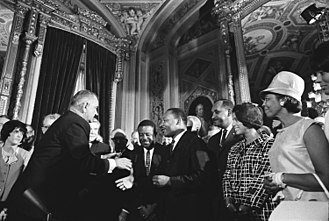
After the March on Washington, some leaders talked with President Kennedy at the White House about civil rights laws. Kennedy watched the speeches and was very impressed. The meeting had important people like Martin Luther King Jr., John Lewis, and A. Philip Randolph.
Labor leader Walter Reuther talked about helping business leaders understand why civil rights were important. The March was a success and helped Kennedy work on his civil rights bill. The meeting showed how leaders could talk with people in power to make changes.
Media coverage
The March on Washington got a lot of attention from newspapers, television, and radio. Many cameras and reporters were there to show the event to people all over the country. Some broadcasts showed parts of Dr. Martin Luther King Jr.'s famous "I have a dream" speech.
The Voice of America shared the speeches with people in other countries, translating them into many languages. The United States Information Agency also made a film about the march to show in embassies around the world. Some writers and media people did not agree with the march and said negative things about it.
Responses and memories
Many people who joined the March on Washington felt it was a very important moment in history. Some said it made them feel part of something big, like being with a huge group all moving together.
Others had mixed feelings. Some thought the march did not go far enough, while a few believed it would not bring real change. Even so, many remembered the day as special and important for the civil rights movement.
Effects and legacy
The March on Washington for Jobs and Freedom had a big impact on American history and civil rights. Many people think the march helped the government pass important laws, like the Civil Rights Act of 1964 and the Voting Rights Act of 1965. These laws worked to end segregation and give all Americans, especially African Americans, equal rights.
The march also started a tradition of big rallies in Washington, D.C., called “Marches on Washington.” Over the years, many groups have used this name for their events to get attention for their causes. In 2013, to celebrate the 50th anniversary of the original march, President Barack Obama honored one of the march’s main organizers, Bayard Rustin, with a special award. Even today, people still hold marches to support civil rights and other important issues.
Analysis
In 2013, the Economic Policy Institute made reports named "The Unfinished March." These reports checked the goals of the original March on Washington to see how much progress was made. They found that while some laws changed, many important goals like better housing, good schools, and fair jobs are still not fully reached.
Dedrick Muhammad of the NAACP said that differences in income and homeownership between racial groups have grown since 1963. He noted these differences got even bigger during the Great Recession.
Images
Related articles



This article is a child-friendly adaptation of the Wikipedia article on March on Washington, available under CC BY-SA 4.0.
Images from Wikimedia Commons. Tap any image to view credits and license.