 Safekipedia
Mechanical calculator
Adapted from Wikipedia · Adventurer experience
A mechanical calculator, or calculating machine, is a mechanical device used to do basic arithmetic automatically. It is like an analog computer or a slide rule. Most mechanical calculators were about the size of small desktop computers. They are no longer used because of the electronic calculator and the digital computer.
In 1642, Blaise Pascal made the first mechanical calculator. He made it to help his father, who was a tax collector, with difficult math work.
In 1672, Gottfried Leibniz began designing a new machine called the Stepped Reckoner. It used a special part called the Leibniz wheel. This wheel was used in many machines for over 200 years, even into the 1970s with the Curta hand calculator. It stopped being used when electronic calculators became popular in the mid-1970s.
Thomas' arithmometer was the first machine that people could buy. It was made in 1851. It was strong and reliable enough to be used every day in an office. For forty years, it was the only mechanical calculator people could buy. Then, in 1890, a new and better machine called the Odhner Arithmometer was made.
The comptometer was introduced in 1887. It was the first machine to use a keyboard with nine keys (from 1 to 9) for each digit. In 1902, the Dalton adding machine was made. It was the first to have a keyboard with ten keys. Some mechanical calculators used electric motors starting in 1901. In 1961, a machine called the Anita Mk VII was made. It was the first desktop mechanical calculator to use an all-electronic engine. This helped connect mechanical and electronic calculators. Mechanical calculators stopped being made in the middle of the 1970s. This ended an industry that had been around for 120 years.
Charles Babbage designed two kinds of mechanical calculators. They were too complicated to build during his life and needed a steam engine to work. The first was an automatic mechanical calculator called the difference engine. It could compute and print math tables by itself. In 1855, Georg Scheutz built a smaller version of this machine. The second was a programmable mechanical calculator called the analytical engine. Babbage began designing it in 1834. In 1937, Howard Aiken convinced IBM to build a machine based on this design, called the ASCC/Mark I. Some people called it "Babbage's dream come true" when it was finished.
Ancient history
Further information: Arithmetic and Abacus
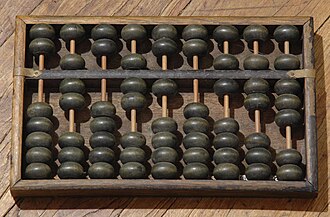
People have always wanted to save time and avoid mistakes when doing math. Early tools for counting included small objects like pebbles. These were used on boards and later became beads on wires, called an abacus. This tool was invented by ancient groups and used around the world.
Later, tools like Napier's Bones were made to help with calculations. In 1642, Blaise Pascal made the first machine that could do arithmetic by itself. Before this, there were machines like odometers and the Antikythera mechanism, which used gears to show information. But Pascal’s machine was the first true mechanical calculator.
Further information: Pascal's calculator
The 17th century
The 1600s was an important time for machines that could do math automatically. In 1642, Blaise Pascal made the first machine that could add and subtract numbers. This machine was called Pascal's calculator. It helped people do math faster because before this, all math was done by hand, which could take a long time.
Other inventors also tried to make machines for math. Wilhelm Schickard designed a machine in the 1620s that could add, subtract, multiply, and divide, but it was never finished. Later, Gottfried Leibniz improved on Pascal’s ideas and made a machine called the Stepped Reckoner. These machines were the first steps toward the calculators we use today. They showed how useful it could be to have machines do math for us.
The 18th century
Further information: Pinwheel calculator and Leibniz wheel
The 1700s was a time when people created machines to help with math. In 1709, an Italian man named Giovanni Poleni built a wooden machine that could multiply numbers by itself. This was the first machine that could do multiplication without someone repeating steps. During this time, machines could help with division, but a person still needed to decide when to stop the calculation.
Many inventors tried to make better machines. In 1727, a German man named Anton Braun showed a machine to an important leader. It could add, subtract, multiply, and divide. Other inventors, like a French craftsman named Lépine and a German pastor named Philipp Matthäus Hahn, also made their own versions of these helpful math machines. These early machines were important steps before we had modern calculators.
The 19th century
Overview
Luigi Torchi made the first machine that could multiply directly in 1834. This was also the second machine where you could press keys to make it work, after James White made one in 1822.
The mechanical calculator industry began in 1851 when Thomas de Colmar released his simpler Arithmomètre. This was the first machine that people could use every day in an office. For 40 years, the arithmometer was the only mechanical calculator people could buy, and it was sold all over the world. By 1890, about 2,500 arithmometers had been sold, along with a few hundred more from two other companies that made copies of it.
The 19th century also saw designs by Charles Babbage for calculating machines. First, he started work on his difference engine in 1822. This was the first calculator that could use the results of one operation for the next one. Later, he began work on his analytical engine in 1834. This was the first programmable calculator and it showed the ideas that would later be used in mainframe computers in the middle of the 20th century.
Desktop calculators produced
In 1851, Thomas de Colmar made his arithmometer simpler by taking out the part that multiplied by one digit. This made it easier to use for adding, but it could still multiply and divide because of its moving part. The arithmometer was now made to work well with the tools people had at the time, so Thomas could make machines that were strong and reliable. He printed manuals and gave each machine a number. Selling these machines started the mechanical calculator industry. Banks, insurance companies, and government offices began using the arithmometer for their everyday work, and slowly, mechanical desktop calculators became common in offices.
In 1878, a company in Germany named Burkhardt made a copy of Thomas' arithmometer. Before this, Thomas de Colmar was the only person making these machines, and he had made about 1,500 of them. Eventually, twenty European companies made copies of Thomas' arithmometer until World War II.
Dorr E. Felt in the U.S. created the Comptometer in 1886. It was the first machine where pressing the keys would do the calculating, without needing to turn a handle or move a lever. In 1887, he joined with Robert Tarrant to form the Felt & Tarrant Manufacturing Company. The comptometer-type calculator was later made with all-electronic parts in 1961, in a machine called the ANITA mark VII made by Sumlock comptometer in the UK.
In 1890, W. T. Odhner got the rights to make his calculator again from a company that had held them since 1878 but had not made any. Odhner used his workshop in Saint Petersburg to make his calculator and sold 500 machines in 1890. He kept making them until 1918, when he had produced 23,000 machines. The Odhner Arithmometer was a new version of Thomas de Colmar's Arithmometer, with a pinwheel inside, which made it cheaper to make and smaller, but it still worked the same way for the user.
In 1892, Odhner sold the Berlin part of his factory to a company called Grimme, Natalis & Co. They moved the factory to Braunschweig and sold their machines under the name Brunsviga. This was the start of many companies making and selling copies of Odhner's machine all over the world; millions were sold until the 1970s.
In 1892, William S. Burroughs began making his printing adding calculator, and his company Burroughs Corporation became one of the top companies for accounting machines and computers.
The "Millionaire" calculator came out in 1893. It could multiply directly by any number — you turned the handle once for each digit in the number you were multiplying by. It had a special part that looked up the results of multiplication, giving the right numbers for units and tens. Another machine that could multiply directly was part of the Moon-Hopkins billing machine; that company was bought by Burroughs later on.
Automatic mechanical calculators
In 1822, Charles Babbage showed a small group of gears that worked like his difference engine. This machine could hold and work with seven numbers, each with 31 digits, and it could use the results from one operation for the next one. It was the first machine that could work by itself and the first to print its results. Work on this machine, later called "Difference Engine No. 1," stopped around 1834.
In 1847, Babbage began work on a new version called "Difference Engine No. 2." Neither of these designs was fully built by Babbage. In 1991, the London Science Museum built a working Difference Engine No. 2 using plans from Babbage and the tools and materials that would have been available in the 19th century.
In 1855, Per Georg Scheutz finished a working difference engine based on Babbage's design. The machine was about the size of a piano and was shown at the Exposition Universelle in Paris in 1855. It was used to make tables of logarithms.
In 1875, Martin Wiberg made a new version of the Babbage/Scheutz difference engine that was about the size of a sewing machine.
Programmable mechanical calculators
In 1834, Babbage began designing his analytical engine, which would become the clear ancestor of modern mainframe computers. It had separate ways to put in data and programs, printers to show results, a part that did the processing (called the mill), memory (called the store), and the first set of instructions for programming. In a proposal that Howard Aiken gave to IBM in 1937 for funding the Harvard Mark I, which became IBM's first computer, he wrote: "Few calculating machines have been designed strictly for use in scientific work, except for those of Charles Babbage and others who followed him. In 1812 Babbage had the idea of a calculating machine more advanced than those made before, to be used for calculating and printing tables of mathematical functions.... After stopping work on the difference engine, Babbage focused on designing and building an analytical engine with much more power than the difference engine..."
In 1843, while translating a French article about the analytical engine, Ada Lovelace wrote an algorithm to find the Bernoulli numbers. This is considered the first computer program.
From 1872 to 1910, Henry Babbage worked on making the mill, the "central processing unit" of his father's machine. After some problems, he successfully showed it working in 1906, and it printed the first 44 multiples of pi with 29 digits.
Cash registers
The cash register was invented by an American saloon owner named James Ritty in 1879. It solved problems of disorganization and dishonesty in business by being a simple adding machine with a printer, a bell, and a display that showed both the customer and the store owner the amount of money being exchanged.
Cash registers were easy to use and, unlike real mechanical calculators, were needed and quickly used by many businesses. "Eighty four companies sold cash registers between 1888 and 1895, but only three stayed around for long."
In 1890, six years after John Patterson started NCR Corporation, his company had sold 20,000 machines, while all genuine calculators together had only sold about 3,500.
By 1900, NCR had built 200,000 cash registers and there were more companies making them than ever before, while the "Thomas/Payen" arithmometer company had sold around 3,300 machines and Burroughs had sold only 1,400.
Prototypes and limited runs
In 1820, Thomas de Colmar created the Arithmometer. It could do all four main math operations with a one-digit part for multiplying and dividing. He spent the next 30 years and 300,000 Francs developing it. This design was replaced in 1851 by a simpler arithmometer that could only add.
From 1840, Didier Roth made and patented a few calculating machines, one of which was based on Pascal's calculator.
In 1842, Timoleon Maurel invented the Arithmaurel, based on the Arithmometer, which could multiply two numbers just by putting them into the machine.
In 1845, Izrael Abraham Staffel showed a machine that could add, subtract, divide, multiply, and find square roots.
Around 1854, Andre-Michel Guerry invented the Ordonnateur Statistique, a cylindrical device meant to help organize data about things like crime.
In 1872, Frank S. Baldwin in the U.S. invented a pinwheel calculator.
In 1877, George B. Grant in Boston, United States, began making the Grant mechanical calculating machine, which could add, subtract, multiply, and divide. The machine was 13x5x7 inches and had eighty moving parts made of brass and steel. It was first shown at the 1876 Centennial Exposition in Philadelphia.
In 1883, Edmondson in the United Kingdom created a circular stepped drum calculator.
1900s to 1970s
Mechanical calculators were special machines used for doing math before computers existed. They worked by moving parts inside, like gears and levers, to add, subtract, multiply, and divide numbers.
In the early 1900s, these machines became very popular. Some were operated by turning a crank, while others used electric motors. By the 1940s, small handheld calculators like the Curta were invented, fitting in one hand. Big companies such as Friden, Monroe, and SCM/Marchant made these calculators, which had full keyboards for quick entering of numbers. These machines were widely used until electronic calculators took over in the 1970s.
Images
Related articles



This article is a child-friendly adaptation of the Wikipedia article on Mechanical calculator, available under CC BY-SA 4.0.
Images from Wikimedia Commons. Tap any image to view credits and license.