 Safekipedia
Mississippi River
Adapted from Wikipedia · Adventurer experience
The Mississippi River is the primary river of the largest drainage basin in the United States. It is the second-longest river in the country. It flows for 2,340 miles (3,766 kilometers) from Lake Itasca in northern Minnesota to the Mississippi River Delta in the Gulf of Mexico.
The river passes through or touches ten states. It collects water from parts of 32 U.S. states and two Canadian provinces. This makes it very important for North America.
For thousands of years, Native Americans lived along the river. They built settlements and farmed near its banks. When Europeans arrived in the 16th century, the river became a key route for explorers and settlers. In the 19th century, it helped the United States grow westward. It also inspired many famous books, especially by Mark Twain.
Today, the Mississippi River is very important for farming, transportation, and the economy. It faces environmental challenges, such as pollution from farms. This pollution creates an area in the Gulf of Mexico where little to no life can survive.
Name and significance
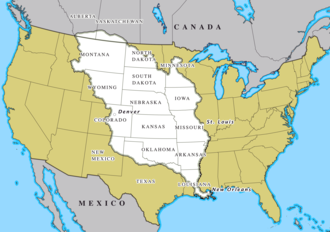
The name "Mississippi" comes from the Anishinaabe word Misi-ziibi, meaning "Great River." In the 1700s, the river became an important border for the new United States after the Treaty of Paris. Later, after the Louisiana Purchase, it divided the country into western and eastern parts. Important places are often described in relation to the river. The river is also called The Mighty Mississippi River.
Main article: Gateway Arch
Main articles: Trans-Mississippi Exposition
Divisions
The Mississippi River can be divided into three sections: the Upper Mississippi, the river from its headwaters to where it meets the Missouri River; the Middle Mississippi, which is from the Missouri River to the Ohio River; and the Lower Mississippi, which flows from the Ohio River to the Gulf of Mexico.
The Upper Mississippi runs from its headwaters to where it meets the Missouri River at St. Louis, Missouri. The source of the Upper Mississippi is Lake Itasca in Itasca State Park in Clearwater County, Minnesota. From Lake Itasca to St. Louis, Missouri, the river’s flow is controlled by 43 dams. The Upper Mississippi has many natural and artificial lakes.
The Mississippi River is called the Middle Mississippi from where the Upper Mississippi River meets the Missouri River at St. Louis, Missouri, for 190 miles (310 km) to where it meets the Ohio River at Cairo, Illinois. The Middle Mississippi flows more freely.
The Mississippi River is called the Lower Mississippi River from where it meets the Ohio River to its mouth at the Gulf of Mexico, a distance of about 1,000 miles (1,600 km). The major tributaries of the Lower Mississippi River include the Ohio River, the White River, the Arkansas River, the Big Black River in Mississippi, and the Yazoo River.
Watershed
The Mississippi River has one of the largest drainage basins in the world. Its basin covers more than 1,245,000 square miles. It includes parts of 32 U.S. states and two Canadian provinces. The water from this basin flows into the Gulf of Mexico, part of the Atlantic Ocean.
The river’s basin lies between the Rocky Mountains and the Appalachian Mountains. The highest point in this area is Mount Elbert, the tallest mountain in the Rocky Mountains, which is 14,440 feet tall. The Mississippi River travels about 2,340 miles from its source to the Gulf of Mexico.
Outflow
The Mississippi River flows out very fast, between 200 and 700 thousand cubic feet every second. It is one of the largest rivers in the world. It has about 8% of the flow of the Amazon River, the biggest river.
In the past, the river carried a lot of soil to the Gulf of Mexico. Now, it carries much less because of changes to control the river’s flow.
Near where the river meets the Gulf of Mexico, salt water from the ocean can mix with the river’s fresh water. In dry years, this salt water can move far up the river and make drinking water unsafe. Special structures were built to help keep the salt water out.
The fresh water from the Mississippi does not mix right away with the ocean’s salt water. It flows into the Gulf of Mexico and even goes as far as the coast of Georgia before mixing completely.
Course changes
The Mississippi River has changed its path many times over millions of years. Long ago, the land rose up and blocked the river. Later, as the land sank, the river found new ways to reach the Gulf of Mexico.
Sometimes the river changes its path quickly when it finds a shorter way. This has moved the river's mouth many miles over thousands of years. Big changes happened after glaciers melted. Even in recent times, the river has shifted, sometimes moving towns to new places.
Length
The Mississippi River is very long. It starts at Lake Itasca and is 2,340 miles (3,766 km) long. If you measure from the most distant source, Brower's Spring in Montana, it is even longer — 3,710 miles (5,971 km). This makes it the fourth longest river in the world, after the Nile, Amazon, and Yangtze.
Depth
The Mississippi River starts very shallow at Lake Itasca, about 3 feet deep. As it flows south, the depth changes. Near Lake Pepin, it can be up to 60 feet deep. Where the Missouri River meets the Mississippi, the depth is around 30 feet. Further down, after the Ohio River joins, the depth increases to between 50 and 100 feet. The deepest point is in New Orleans, where the river reaches 200 feet deep.
Cultural geography
State boundaries
The Mississippi River flows through or along 10 states, from Minnesota to Louisiana. It helps define parts of the borders between these states. Wisconsin, Illinois, Kentucky, Tennessee, and Mississippi lie on the east side of the river, while Iowa, Missouri, and Arkansas are on the west side. Large parts of Minnesota and Louisiana are on both sides of the river.
When the borders were set, the middle of the river was used as the boundary line. Even though the river has moved since then, the borders have stayed the same. This means some small areas of one state are now on the other side of the river.
Major communities along the river
All communities along the river
Notable towns and cities are listed from the river’s source at Lake Itasca to where it meets the Gulf of Mexico.
Bridge crossings
See also: List of crossings of the Upper Mississippi River and List of crossings of the Lower Mississippi River
The earliest bridge across the Mississippi was built in 1855 in Minneapolis, where the Hennepin Avenue Bridge stands today. The first railroad bridge was built in 1856 between Rock Island, Illinois, and Davenport, Iowa. Some famous bridges include:
- Stone Arch Bridge – A former railroad bridge now for walking in Minneapolis.
- I-35W Saint Anthony Falls Bridge – Built in 2008 after an older bridge collapsed.
- Eisenhower Bridge (Mississippi River) – Opened in 1960 in Red Wing, Minnesota.
- Eads Bridge – A famous bridge in St. Louis completed in 1874.
Many more bridges cross the river, each with its own history and design.
| Metro Area | Population |
|---|---|
| Minneapolis–Saint Paul | 3,946,533 |
| St. Louis | 2,916,447 |
| Memphis | 1,316,100 |
| New Orleans | 1,214,932 |
| Baton Rouge | 802,484 |
| Quad Cities, IA-IL | 387,630 |
| St. Cloud, MN | 189,148 |
| La Crosse, WI | 133,365 |
| Cape Girardeau–Jackson MO-IL | 96,275 |
| Dubuque, IA | 93,653 |
Navigation and flood control
Main article: List of locks and dams of the Upper Mississippi River
The Mississippi River is an important route for boats and ships. The United States Army Corps of Engineers works to keep a deep water path for travel. They started removing obstacles from the river in 1829.
The upper part of the river sometimes freezes in winter, but only in very cold years does the main channel freeze.
There are 29 special structures called locks and dams on the upper Mississippi. Most were built in the 1930s to keep the river deep enough for boats. These structures help create lakes for boating and fishing. They make the river wider and deeper but do not stop flooding. When the river gets too full, the gates open, and the dams stop working. Below the city of St. Louis, the river flows more freely but is guided by walls called levees and wing dams. These levees, built along both sides of the river, are very long and have sometimes been compared to the Great Wall of China.
In the lower part of the river, from Baton Rouge to where it meets the Gulf of Mexico, ships can travel because the river is deep enough. There are plans to make it even deeper so bigger ships can pass through.
19th century
In 1829, people studied two rocky parts of the river that made travel hard: the Des Moines Rapids and the Rock Island Rapids. The Des Moines Rapids were near the mouth of the Des Moines River in Iowa, and the Rock Island Rapids were between Rock Island and Moline, Illinois. Both were very difficult to pass.
In 1848, a canal was built to connect the Mississippi River to Lake Michigan through the Illinois River. This helped ships travel between these places. Later, in 1900, this canal was replaced with another that also helped keep Chicago’s water clean.
Work began in the 1830s to make the Des Moines Rapids deeper, but it took until 1877 to finish a canal around them. The Rock Island Rapids were still a problem until 1907 when a lock was built to go around them.
To help ships travel between St. Paul, Minnesota, and Prairie du Chien, Wisconsin, several dams were built on lakes near the river’s beginning. These dams stored extra water and released it when the river was low.
20th century
In 1907, plans were made to make the river deeper, but this was stopped in the late 1920s in favor of a deeper channel.
In 1913, the first dam below a major waterfall was finished at Keokuk, Iowa. It made electricity for things like streetcars in St. Louis. Another dam was finished in Minneapolis in 1917, and a third near Hastings, Minnesota was done in 1930.
Before a big flood in 1927, the strategy was to close side channels to make the main river flow faster. But the flood showed this was not safe.
In the 1930s, new locks and dams were built to keep a deep channel for ships.
In the 1950s, scientists found that the Mississippi River was slowly changing its path to a different river called the Atchafalaya River. To stop this, Congress approved a project to keep the river in its current path. This project was finished in 1986.
21st century
Today, special areas are used to divert extra water during floods, protecting cities like Baton Rouge and New Orleans. Some of the old methods from before 1927 are still used to help reduce flooding.
History
A long time ago, about 50,000 years ago, a big sea covered the central United States. The Mississippi River and its smaller rivers drained this water into the Gulf of Mexico, making new floodplains and stretching the land further south. This left very rich soil in places like Louisiana.
The area around the Mississippi River was first home to Native American peoples who hunted and gathered. They grew plants on purpose, like sunflowers, plants like goosefoot, marsh elder, and squash, as early as 4,000 years ago. Over time, they built shelters, made pottery, and weaving.
Later, between about 200 and 500 years ago, a network of trade routes called the Hopewell interaction sphere spread ideas along the rivers from the Gulf of Mexico to the Great Lakes. After this, smaller communities lived in the area, and farming grew, especially with crops like corn, beans, and squash from Mesoamerica. By around 800 years ago, a society called the Mississippian culture developed, with big towns and leaders.
One of the biggest towns was Cahokia, which had many people at its peak, even bigger than London at the time. When Europeans first arrived, many of these towns had broken up.
Europeans first reached the Mississippi River in 1519. In 1541, Spanish explorer Hernando de Soto reached the river and called it Río del Espíritu Santo. French explorers Louis Jolliet and Jacques Marquette explored the river in the 1600s. In 1682, French explorers claimed the river valley for France.
After Britain won a war, the Mississippi became the border between British and Spanish lands. The Treaty of Paris in 1763 gave Britain land east of the Mississippi and Spain land to the west. Later, the U.S. bought this land in the Louisiana Purchase of 1803.
Control of the river was very important during a big war. The Union wanted to control the river to help them win. They took key places like Memphis, New Orleans, and Vicksburg.
In more recent times, the river has faced big floods, like the flood of 1927 and the flood of 1993. People have built levees and other structures to control the river.
Recreation
Water skiing started on the Mississippi River between Minnesota and Wisconsin, at a place called Lake Pepin. Ralph Samuelson from Lake City, Minnesota invented and improved the sport in 1922. He also did the first water ski jump in 1925, pulled by a flying boat going fast.
There are seven special places cared for by the National Park Service along the Mississippi River. The Mississippi National River and Recreation Area works to protect the river. The other six sites are Effigy Mounds National Monument, Gateway Arch National Park, Vicksburg National Military Park, Natchez National Historical Park, New Orleans Jazz National Historical Park, and Jean Lafitte National Historical Park and Preserve.
Ecology
Further information: Mississippi River System § Ecology
The Mississippi River basin is home to many different kinds of water animals and has been called the "mother fauna" of North American freshwater.
Fish
About 375 different fish live in the Mississippi basin. Some special fish found here include paddlefish, sturgeon, gar, and bowfin. The Upper Mississippi River alone has around 120 fish species, such as walleye, largemouth bass, smallmouth bass, northern pike, bluegill, crappie, channel catfish, and shovelnose sturgeon.
Other fauna
The river and its surrounding areas are also home to many reptiles, including American alligators and different kinds of turtles. There are also many amphibians and crayfish. In addition, about 40% of the migratory birds in the United States use the Mississippi River during their travels in spring and fall. Even more — 60% of all migratory birds in North America — use the river basin as a path for their journeys.
Introduced species
Many animals that are not native to the area have been found in the Mississippi River. Some of these can cause problems. For example, Asian carp, including silver carp, have spread through much of the basin. The Minnesota Department of Natural Resources has noted that zebra mussels and Eurasian watermilfoil are also present in parts of the river.
Images
Related articles


This article is a child-friendly adaptation of the Wikipedia article on Mississippi River, available under CC BY-SA 4.0.
Images from Wikimedia Commons. Tap any image to view credits and license.