 Safekipedia
Moscow Mathematical Papyrus
Adapted from Wikipedia · Adventurer experience
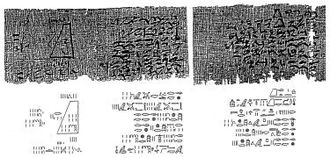
The Moscow Mathematical Papyrus, also named the Golenishchev Mathematical Papyrus after its first non-Egyptian owner, Egyptologist Vladimir Golenishchev, is an ancient Egyptian mathematical papyrus with many problems in arithmetic, geometry, and algebra. Golenishchev bought the papyrus in 1892 or 1893 in Thebes. It is now in the Pushkin State Museum of Fine Arts in Moscow, where it stays today.
Based on the writing style of the hieratic text, experts think the papyrus was most likely written in the 13th Dynasty and based on older work from the 12th Dynasty of Egypt, around 1850 BC. It is about 5.5 m (18 ft) long and between 3.8 and 7.6 cm (1.5 and 3 in) wide. In 1930, a Soviet Orientalist Vasily Struve split it into 25 problems with answers.
It is a famous old math book, often talked about with the Rhind Mathematical Papyrus. The Moscow Mathematical Papyrus is older, but the Rhind Mathematical Papyrus is bigger.
Exercises contained in the Moscow Papyrus
The Moscow Papyrus has many math problems, not in any special order. It is well-known for its geometry questions. Examples include finding the surface area of a rounded shape and the space inside a cut-off pyramid. Other problems involve parts of ships, puzzles with unknown numbers, and measuring how strong bread or beer is made from grain.
Some problems ask about how much work can be done. For example, they figure out how many smaller logs equal a certain number of bigger logs. Or they calculate how many sandals a shoe maker can finish. These exercises show the smart math skills of ancient people.
Main article: Rhind Mathematical Papyrus
Further information: Egyptian algebra
Two geometry problems
The Moscow Mathematical Papyrus has two fun geometry problems.
Problem 10 asks how to find the surface area of a special round shape, like half of a ball. The ancient Egyptians used a step-by-step way to figure this out.
Problem 14 shows how to find the space inside a cut-off pyramid. The top and bottom are flat squares of different sizes. The Egyptians used a clear way to solve this, and their answer matches what we know today.
Summary
The Moscow Mathematical Papyrus is an old Egyptian paper with many math problems. It has questions about counting, shapes, and solving equations. People study it to learn how people in the past did math.
Numbers in the papyrus show fractions, like one-fourth, which they used in their calculations.
| No. | Detail |
|---|---|
| 1 | Damaged and unreadable. |
| 2 | Damaged and unreadable. |
| 3 | A cedar mast. 3 ¯ 5 ¯ {\displaystyle {\bar {3}}\;{\bar {5}}} of 30 = 16 {\displaystyle 30=16} . Unclear. |
| 4 | Area of a triangle. 2 ¯ {\displaystyle {\bar {2}}} of 4 × 10 = 20 {\displaystyle 4\times 10=20} . |
| 5 | Pesus of loaves and bread. Same as No. 8. |
| 6 | Rectangle, area = 12 , b = 2 ¯ 4 ¯ l {\displaystyle =12,b={\bar {2}}\;{\bar {4}}l} . Find l {\displaystyle l} and b {\displaystyle b} . |
| 7 | Triangle, area = 20 , h = 2 2 ¯ b {\displaystyle =20,h=2\;{\bar {2}}b} . Find h {\displaystyle h} and b {\displaystyle b} . |
| 8 | Pesus of loaves and bread. |
| 9 | Pesus of loaves and bread. |
| 10 | Area of curved surface of a hemisphere (or cylinder). |
| 11 | Loaves and basket. Unclear. |
| 12 | Pesu of beer. Unclear. |
| 13 | Pesus of loaves and beer. Same as No. 9. |
| 14 | Volume of a truncated pyramid. V = ( h / 3 ) ( a 2 + a b + b 2 ) {\displaystyle V=(h/3)(a^{2}+ab+b^{2})} . |
| 15 | Pesu of beer. |
| 16 | Pesu of beer. Similar to No. 15. |
| 17 | Triangle, area = 20 , b = ( 3 ¯ 15 ¯ ) h {\displaystyle =20,b=({\bar {3}}\;{\bar {15}})h} . Find h {\displaystyle h} and b {\displaystyle b} . |
| 18 | Measuring cloth in cubits and palms. Unclear. |
| 19 | Solve the equation 1 2 ¯ x + 4 = 10 {\displaystyle 1\;{\bar {2}}x+4=10} . Clear. |
| 20 | Pesu of 1000 loaves. Horus-eye fractions. |
| 21 | Mixing of sacrificial bread. |
| 22 | Pesus of loaves and beer. Exchange. |
| 23 | Computing the work of a cobbler. Unclear. Peet says very difficult. |
| 24 | Exchange of loaves and beer. |
| 25 | Solve the equation 2 x + x = 9 {\displaystyle 2x+x=9} . Elementary and clear. |
Other papyri
Other mathematical texts from Ancient Egypt include:
- Berlin Papyrus 6619
- Egyptian Mathematical Leather Roll
- Lahun Mathematical Papyri
- Rhind Mathematical Papyrus
General papyri:
- Papyrus Harris I
- Rollin Papyrus
For the 2/n tables see:
Related articles


This article is a child-friendly adaptation of the Wikipedia article on Moscow Mathematical Papyrus, available under CC BY-SA 4.0.
Images from Wikimedia Commons. Tap any image to view credits and license.