 Safekipedia
Philip Galle
Adapted from Wikipedia · Adventurer experience
Philips Galle, also known as Philip Galle, was a Dutch publisher. He lived from 1537 until he died in March 1612. He is most famous for publishing old master prints. He also worked as a designer and engraver, making detailed images for these prints.
One of his biggest contributions was publishing reproductive engravings. These engravings copied famous paintings. They let more people see and enjoy these artworks. Thanks to Galle’s work, many beautiful pieces of art could be shared with many people.
Life
Philip Galle was born in Haarlem in the Netherlands. He learned engraving from a famous artist named Dirck Volkertsz. Coornhert. In 1569, he married Catharina van Rollant, and they had five children who also became artists: Theodoor, Cornelis, Philips II, Justa, and Catharina.
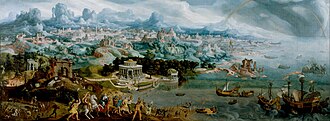
Galle made many beautiful prints based on paintings by famous artists like Maarten van Heemskerck. He started his own printing business in Haarlem in 1563. Later, he moved to Antwerp around 1570. There, he took over a printing press and became a successful publisher. He made many prints based on works by other artists and taught many students who became famous engravers. His family continued his business for many years.
Writings
Philip Galle lived in Antwerp and saw many events of the Eighty Years War. One big event he saw was the siege and looting of the town in 1576 by the Spaniards, called "The Spanish Fury." Galle wrote a short book about these events, called Cort Verhael, which was published around the end of 1578. This book had maps and was dedicated to archduke Matthias of Austria, a relative of the king Philip II of Spain. Later, another print was dedicated to Jean de Bourgogne, lord of Froidmont or Fromont. The book was translated into several languages and shows that Galle wanted peace and stayed away from the fights and politics of his time.
Death
He died in Antwerp in March 1612.
Images
Related articles


This article is a child-friendly adaptation of the Wikipedia article on Philip Galle, available under CC BY-SA 4.0.
Images from Wikimedia Commons. Tap any image to view credits and license.