 Safekipedia
Philolaus
Adapted from Wikipedia · Adventurer experience
Philolaus was a Greek philosopher who lived a long time ago, around 470 to 385 BC. He was born in a Greek colony in Italy and later moved to Greece. Philolaus was a Pythagorean and a pre-Socratic philosopher. This means he followed the ideas of Pythagoras and thought about big questions before Socrates.
Philolaus was very important in the Pythagorean school. Pythagoras started a school where people studied math and mystery together. Most of what we know about Pythagorean ideas about space comes from Philolaus. Some people think he was the first to write down these beliefs. He might have been the leader after Pythagoras.
Philolaus had interesting ideas about the universe. He believed that everything is built on two things: the limiting and the limitless, which come together in harmony. He also thought that the Earth was not at the center of everything. This idea was one of the earliest thoughts about heliocentrism, the belief that the Sun, not the Earth, is at the center of the universe. Philolaus talked about a Central Fire in the middle of everything, with spheres—including the Sun—moving around it.
Biography
Philolaus was a Greek philosopher from a place in Southern Italy. These places were called Magna Graecia. He later moved to Greece. Plato wrote that Philolaus taught two students named Simmias and Cebes around the year 399 BC. This means he lived around the same time as Socrates.
Later writers shared more stories about Philolaus, but they are not very reliable. Some say he studied under a teacher named Aresas. One writer, Diogenes Laërtius, said that Plato visited Italy and met Philolaus. Philolaus had many students, including Xenophilus, Phanto, Echecrates, Diocles, and Polymnastus.
Writings
Pythagoras and his early followers did not write down their ideas. But Philolaus is known for being the first to write about the Pythagorean doctrines. Some sources say he wrote one book, while others mention three books. It’s possible that one big work was split into three parts.
Plato, a famous philosopher, is said to have obtained a copy of Philolaus’s book. One of Philolaus’s works was called On Nature. This book talked about the universe and how everything is connected through numbers, which was a key idea in Pythagorean thinking. Historians believe some pieces of Philolaus’s writing have survived, giving us clues about his thoughts on nature and the cosmos.
Philosophy
See also: Pythagoreanism § Music and harmony, and Pythagorean astronomical system
Philolaus believed that two ideas—limit and the unlimited—are important in everything. He thought all things come from a mix of these ideas. If everything were only unlimited, we could never know anything.
He saw the universe as a harmony where these ideas come together. Philolaus was one of the first to suggest that the Earth does not stay still at the center of the universe. Instead, he imagined a central fire with many heavenly bodies moving around it. These included the stars, planets, Sun, Moon, Earth, and a special hidden body he called the Counter-Earth.
His ideas were new for his time and influenced later thinkers, even though some details are still unclear.
Related articles
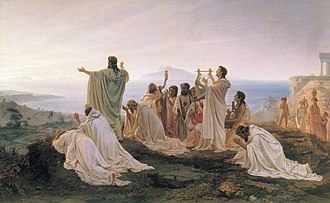


This article is a child-friendly adaptation of the Wikipedia article on Philolaus, available under CC BY-SA 4.0.
Images from Wikimedia Commons. Tap any image to view credits and license.