 Safekipedia
Philosophiæ Naturalis Principia Mathematica
Adapted from Wikipedia · Adventurer experience
Main article: History of calculus
Philosophiæ Naturalis Principia Mathematica (English: The Mathematical Principles of Natural Philosophy), often called simply the Principia (/prɪnˈsɪpiə, -ˈkɪp-/), is a book by Sir Isaac Newton. In this book, Newton explains Newton's laws of motion and his law of universal gravitation. He wrote it in Latin, and it has three volumes. The Principia was first shared with the world in 1687. Before it was released, Samuel Pepys, the President of the Royal Society, approved it.
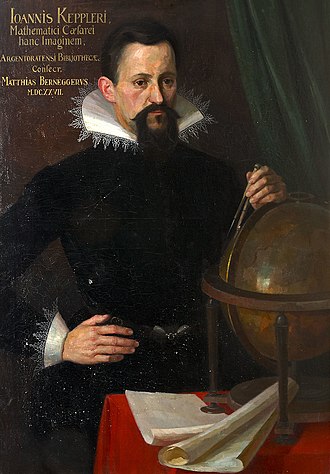
This important book helped start classical mechanics and is one of the greatest works in the history of science. Newton used special math methods that are now called calculus. He showed his ideas using geometric shapes. He also explained why planets move as they do, supporting Johannes Kepler's laws of planetary motion.
Newton’s work showed that he did not just guess about nature. He used real observations. The Principia remains a key part of science history. It shows how one person’s ideas can help us understand the universe.
Contents
The Principia explains how objects move and the forces that affect their motion. Newton wrote it in Latin, and it has three main parts.
Book 1 looks at how objects move without any resistance, like in space. It talks about forces pulling objects toward each other and how this creates paths such as ellipses. This book also begins to explore the tricky problem of how three objects, like the Sun, Earth, and Moon, affect each other's motion.
Book 2 examines how objects move through materials that offer resistance, like air or water. Newton tested ideas about how resistance changes with speed and used experiments with pendulums to learn more about air resistance.
Book 3 applies the ideas from the earlier books to the Solar System. It explains the orbits of planets and moons, the pull of gravity between them, and phenomena like tides and the slow shift in the stars called the precession of the equinoxes. Newton also used this book to support the idea that the Sun, not the Earth, is at the center of our solar system.
Rules of Reason
In his book Philosophiæ Naturalis Principia Mathematica, Sir Isaac Newton included a section called "Rules of Reasoning in Philosophy" starting from the second edition in 1713. These rules help scientists understand nature by using careful observations and logical thinking.
Newton's four rules guide scientists to use only true and needed explanations, to use the same causes for similar effects, to recognize qualities that all bodies share, and to trust conclusions drawn from many observations until new information appears. These ideas became important for modern science.
The General Scholium is an essay Newton added in later editions. He used it to talk about his ideas about gravity, saying that while gravity exists, its cause was still unknown. He also talked about the design of the universe as evidence of a creator.
Main article: General Scholium
Publishing the book
Edmond Halley helped Isaac Newton write and publish his important book, Philosophiae Naturalis Principia Mathematica. In 1684, Halley talked with Newton about how planets move. This inspired Newton to begin writing the book. Newton sent Halley a paper called De motu corporum in gyrum in 1684. This paper had early ideas that were later used in the Principia.
The first edition of the Principia was published in 1687. Halley paid for the printing himself. Newton made changes for new editions in 1713 and 1726. Halley’s support was very important in sharing Newton’s work with the world.
Historical context
Further information: History of gravitational theory
Nicolaus Copernicus changed how we see the universe by showing that Earth is not at the center. This happened in 1543. Johannes Kepler later found that planets move in elliptical orbits around the Sun and that their speeds change in a special way. These discoveries helped us learn more about how objects move in space.
Isaac Newton used these earlier ideas. While at Cambridge, he created new math and studied light and color. He also looked at how objects move, like when they bump into each other or go around a planet. Newton’s work on these topics grew when he talked with other scientists, and this led to his famous book.
Location of early edition copies
Many copies of the first edition of Newton's Principia still exist today. Important libraries that have these copies include the Cambridge University Library, which has Newton's own copy with notes. The Folger Shakespeare Library in Washington, D.C. has both a first and second edition. Other libraries with copies are the Huntington Library in San Marino, California and the Uppsala University Library in Sweden.
In 2016, a first edition sold for $3.7 million, showing how valuable it is. The second edition had 750 copies printed, and the third edition had 1,250 copies.
Later editions
Two later versions of the Principia were made by Newton. The second version came out in 1713. Newton was asked to update his work because the first version was hard to find and very costly. Richard Bentley and Roger Cotes helped with this new version, making many big changes.
The third version was made in 1726, when Newton was 80 years old. It was made ready by Henry Pemberton. After that, French scholars made very careful copies of this version. Émilie du Châtelet also turned the Principia into French, so more people could read it.
Translations
The Principia has been translated into English four times. The first translation was done by Andrew Motte in 1729. It helps us see Newton's original ideas clearly.
In 1999, I. Bernard Cohen, Anne Whitman, and Julia Budenz made a new modern English version. Another translation by Ian Bruce is on his website.
The most recent translation was done by Charles Leedham-Green in 2021. He worked on it for twenty years to make Newton’s ideas easier for scientists today.
Dana Densmore and William H. Donahue also translated the main ideas in 1996. They added explanations to help students learn.
Legacy
The Principia changed science a lot. Many smart people liked it very much. Alexis Clairaut said it helped physics grow. Joseph-Louis Lagrange called it one of the greatest books ever written. Pierre-Simon Laplace said it was the best work humans have ever made.
A study in 2020 found more copies of the first edition than people expected. This shows the Principia had a bigger effect on science than we thought before.
Varia
In 1977, the spacecraft Voyager 1 and Voyager 2 left Earth. They carried a picture of a page from Newton's Principia Mathematica. This was part of the Golden Record, a special collection of messages for space travelers.
In 2014, British astronaut Tim Peake named his mission to the International Space Station Principia. He did this to honor Britain's greatest scientist. The mission launched on December 15, 2015, aboard Soyuz TMA-19M.
Images
Related articles


This article is a child-friendly adaptation of the Wikipedia article on Philosophiæ Naturalis Principia Mathematica, available under CC BY-SA 4.0.
Images from Wikimedia Commons. Tap any image to view credits and license.