
Planetary nebula
A planetary nebula is a glowing cloud of gas that comes from stars like our Sun at the end of their lives. These stars, called red giant stars, send off their outer layers, making a shiny shell of light around the hot core left behind. Even though we call them "planetary," they are not related to planets. Long ago, astronomers thought they looked like planets through their telescopes, and the name stayed.
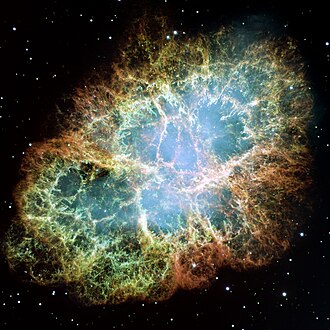
These glowing clouds only last for a short time—maybe a few thousand years—compared to the long life of a star. The Hubble Space Telescope has shown us that planetary nebulae come in many amazing shapes and colors, from round balls to complex patterns. Scientists think that binary stars, winds, and magnetic fields may help create these different shapes.
Planetary nebulae are important because they spread new materials into space, helping to build new stars and planets. One day, our own Sun will become a planetary nebula, sharing its elements with the Milky Way galaxy.
Observations
The first planetary nebula ever found was the Dumbbell Nebula in the constellation of Vulpecula. It was seen by Charles Messier in 1764 and listed as M27 in his catalogue of fuzzy objects in the night sky. Early astronomers thought these objects looked like planets through their telescopes, which is why they are called "planetary" nebulae, even though they are not planets.
Later, scientists used special tools to study the light from these nebulae. They found that the light showed patterns that helped them learn what these objects are made of. These nebulae are the remains of old stars that have thrown off their outer layers. Today, with better telescopes, we can see that planetary nebulae often have very beautiful shapes.
Origins
Stars that are not too big or too small end their lives by making glowing clouds called planetary nebulae. These stars spend most of their time turning hydrogen into helium, which keeps them stable for millions or billions of years.
When the hydrogen runs out, the star grows bigger and cooler, becoming a red giant. Then, the star grows bigger again and throws a lot of its material into space. When the hot core shines with bright ultraviolet light, it makes the gas around it glow, forming a planetary nebula.
Lifetime
After a star finishes a certain stage of its life, it begins a new phase called a planetary nebula. During this time, gases are pushed away from the star. The remaining star gets very hot and then slowly cools down. Eventually, it becomes what is known as a white dwarf. The gas cloud spreads out and fades away. This whole process takes about 10,000 years.
Role in galactic enrichment
Planetary nebulae help galaxies by adding heavier elements. As stars get older, they make heavier elements through nuclear fusion. They then blow these elements into space with strong winds. These winds send elements like carbon, nitrogen, and oxygen into the space between stars, adding to the Milky Way's supply of these materials.
When new stars form from this enriched material, they have more of these heavier elements. Even though these elements are only found in small amounts, they affect how stars change and react over time. The first stars in the universe had fewer of these heavier elements.
Characteristics
A planetary nebula is a glowing shell of gas. It comes from stars called red giants at the end of their lives. These nebulae are usually about one light year wide. They are made of very thin gas. The gas is heated by the hot star in the center.
Only about 20% of these nebulae are perfectly round. They can have many different shapes. Some look like rings or have two lobes. Others are irregular. Scientists think the shapes might be influenced by magnetic fields or by companion stars orbiting the central star. These nebulae are found mostly in the plane of the Milky Way, especially near the Galactic Center.
Membership in clusters
Planetary nebulae have been found in four globular clusters: Messier 15, Messier 22, NGC 6441 and Palomar 6. Scientists think they might also be in globular clusters in the galaxy M31.
Only one planetary nebula, PHR 1315-6555, has been found in an open cluster named Andrews-Lindsay 1.
Usually, planetary nebulae come from stars that are a little bigger or smaller than the Sun. But finding them in open clusters is hard. This is because this phase only lasts a few thousand years, and open clusters often break apart after much longer.
Current issues in planetary nebula studies
Scientists are trying to learn more about how far away planetary nebulae are. The Gaia mission is helping by measuring distances using a method called parallactic distances. Another way is to watch how fast these glowing clouds spread out. By comparing how quickly they expand with their speed, scientists can figure out how far away they are.
One big question is why planetary nebulae have different shapes. Some think it’s because material leaves the star at different speeds. Others believe that stars orbiting each other, called binary stars, might create more unusual shapes. Scientists also study the amount of elements called metals in these clouds, but sometimes their methods don’t agree. They are still trying to find out why this happens.
Pictures
Keep exploring



This article is a child-friendly adaptation of the Wikipedia article on Planetary nebula, available under CC BY-SA 4.0.
Images from Wikimedia Commons. Tap any image to view credits and license.