 Safekipedia
Propulsion
Adapted from Wikipedia · Adventurer experience
Propulsion
Propulsion is the way objects move by using force to push or pull themselves forward. This force can come from many different sources and can make things move in many ways. The word "propulsion" comes from Latin words meaning "to drive forward."
In nature, animals use their muscles and body parts like wings, fins, or legs to move. Birds use their wings to fly, fish use their fins to swim, and humans use their legs to walk or run. These are all examples of biological propulsion.
In technology, machines use engines or motors to create movement. Cars use engines to turn wheels, airplanes use jet engines to move propellers or nozzles, and boats use engines to turn propellers in the water. These machines may also need extra parts like clutches or gearboxes to connect the engine to the wheels, propellers, or other moving parts.
Propulsion is most often thought of as making something move from one place to another, like a car driving down a road or a plane flying through the sky. But even turning or shaking can be a kind of propulsion, though we usually don’t think of it that way in everyday language.
Vehicular propulsion
Air propulsion
Main article: Powered aircraft
An aircraft propulsion system usually has an aircraft engine and something to create moving air, like a propeller or a propulsive nozzle.
Aircraft need the right amount of push to stay in the air and to speed up. When moving smoothly, the push balances the pull back, called drag. To speed up, the push needs to be more than the drag.
Some airplanes, like cargo planes, focus on using fuel wisely. Others, like fighter planes, need a lot of push to speed up fast. Modern combat aircraft often add a special part to get more push.
Ground
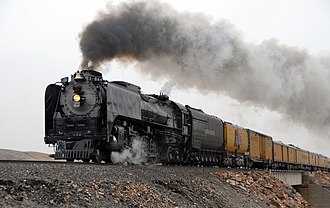
Ground propulsion helps move things on land, mostly for transportation. It usually uses an engine or motor, a gearbox, and wheel and axles.
The steam engine and internal combustion engine helped create rail vehicles and motor vehicles. The electric motor makes quieter vehicles that use less fuel.
Maglev
Main article: Maglev
Maglev uses magnetic levitation to lift and move vehicles without wheels. Magnets hold the vehicle slightly above a track, giving it a smooth and quiet ride. Maglev can speed up and slow down faster than regular trains.
Marine
Main article: Marine propulsion
Marine propulsion moves ships and boats through water. Small boats may use paddles or sails, but most big ships use engines turning a propeller. Older ships used steam engines, but today most use diesel engines or gas turbines.
Space
Main article: Spacecraft propulsion
Spacecraft propulsion helps space vehicles move. Most use a rocket engine that pushes out gas very fast to create movement. Some satellites use small thrusters to stay in the right place.
Cable
Main article: Cable car (railway)
A cable car is a vehicle pulled by a cable from a motor that isn’t on the car itself. These cars move smoothly along tracks without their own engines.
Animal
Main article: Animal locomotion
Animals move in many ways, such as running, swimming, jumping, and flying. They move to find food, find a partner, or find a good place to live, and to stay safe from danger. Moving is very important for many animals, so they have developed special ways to move better.
Animals need energy to move because they must work against things like friction, drag, inertia, and gravity. On land, animals must work against gravity, but air resistance is not as big a problem. In water, animals mainly fight against drag, and gravity is less of a worry. Some animals can stay up easily without using much energy, but others must work to stay up. In the air, animals also face drag, and birds have special shapes to help them move better. Animals without legs on land must push against the ground to move forward. This pushing follows Newton's third law of motion.
Related articles




This article is a child-friendly adaptation of the Wikipedia article on Propulsion, available under CC BY-SA 4.0.
Images from Wikimedia Commons. Tap any image to view credits and license.