 Safekipedia
Renewable energy
Adapted from Wikipedia · Adventurer experience
Renewable energy, also called green energy, is energy made from natural resources that can grow back quickly, like the sun, wind, and water. The most common types of renewable energy are solar energy, wind power, and hydropower. Other types include bioenergy and geothermal power. These energy sources can be used in both big cities and small towns, and they often work well with electricity, which can power homes, move heat, and run vehicles cleanly.
Over the past few years, renewable energy systems have become better and cheaper. Today, most new electricity comes from renewable sources. Solar and wind power are now some of the cheapest ways to make electricity in many places. The big reason to use renewable energy is to cut down on gases that cause climate change. Unlike fossil fuels, renewables make less pollution and are quieter. There are still some challenges, such as some people not wanting renewable energy projects built near them. While some say that nuclear power a renewable power source, this is debated because it relies on uranium, which is not renewable.
Overview
See also: Lists of renewable energy topics
Renewable energy sources, like solar photovoltaic and wind, are creating more and more electricity. Coal, oil, and natural gas are still the main energy sources in the world, but renewables are growing fast.
Renewable energy comes from natural processes that happen all the time. The International Energy Agency says it is "energy from natural processes that are replenished faster than they are used". Solar power, wind power, hydroelectricity, geothermal energy, and biomass are the main types of renewable energy. Renewable energy can be used for electricity generation, hot water/space heating, transportation, and energy in places far from cities.
Many countries want to limit climate change by net zero greenhouse gas emissions. This means stopping the use of fossil fuels and using energy that does not pollute. At the 2023 United Nations Climate Change Conference, many countries agreed to increase renewable energy use by 2030. The European Union wants 40% of its electricity to come from renewables by that year.
Renewable energy is found all over the world, unlike fossil fuels, which are only in a few places. It also helps health by cutting down air pollution from burning fossil fuels.
Solar and wind energy are not always available. Solar energy only works during the day and best when the sky is clear. Wind energy can change a lot. This makes it hard to stop using fossil fuels because sometimes we need more or less energy than renewables can give. In the future, energy storage will help with this problem. Using many types of renewable energy and smart grids can also help balance energy supply and demand.
Mainstream technologies
Main articles: Solar energy, Solar power, and Outline of solar energy
Solar power uses sunlight to make energy. We can use solar energy anywhere that gets sun. There are two main ways: solar thermal, which makes heat, and photovoltaics (PV), which makes electricity. PV is very common and is growing quickly.
Main articles: Wind power and Wind power by country
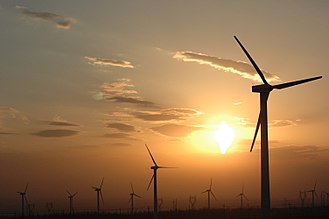
Wind power has been used for thousands of years. Today, we mostly use wind turbines to make electricity. These turbines are big and are placed where the wind is strong, like near the ocean or in high places. Wind power is growing all the time.
Main articles: Hydroelectricity and Hydropower
Hydropower uses moving water to make electricity. It is very efficient and can change quickly to give power when we need it. We can use big dams, small rivers, or other water systems to get hydropower.
Main article: Bioenergy
Bioenergy comes from plants and organic materials. We can use it for heat or turn it into fuels like ethanol and biodiesel for cars. We must use it carefully so we do not hurt forests or nature.
Main articles: Geothermal energy, Geothermal power, Renewable thermal energy, and Geothermal energy in the United States
Geothermal energy uses heat from inside the Earth to warm homes or make electricity. It works best where there is volcanic activity or where tectonic plates meet. Countries like Iceland and the United States use geothermal energy to heat homes and power buildings.
| Installed capacity and other key design parameters | Value and year |
|---|---|
| Global electricity power generation capacity | 1419.0 GW (2023) |
| Global electricity power generation capacity annual growth rate | 25% (2014-2023) |
| Share of global electricity generation | 5.5% (2023) |
| Levelized cost per megawatt hour | Utility-scale photovoltaics: USD 38.343 (2019) |
| Primary technologies | Photovoltaics, concentrated solar power, solar thermal collector |
| Main applications | Electricity, water heating, heating, ventilation, air conditioning (HVAC) |
| Installed capacity and other key design parameters | Value and year |
|---|---|
| Global electricity power generation capacity | 1017.2 GW (2023) |
| Global electricity power generation capacity annual growth rate | 13% (2014-2023) |
| Share of global electricity generation | 7.8% (2023) |
| Levelized cost per megawatt hour | Land-based wind: USD 30.165 (2019) |
| Primary technology | Wind turbine, windmill |
| Main applications | Electricity, pumping water (windpump) |
| Installed capacity and other key design parameters | Value and year |
|---|---|
| Global electricity power generation capacity | 1,267.9 GW (2023) |
| Global electricity power generation capacity annual growth rate | 1.9% (2014-2023) |
| Share of global electricity generation | 14.3% (2023) |
| Levelized cost per megawatt hour | USD 65.581 (2019) |
| Primary technology | Dam |
| Main applications | Electricity, pumped storage, mechanical power |
| Installed capacity and other key design parameters | Value and year |
|---|---|
| Global electricity generation capacity | 150.3 GW (2023) |
| Global electricity generation capacity annual growth rate | 5.8% (2014-2023) |
| Share of global electricity generation | 2.4% (2022) |
| Levelized cost per megawatt hour | USD 118.908 (2019) |
| Primary technologies | Biomass, biofuel |
| Main applications | Electricity, heating, cooking, transportation fuels |
| Installed capacity and other key design parameters | Value and year |
|---|---|
| Global electricity power generation capacity | 14.9 GW (2023) |
| Global electricity power generation capacity annual growth rate | 3.4% (2014-2023) |
| Share of global electricity generation | |
| Levelized cost per megawatt hour | USD 58.257 (2019) |
| Primary technologies | Dry steam, flash steam, and binary cycle power stations |
| Main applications | Electricity, heating |
Emerging technologies
There are other ways to make energy from nature that are still being made better. These include enhanced geothermal systems, concentrated solar power, cellulosic ethanol, piezoelectricity, and marine energy. These ways are not used a lot yet and need more work to become common.
Enhanced geothermal systems
Main article: Enhanced geothermal systems
Enhanced geothermal systems (EGS) are a new way to get heat from deep under the ground to make electricity. They break rocks far below us to let out heat that can be used for power. This could work almost anywhere, if it is not too expensive.
Sand battery
Sand batteries are big containers filled with special stones that can hold heat. They save extra energy from the sun or wind as heat. This heat can be used later to make hot water, steam, or warm air. Finland is using this idea with a large sand battery that can hold a lot of energy.
Piezoelectricity
Piezoelectricity is a way to make electricity from movement or shaking without using fuel. When some materials are pushed or bent, they make tiny electric charges. This can power small things like sensors and medical tools.
Marine energy
Main article: Marine energy
Marine energy comes from the ocean, using waves, tides, and differences in salt to make electricity. Ways to do this include wave power, marine current power, and tidal power. Tidal energy is the most ready to use, but it is still not used a lot. The biggest tidal power station is in South Korea.
Earth infrared thermal radiation
Our planet sends out a lot of heat into space. Scientists are trying to find ways to catch this heat and turn it into electricity, which could be useful when the sun is not shining.
Others
Algae fuels
Main article: Algae fuels
Scientists are trying to make fuel from special plants called algae. These algae can grow in places like empty or desert lands.
Space-based solar power
Main article: Space-based solar power
Some people have thought about putting very big solar panels in space to collect sunlight and send it to Earth. A study in 2024 said this idea is not possible right now with today’s technology.
Water vapor
People are testing a way to get electricity from tiny bits of water on metal. This could work well in places where it is very humid.
Nuclear energy
Breeder reactors could use almost all the energy in uranium or thorium, making nuclear power better. This could give a lot of energy for a very long time.
Artificial photosynthesis
Main article: Artificial photosynthesis
Artificial photosynthesis tries to copy how plants use sunlight. It uses very small tools to turn sunlight into fuels like hydrogen or methanol. This could help make clean fuels for airplanes and ships, but it still needs more work to be good enough.
Comparison of the theoretical and practical potentials of different renewable energy technologies
Global energy use in 2019 was about 65,000 terawatt-hours each year. Many renewable energy sources could help meet this need.
Solar power, wind power, and hydropower are some of the most important types. Studies show that solar and wind energy alone could give more than enough power for the whole world, many times over. Hydropower can also give a lot of energy, about one-third of what the world uses each year. Geothermal energy, which comes from heat inside the Earth, has great potential too. Other ocean-based energies like wave and tidal power have smaller but still helpful amounts of energy available.
Market and industry trends
Most new renewable energy comes from solar power. Wind, hydropower, and bioenergy are also important. Investing in renewables creates many jobs. In 2020, about 12 million people worked in renewable energy jobs around the world.
In 2021, China added the most new renewable electricity. By 2025, renewables made up almost half of all electricity generation worldwide. Solar power provided most of the new capacity that year.
Renewable energy is becoming more common everywhere. Some studies show that it’s possible to power the whole world with 100% renewable energy. Many countries now use solar water heating systems. Heat pumps are becoming popular because they can heat and cool buildings efficiently. Electric vehicles are also becoming more common as a way to reduce pollution from transportation.
| Installed TWp | Growth TW/yr | Production per installed capacity* | Energy TWh/yr* | Growth TWh/yr* | Levelized cost US¢/kWh | Av. auction prices US¢/kWh | Cost development 2010–2019 | |
|---|---|---|---|---|---|---|---|---|
| Solar PV | 0.580 | 0.098 | 13% | 549 | 123 | 6.8 | 3.9 | −82% |
| Solar CSP | 0.006 | 0.0006 | 13% | 6.3 | 0.5 | 18.2 | 7.5 | −47% |
| Wind Offshore | 0.028 | 0.0045 | 33% | 68 | 11.5 | 11.5 | 8.2 | −30% |
| Wind Onshore | 0.594 | 0.05 | 25% | 1194 | 118 | 5.3 | 4.3 | −38% |
| Hydro | 1.310 | 0.013 | 38% | 4267 | 90 | 4.7 | +27% | |
| Bioenergy | 0.12 | 0.006 | 51% | 522 | 27 | 6.6 | −13% | |
| Geothermal | 0.014 | 0.00007 | 74% | 13.9 | 0.7 | 7.3 | +49% |
Policy
Policies help countries use more renewable energy. Many places have rules to support renewable energy use. The International Renewable Energy Agency (IRENA) helps countries with this. IRENA gives advice and supports learning and sharing technology.
The 2015 Paris Agreement encouraged countries to improve their renewable energy rules. In 2017, 121 countries had some type of renewable energy policy, and 176 countries set goals for using renewable energy. Some local governments also have rules to support renewable energy. Green banks are special groups that help fund clean energy projects.
Finance
Electrified transport and renewable energy are important for fighting climate change through an energy transition. China leads in batteries and solar energy, while Europe leads in wind energy and smart grids.
The International Renewable Energy Agency says investment in renewable energy has grown since 2018. In 2022, investments reached USD 499 billion to fight climate change and improve energy security. Policies like feed-in tariffs in China and Vietnam have helped use more renewable energy. Solar and wind energy costs have dropped a lot since 2013, making them more affordable.
In 2023, investments in solar and wind energy jumped by 75% to about USD 200 billion. Renewable energy adds 1% to 4% to the GDP in places like the United States, China, the European Union, and India. The energy sector gets about USD 3 trillion each year, with USD 1.9 trillion going to clean energy. To reach Net Zero Emissions goals by 2035, this needs to grow to USD 5.3 trillion yearly.
Debates
Further information: Climate change mitigation § Overviews, strategies and comparisons of measures
Using more renewable energy changes the world in big ways. Countries that sell a lot of oil, like Qatar, Russia, Saudi Arabia, and Norway, might matter less as the world uses more clean energy. But places with lots of sun and wind, such as Australia, China, and many parts of Africa and the Middle East, could become important suppliers of renewable energy.
Creating renewable energy uses more metals and minerals, like copper, nickel, and lithium. Getting these can sometimes hurt the environment and cause trouble for people living nearby. For example, lithium mining needs a lot of water, which can affect farms and animals close by. As we use more renewable energy, we will need to find better ways to reuse these materials to keep our planet safe.
Society and culture
Most people think countries should support renewable energy to help protect the planet. Many people in places like the European Union, China, and the United States agree with this.
Some people worry about how solar and wind power might change the land or affect animals. For example, solar farms might use land that could grow food, and wind turbines can sometimes hurt birds and bats. But many communities support renewable energy when they can help make decisions and benefit from these projects.
History
Before coal became common in the mid-1800s, nearly all energy came from renewable sources. The oldest known renewable energy is biomass used for fires, dating back over a million years. People also used wind to sail ships around 7000 years ago in the Persian Gulf and on the Nile. Geothermal energy from hot springs was used for bathing since ancient times.
Later, people used windmills for grinding grain and water mills for many tasks. In the 1900s, scientists began exploring solar energy, realizing its huge potential. By the 1970s, concerns about running out of oil led to more interest in wind and solar power. Today, renewable energy provides a growing part of the world's electricity.
Images
Related articles



This article is a child-friendly adaptation of the Wikipedia article on Renewable energy, available under CC BY-SA 4.0.
Images from Wikimedia Commons. Tap any image to view credits and license.