 Safekipedia
Riemann curvature tensor
Adapted from Wikipedia · Adventurer experience
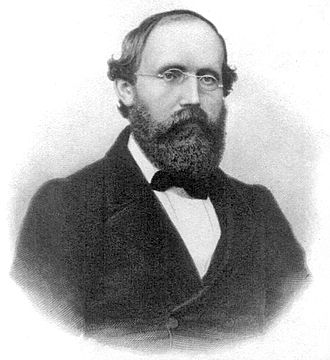
The Riemann curvature tensor is an important idea in a part of math called differential geometry. It helps us understand how space can be curved. It is named after two mathematicians, Bernhard Riemann and Elwin Bruno Christoffel. This tool gives us special numbers, called tensors, for each point in a space. These numbers show how the space bends at that point.
Simply put, the Riemann curvature tensor tells us how things look different when we see them from various angles in a curved space. If a space has no curvature, it is flat, like the regular Euclidean space we know. But if the space is curved, this tensor shows us exactly where and how the curvature happens.
This idea is very useful in physics, especially in general relativity. General relativity explains gravity as the bending of spacetime caused by mass and energy. The Riemann curvature tensor helps scientists explain how this bending changes the way objects move, like how Earth goes around the Sun. It also helps explain the small changes in the pull of the Moon and Sun on Earth’s oceans.
Definition
The Riemann curvature tensor is a way to describe how space curves in math. It helps us understand the shape of space by looking at how things change when we move from one point to another.
This tensor is important because it shows how the rules for moving in space change when the space is not flat, like the surface of a sphere. It is used in studying shapes and spaces in advanced math.
Main article: Riemann curvature tensor
Geometric meaning
Imagine you're walking on a flat tennis court with a tennis racket held out in front of you. As you walk around the court in a loop, keeping the racket pointed the same way, it will still point the same way when you return to your starting point. This is because the tennis court is flat.
Now imagine walking on the curved surface of the Earth. Start at the equator, pointing your racket north. Walk to the north pole, then sideways, then back down to the equator, and finally back to your starting point. When you return, your racket will no longer point north—it will point west instead. This happens because the Earth's surface is curved. The Riemann curvature tensor helps us measure this kind of curvature in mathematics.
The Riemann curvature tensor shows how much a shape curves by looking at how vectors change when moved along paths. It tells us how the rules for moving in straight lines change on curved surfaces.
Coordinate expression
When we talk about how space curves, we can use special math tools called tensors. The Riemann curvature tensor is one of these tools. It helps us understand the shape of space at any point.
We can write this tensor using something called coordinate vector fields and another tool named Christoffel symbols. These help break the tensor into smaller parts for easier calculations. This helps mathematicians study the curves and bends in space more clearly.
Main article: List of formulas in Riemannian geometry
Symmetries and identities
The Riemann curvature tensor has special rules called symmetries and identities. These rules help mathematicians study curved spaces. They tell us how the tensor behaves during different operations and calculations.
One important rule is the Bianchi identity, named after the mathematician who discovered it. This identity helps us understand how curvature changes as we move through space. These symmetries and identities are important for learning about the properties of curved surfaces and higher-dimensional spaces.
Main article: Bianchi identity
| Skew symmetry | R ( u , v ) = − R ( v , u ) {\displaystyle R(u,v)=-R(v,u)} | R a b c d = − R a b d c ⇔ R a b ( c d ) = 0 {\displaystyle R_{abcd}=-R_{abdc}\Leftrightarrow R_{ab(cd)}=0} |
|---|---|---|
| Skew symmetry | ⟨ R ( u , v ) w , z ⟩ = − ⟨ R ( u , v ) z , w ⟩ {\displaystyle \langle R(u,v)w,z\rangle =-\langle R(u,v)z,w\rangle } | R a b c d = − R b a c d ⇔ R ( a b ) c d = 0 {\displaystyle R_{abcd}=-R_{bacd}\Leftrightarrow R_{(ab)cd}=0} |
| First (algebraic) Bianchi identity | R ( u , v ) w + R ( v , w ) u + R ( w , u ) v = 0 {\displaystyle R(u,v)w+R(v,w)u+R(w,u)v=0} | R a b c d + R a c d b + R a d b c = 0 ⇔ R a [ b c d ] = 0 {\displaystyle R_{abcd}+R_{acdb}+R_{adbc}=0\Leftrightarrow R_{a[bcd]}=0} |
| Interchange symmetry | ⟨ R ( u , v ) w , z ⟩ = ⟨ R ( w , z ) u , v ⟩ {\displaystyle \langle R(u,v)w,z\rangle =\langle R(w,z)u,v\rangle } | R a b c d = R c d a b {\displaystyle R_{abcd}=R_{cdab}} |
| Second (differential) Bianchi identity | ( ∇ u R ) ( v , w ) + ( ∇ v R ) ( w , u ) + ( ∇ w R ) ( u , v ) = 0 {\displaystyle \left(\nabla _{u}R\right)(v,w)+\left(\nabla _{v}R\right)(w,u)+\left(\nabla _{w}R\right)(u,v)=0} | R a b c d ; e + R a b d e ; c + R a b e c ; d = 0 ⇔ R a b [ c d ; e ] = 0 {\displaystyle R_{abcd;e}+R_{abde;c}+R_{abec;d}=0\Leftrightarrow R_{ab[cd;e]}=0} |
Ricci curvature
The Ricci curvature tensor is a simpler way to understand how space is shaped. It is made by combining parts of the Riemann tensor. It helps us learn how space curves and bends in different directions.
Special cases
For a flat surface, like a piece of paper, the Riemann tensor is very simple. It has just one important piece of information. This is called the Gaussian curvature. It tells us how curved the surface is at each point.
A space form is a special kind of curved space where the curvature is the same everywhere. In these spaces, the Riemann tensor has a simple form. This depends only on this constant curvature. It shows how the shape of the space affects how things move and bend within it.
Main article: Space form
Related articles


This article is a child-friendly adaptation of the Wikipedia article on Riemann curvature tensor, available under CC BY-SA 4.0.
Images from Wikimedia Commons. Tap any image to view credits and license.