Roman governor
A Roman governor was an official who led one or more of the many provinces in the Roman Empire. Governors were chosen either by election or by appointment. They were in charge of Roman law in their provinces.
In Roman legal language, the general name for these officials was rector provinciae. This name was used no matter what special title a governor had. The different titles showed how important a province was and how much power its governor had.
By the early Empire, there were two main kinds of provinces, senatorial and imperial. Over time, several different kinds of governor developed. Only proconsuls and propraetors were counted as a promagistrate.
Duties of the governor
The governor was the province's chief judge. He was the only one who could order the death penalty, and serious cases were usually heard by him. If someone wanted to appeal his decision, they had to travel to Rome and present their case to the praetor urbanus or even the Emperor himself. This was expensive, so it rarely happened, and an appeal was unlikely to succeed. The governor also travelled across his province to hear cases in the big towns where he was needed.
Most importantly, he led the military forces in the province. In the more important provinces these could include legions, but elsewhere there were only auxiliaries. He could use his legions to stop organized criminal gangs or rebels without needing permission from the Emperor or the Senate. He also had advisors and helpers called his comites (Latin for "companions"). The number of helpers depended on his social standing and rank. Each one looked after a different part of the province and helped him make decisions. In provinces with many legions, his second-in-command was usually a quaestor, who was chosen in Rome and mainly handled money matters. In other provinces, governors appointed prefects or procurators to run a small part of the province.
Republican governors
During the time of the Roman Republic, the council chose governors for Rome's provinces. It sent promagistrates to serve. They were picked either by a random casting of lots or by following a senatus consultum, which was advice from the Senate. These choices were not truly binding under the law, and Roman assemblies could cancel them.
At first, a governor's title, pro praetore or pro consule, depended on the last public office he had held. Former praetors served as pro praetore, and former consuls served as pro consule. This system began to change after private citizens were given commands in Spain as pro consule during the Second Punic War. By the late Republic, praetors were almost always given the title pro consule. Calmer provinces, where there was little chance of revolt or invasion, usually went to former praetors. Provinces where fighting was expected were given to recent consuls instead.
These promagistrates had the same power as other officials with the same level of imperium. They also had the same number of lictors as those officials. In general, they held almost complete power in their provinces. Many governors took large amounts of money from the people they ruled. A governor was protected from being put on trial as long as he held his imperium. Once he left office, however, he could be taken to court for what he had done while in charge.
Imperial governors
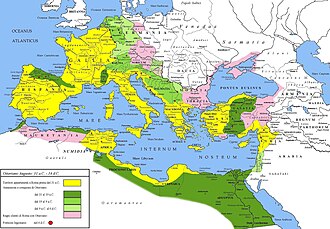
After Augustus set up the Principate, the Emperor himself directly governed Rome's most important imperial provinces. Even in provinces he did not govern directly, he was in charge over other governors because he held imperium maius, or supreme imperium. In imperial provinces, the Emperor chose legates to rule in his name. Legates ranked lower than other governors because they were only representatives of the Emperor.
The Senate chose the governors of senatorial provinces. These provinces were far from Rome's borders and had few or no legions, so they were less likely to rebel. Augustus decided that at least ten provinces would be run this way. Two of them, Asia and Africa, were led by proconsuls who served for one year. The other eight were led by propraetors who served for up to three years. The province of Africa always had at least one legion to protect it from Berber tribes.
The Emperor also controlled smaller provinces that did not need a full legion. These were run by governors of equestrian rank, called procurators. Egypt was a special case. It was considered the personal property of the Emperor, and it was governed by the praefectus Aegypti, one of the highest posts for equestrians in the early Empire. Procurators did not receive the powers of a governor until the reign of Claudius. Unlike prefects, procurators were civilian officials and not magistrates. They did not hold imperium, so they could only use authority with the approval of the Emperor or a governor.
Late imperial governors
The provincial governors were the most important officials in the Roman government. They collected taxes, handled justice first, and kept public order. Three times a year, they received tax demands from the prefectures and passed them on to the towns.
Under the Dominate, the Emperor Diocletian began changing how the provinces were run in AD 293. The changes were finished under the Emperor Constantine the Great in 318. Diocletian set up twelve dioceses. Later, some of them were split. Each diocese was governed by a vicarius, who acted for the praetorian prefect. Each diocese had several Roman provinces, which were called eparchies in Greek. Each province had a governor. The governor's title could vary, such as corrector provinciae or praesidens. Constantine completely removed the governors' military commands, a change that had begun under Diocletian. Border units were led by a dux. Field units were led by a comes, and later by the magistri militum. Late in his reign, Constantine organized the empire into three Praetorian prefectures: the prefecture of Gaul, the prefecture of Italy, and the prefecture of the East. Each one was led by a praetorian prefect, the highest civilian officer.

Quiz time!
4 questions about Roman governor
What was a Roman governor's job when it came to the courts?
Keep exploring



This article is a child-friendly adaptation of the Wikipedia article on Roman governor, available under CC BY-SA 4.0.