 Safekipedia
Self-Portrait with the Colosseum
Adapted from Wikipedia · Adventurer experience
The Self-Portrait with the Colosseum is an oil painting made in 1553 by a Dutch artist named Maarten van Heemskerck. This painting was made during the Dutch Golden Age, a time when Dutch artists created many beautiful works.
In the painting, Maarten van Heemskerck shows himself standing in front of the famous Colosseum in Rome. Even though the Colosseum is in Italy and he was from the Netherlands, he painted it to remember his visit and to show how much he liked ancient Roman buildings.
Today, this artwork is kept safely in the Fitzwilliam Museum in Cambridge. It helps us understand how artists saw the world long ago and remembers Maarten van Heemskerck’s travels and talent.
History and description
This painting shows the artist as a traveler with the Colosseum in the background. It was made in 1553. The artist appears twice: once looking at the viewer and again drawing the Colosseum. Heemskerck painted it when he arrived in Italy. The painting later became part of the collection of Anton Perrenot de Granvella.
The image of the Colosseum was also used by Pieter Jansz. Saenredam for his painting in 1631. Many of Heemskerck’s sketches were used by others, as described by Karel van Mander in his book Schilder-boeck. Some of these sketches were later published by Philips Galle in 1569.
Images
Related articles
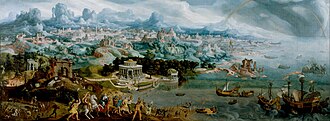


This article is a child-friendly adaptation of the Wikipedia article on Self-Portrait with the Colosseum, available under CC BY-SA 4.0.
Images from Wikimedia Commons. Tap any image to view credits and license.