 Safekipedia
Telecommunications engineering
Adapted from Wikipedia · Adventurer experience
Telecommunications engineering is a part of electrical engineering. It helps people talk and share information over long distances. Engineers design and set up equipment like telephone networks, fiber optic cables, and wireless signals.
Their work includes designing small parts and planning big communication networks. They make sure we have fast and reliable ways to send data. This can be through wires like twisted pairs and coaxial cables, or through the air using radio waves, satellites, and Wi‑Fi.
Telecommunications engineering is important because it connects people and devices around the world. It supports technologies we use every day, including the internet, mobile phones, and television broadcasting. These engineers help build the systems that keep our world linked together.
History
Telecommunication systems are made by engineers who improve old ideas. In the late 1800s, the telegraph let people send messages far away. By the early 1900s, radio and telephone systems started to grow, making it easier to talk from far places.
Today, we use devices like television, radio, and telephone to connect with others worldwide. Networks such as computer systems, telephone lines, and television stations link these devices. The Internet is one way we share information through telecommunication. It is very important in our lives.
Telegraph and telephone
Main articles: Electrical telegraph, Transatlantic telegraph cable, Invention of the telephone, and History of the telephone
Samuel Morse made an early telegraph in 1837, with help from Alfred Vail. They sent messages far away, and by 1851, telegraph lines crossed the United States. The first cable between continents was finished in 1866, letting messages go between Europe and America for the first time.
The first telephone services started in 1878 in cities like New Haven and London. Alexander Graham Bell had the main patent for the telephone. Over time, telephone lines connected cities, and by the 1880s, many big cities had telephone centers. It was not until 1927 that people could talk across the Atlantic using radio, and a cable connection came in 1956.
Radio and television
Main articles: History of radio and History of television
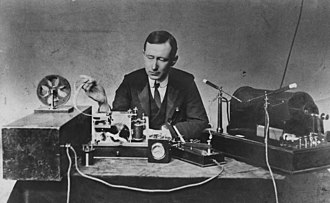
In the 1890s, Guglielmo Marconi built the first wireless telegraph system using radio waves. In 1901, he sent messages between Britain and Newfoundland and won a Nobel Prize. By 1900, voices could be sent wirelessly, and in the 1920s, John Logie Baird showed the first moving pictures on television. These early television pictures were shown in shops in London.
Satellite
Main articles: Communications satellite, Satellite phone, Satellite radio, Satellite television, and Satellite Internet access
The first U.S. satellite to send messages was Project SCORE in 1958, used to send a holiday message from the president. Later satellites helped send television, telephone, and Internet signals around the world. Satellites are very important for places without cables, like remote islands.
Computer networks and the Internet
Main articles: Computer networking and History of the Internet
In 1969, a small network started that would become the Internet. This network let computers share information by sending small pieces of data. Over time, these networks grew and joined together, creating the Internet we use today.
Optical fiber
Main article: Fiber-optic communication
Optical fiber uses thin glass threads to send light signals far away with very little loss. This makes it great for telephone and Internet services. In the 1970s, scientists made the first practical fiber-optic systems, and by the late 1970s, they were used to send telephone calls through fiber cables. Today, fiber optics help connect people all over the world.
Concepts
Basic elements of a telecommunication system
Main article: Telecommunication
Transmitter
Main article: Transmitter
A transmitter is a tool that changes information into a signal for sending. In electronics and telecommunications, a transmitter uses an antenna to create radio waves. Transmitters are used in many devices that talk using radio waves, like cell phones.
Transmission medium
Main article: Transmission medium
A transmission medium is what carries the signal. For sounds, this is usually air, but solids and liquids can also carry sound. In networking, copper wire is often used to carry signals over long distances with little power. Another common medium is optical fiber, a thin glass strand that guides light.
The vacuum can also carry electromagnetic waves such as light and radio waves.
Receiver
Main article: Receiver (radio)
A receiver changes a signal back into useful information. In radio communications, a receiver is a device that gets radio waves and turns them into something we can use, like sound, pictures, or digital data. It works with an antenna.
Wired communication
Main article: Wired communication
Wired communication uses cables, often placed underground, to send information. These cables have special devices called amplifiers to boost the signal along the way.
Wireless communication
Main article: Wireless
Wireless communication sends information over distances without wires. This allows for services like long-range communication that would be hard or impossible with wires. The term is often used for telecommunications systems, like radios and remote controls, that use energy such as radio waves to send information without wires. This works for both short and long distances.
Roles
Telecom equipment engineer
A telecom equipment engineer makes tools such as routers, switches, and other special parts for communication networks.
Network engineer
A network engineer plans, sets up, and takes care of computer networks. They work in special rooms that control networks, design big connections between networks, or manage links where many computers are connected.
Central-office engineer
A central-office engineer helps put communication tools in special buildings called central offices. They make sure new technology works with the old network, decide where to place equipment, and provide power and monitoring for it. They also plan how to organize many wires and oversee putting in new tools.
Sub-roles
Like structure experts, CO engineers design where to place equipment racks and organize wires. Like electricity experts, they make sure wires and tools work well for clear phone and internet service. They also calculate how much power is needed for new tools.
Outside-plant engineer
Outside-plant engineers, often called field engineers, spend time outside checking areas where wires and signals travel. They take communication lines from central offices to places where people live or work. They might place special boxes to connect wires more easily, saving space and money.
The lines can travel underground, on poles, or through microwave signals for long distances.
Sub-roles
Like structure experts, OSP engineers design where to place cell towers and poles, and calculate how strong they need to be. Like electricity experts, they make sure wires work well and plan for power needs. Like city planners, they draw plans for where wires will go and work with local governments to get permission. They also help explain how communication services work to others.
Related articles


This article is a child-friendly adaptation of the Wikipedia article on Telecommunications engineering, available under CC BY-SA 4.0.
Images from Wikimedia Commons. Tap any image to view credits and license.