Television
"TV" redirects here. For other uses, see TV (disambiguation) and Television (disambiguation). Television (TV) is a telecommunication medium for sending moving pictures and sound. The word can also mean a physical television set, not the medium of transmission. Television is a mass medium used for advertising, entertainment, news, and sports. It can do more than radio broadcasting, which only sends sound to radio receivers.
Television first appeared in simple experimental forms in the 1920s. It took several more years of work before it was sold to people. After World War II, a better black-and-white form of television became popular in the United Kingdom and the United States. Television sets became common in homes, businesses, and institutions. In the 1950s, television was the main way that public opinion was shaped. In the mid-1960s, color broadcasting began in the U.S. and most other developed countries.
Recording devices such as Betamax and VHS tapes, LaserDiscs, high-capacity hard disk drives, Video CDs, DVDs, flash drives, high-definition Blu-ray discs, and digital video recorders let viewers watch recorded shows, such as movies, at home whenever they like. Today, many programs are also stored in the cloud, which makes them easy to get, such as through the video-on-demand service by Netflix. In the early 2010s, digital television became much more popular. Another change was moving from standard-definition television (SDTV) (576i, with 576 interlaced lines of resolution and 480i) to high-definition television (HDTV), which has much higher resolution. HDTV can be sent in different formats: 1080p, 1080i, and 720p. Since 2010, when smart television was invented, Internet television has made more shows and movies available online through streaming video services such as Netflix, Amazon Prime Video, iPlayer, and Hulu.
In 2013, 79% of the world's households owned a television set. The older cathode-ray tube (CRT) screens were replaced by thinner, energy-saving flat screens, such as LCDs (both fluorescent-backlit and LED), OLED displays, and plasma displays. This change started with computer monitors in the late 1990s. Most TVs sold in the 2000s were still CRT, but flat-screen TVs passed CRT in the early 2010s. By the mid-2010s, major manufacturers had stopped making CRT, Digital Light Processing (DLP), plasma, and even fluorescent-backlit LCDs. LEDs are slowly being replaced by OLEDs. Major manufacturers also began making more smart TVs in the mid-2010s. Smart TVs with built-in Internet and Web 2.0 features became the most common type of television by the late 2010s.
At first, television signals were sent only as terrestrial television, using powerful radio-frequency television transmitters to send the signal to each television receiver. Today, signals are also sent by coaxial cable or optical fiber, satellite systems, and, since the 2000s, over the Internet. Until the early 2000s, these were sent as analog signals, but a transition to digital television was expected to be finished around the world by the late 2010s. A standard television set has many internal electronic circuits, including a tuner that receives and decodes broadcast signals. A visual display device without a tuner is correctly called a video monitor, not a television. Television broadcasts are mainly one-way, meaning signals go only from the transmitter to the receiver.
Etymology
The word television comes from Ancient Greek tele, meaning 'far', and Latin visio, meaning 'sight'. The first known use of the term was in 1900, when the Russian scientist Constantin Perskyi used it in a paper. He presented it in French at an event in Paris during the International World Fair.
The anglicized form of the word first appeared in 1907. At that time, television was still an idea for sending moving pictures over telegraph or telephone wires. Earlier names for the idea included telephote and televista. The short form TV began to be used in 1948. Today, telly is a more common word in the UK. The slang term "the tube" comes from the large cathode-ray tube used in most TVs until flat-screen TVs arrived. Another slang name is "idiot box."
History
Main article: History of television
Ideas for sending pictures began in the early 1800s. Early TV systems used spinning disks. John Logie Baird gave the first public demonstration of moving images in 1925. The word "television" had already been coined by Constantin Perskyi in 1900. Later, electronic systems replaced the spinning disks as the main way to make television. In 1927, Philo Farnsworth sent his first image with an electronic system. In 1936, the BBC began a regular high-definition service from Alexandra Palace.
Color television was tested for many years before the first color broadcast in 1954. Color sets became common in the mid-1960s. Later, digital television allowed for more channels and smart televisions that connect to the Internet. Some television sets also show 3D television, which gives viewers a sense of depth.
Broadcast systems
Terrestrial television
Main article: Terrestrial television
See also: Timeline of the introduction of television in countries
Television stations, often called "channels", are licensed by their governments. They can only broadcast over assigned channels in the television band. At first, terrestrial broadcasting was the only way to reach many people. Because bandwidth was limited and only a few channels were available, governments controlled broadcasting. In the U.S., the Federal Communications Commission (FCC) allowed advertising starting in July 1941, but stations had to offer public service programs. In the United Kingdom, people who owned television sets paid a television license fee. This money helped fund the British Broadcasting Corporation (BBC).
WRGB claims to be the world's oldest television station. It started as an experimental station on 13 January 1928 at a General Electric factory in Schenectady, NY. On 2 November 1936, the BBC began the world's first public regular high-definition service from Alexandra Palace in north London. Since the 1970s and 1980s, terrestrial broadcasts have declined as cable spread across the United States. Many countries are now switching to digital terrestrial television.
Cable television
Main article: Cable television
See also: Cable television by region
Cable television sends programs to paying subscribers through cables. It uses radio signals over coaxial cables or light pulses through fiber-optic cables. This is different from terrestrial television, which uses radio waves sent through the air. Cable systems can also provide services like radio, high-speed Internet, and telephone service.
Satellite television
Main article: Satellite television
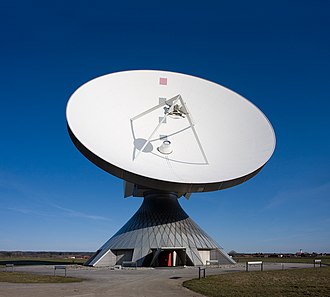
Satellite television sends programs using signals relayed from communication satellites. Viewers receive the signals with a satellite dish and a low-noise block downconverter. A satellite receiver then shows the program on a television set. Satellite television offers many channels, especially in areas without terrestrial or cable service. The first satellite TV signals from Europe to North America were relayed by Telstar on 23 July 1962. The first commercial communications satellite, Intelsat I, was launched on 6 April 1965.
Internet television
Main article: Streaming television
Not to be confused with Smart television, Internet Protocol television, or Web television.
Internet television sends television content over the Internet instead of through terrestrial, cable, or satellite systems. Viewers can watch shows through video streaming. In 2013, Netflix earned the first Primetime Emmy Award nominations for original streaming television. In 2017, YouTube TV launched as a streaming service for live television. As of 2018, Netflix was the world's largest streaming TV network, with 117 million paid subscribers. In 2020, the COVID-19 pandemic had a strong effect on television streaming, as people stayed at home.
Sets
A television set, also called a TV or "telly", is a device that lets people watch television and hear its sound. It has a tuner, a display, an amplifier, and speakers. The first sets appeared in the late 1920s. They were mechanical devices. After World War II, electronic sets that used cathode-ray tubes became popular. Color shows, which began after 1953, made them even more popular. Outdoor antennas became common on houses in the suburbs. In the 1970s, people used sets with Betamax and VHS to record shows and watch movies. Later, people used them to watch DVDs and Blu-ray Discs.
By the mid-2010s, major TV makers had announced they would stop making older types, such as CRT, DLP, plasma, and fluorescent-backlit LCD sets. Since the 2010s, most televisions have used LEDs. LEDs may be replaced by OLEDs in the near future.
Main article: Display device
Main article: Nipkow disk
Main article: Cathode-ray tube
Main article: Digital Light Processing
Main article: Plasma display
Main article: Liquid-crystal display
Main article: OLED
Main article: Low-definition television
Main article: Standard-definition television
Main article: High-definition television
Main article: Ultra-high-definition television
| Worldwide TV manufacturers market share, H1 2023 | ||
|---|---|---|
| Manufacturer | Market share | |
| Samsung Electronics | 31.2% | |
| LG Electronics | 16.2% | |
| TCL | 10.2% | |
| Hisense | 9.5% | |
| Sony | 5.7% | |
| Others | 39% | |
Content
TV shows reach viewers in a few steps. First, a producer makes a show and shows it on a station or network. That station or network either paid for the show or got permission to air it. Later, broadcast syndication sells the show again to other stations and countries.
Shows come in many Television genres. Dramas are usually the most expensive to make. Cheaper types include game shows, talk shows, variety shows, and reality TV.
Broadcast TV is paid for in different ways. Governments, advertising, licence fees, subscriptions, or a mix of these can pay for it. Many private networks rely on advertising. Ads can be short, or they can be longer infomercials.
For broadcasting, programs are put in order on a schedule. This is called Broadcast programming, or TV listings in the United Kingdom (TV listings (UK).
Social aspects
Television has played an important role in how people get together and learn from each other in the 20th and 21st centuries. It also has some downsides, such as media violence. Current research shows that lonely people can use television to form a parasocial relationship, a kind of pretend friendship, with characters from their favorite shows and movies. This can help them feel less alone. Several studies have found that educational television has many advantages. The article "The Good Things about Television" says that television can be a powerful and useful way for children to learn when it is used wisely. Many Christian denominations use television for religious broadcasting.
Some religious groups avoid television. Methodist groups in the conservative holiness movement, such as the Allegheny Wesleyan Methodist Connection and the Evangelical Wesleyan Church, do not use it. Some Baptists, including those linked to Pensacola Christian College, also avoid it. Many Traditional Catholic congregations, such as the Society of Saint Pius X (SSPX), along with Laestadian Lutherans and Conservative Anabaptists like the Dunkard Brethren Church and the Bruderhof, do not want televisions in the home. They teach that it is an occasion of sin.
Negative impacts
Young children, especially those aged five or younger, can be hurt when a television falls over. An old CRT television that falls on a child hits with about the same force as falling from several floors of a building. Newer flat-screen televisions are "top-heavy and have narrow bases," so a small child can easily pull one over. In 2015, TV tip-overs caused more than 10,000 injuries to children in the United States each year. These injuries cost more than US$8 million a year in emergency care.
A 2017 study in The Journal of Human Resources found that watching cable television was linked to lower thinking skills and lower high school graduation rates for boys. The effect was stronger for boys from more educated families. The study suggests that easy TV watching can take the place of activities that make the mind work harder. Old CRTs contain a lot of lead. Newer screens, some of which (LCDs) use lamps containing mercury, add to concern about electronic waste from thrown-away televisions. Televisions also need more electrical energy over time, which adds to concerns about the environment.

Quiz time!
4 questions about Television
What can television send that radio cannot?
Pictures
Keep exploring



This article is a child-friendly adaptation of the Wikipedia article on Television, available under CC BY-SA 4.0.
Images from Wikimedia Commons. Tap any image to view credits and license.