 Safekipedia
Timeline of Staten Island
Adapted from Wikipedia · Adventurer experience
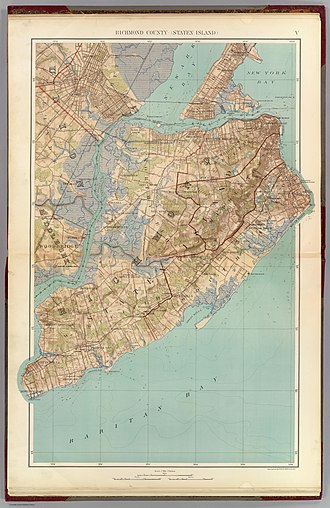
Staten Island is one of the five boroughs of New York City. This timeline shows important events and changes that have happened there over time. From its early days as land shared by Native American tribes to its growth as part of a big city, Staten Island has many interesting stories.
The island has seen many changes, including the arrival of new people, the building of homes and roads, and the development of schools and parks. Some events mark big moments in history, while others show how daily life has evolved.
Because this is a dynamic list, it might not include every single event. Anyone can help by adding more important moments with details from reliable sources. Exploring this timeline gives us a glimpse into the rich history of Staten Island and its place in New York City.
17th century
In 1609, Henry Hudson named the island "Staaten Eylandt." In 1630, the Dutch West India Company gave the island to Michael Pauw. By 1636, part of the island was given to David Pietersz. de Vries, and in 1640, the rest was given to Cornelis Melyn. That same year, Willem Kieft built the first distillery in North America.
In 1641, David Pietersz. de Vries started a settlement at Oude Dorp in New Netherland. The island became part of the British Province of New York in 1668. The first church was built in 1670, and the first Dutch Reformed Church was formed in 1680. In 1683, Richmond County was established, and in 1696, the oldest known schoolhouse in America, the Voorlezer's House, was finished. By 1698, the island's population had grown to 727.
18th century
In 1713, St. Andrew's Church was built, and in 1727, Richmond village became the center of Richmond County, New York. The Moravian Cemetery was set up in 1740.
In 1774, Staten Island was the only county in New York that chose not to send a representative to the First Continental Congress. In 1776, British soldiers came to the island. New towns like Castleton, Northfield, Southfield, and Westfield were created in 1788. In 1794, Cornelius Vanderbilt, a famous businessman, was born.
19th century
In the 1800s, many important events happened on Staten Island. In 1808, it became known as the borough of Richmond in Greater New York. During this time, many churches, schools, and public buildings were built.
By the late 1800s, new transportation options like railways started, and communities grew. In 1871, an early version of the telephone was patented by Antonio Meucci. Staten Island also saw the founding of clubs, museums, and newspapers, shaping its history.
20th century
1900s–1940s
In the early 1900s, Staten Island changed a lot. The Tottenville Copper Company started in 1900, and the number of people living there grew to 67,021. In 1903, Fort Wadsworth Light began operating, and Notre Dame Academy was created. The Wittemann brothers started America’s first airplane factory in 1905. Staten Island Borough Hall was built in 1906, and Happyland Amusement Park opened in South Beach. The Public Museum of the Staten Island Institute of Arts and Sciences started in 1907. By 1910, the population had grown to 85,969. Wagner College moved to Staten Island in 1918. The Staten Island Stapletons football team began in 1915 and later played in the National Football League from 1929 to 1932. In 1923, work started on the Staten Island Tunnel, but it was stopped in 1925. Many schools, parks, and buildings were built during this time, including Curtis High School in 1904, Port Richmond High School in 1927, and the Staten Island Zoo in 1936.
1950s–1990s
The middle of the 20th century brought more growth to Staten Island. In 1950, the population was 191,555. In 1956, Staten Island Community College was founded. In 1957, Queen Elizabeth visited the island. The Verrazzano–Narrows Bridge opened in 1964, linking Staten Island to Brooklyn. Staten Island won the Little League World Series in 1964. The College of Staten Island was created in 1976. The Staten Island Children’s Museum opened in 1976. In 1992, the Wu-Tang Clan was formed on the island. In 1993, people voted for Staten Island to separate from New York City, though it was not binding. The Staten Island Ferry became free in 1997. The New York Chinese Scholar’s Garden and the College of Staten Island Baseball Complex opened in 1999, and the Staten Island Yankees baseball team was created.
21st century
In 2001, a new baseball stadium called Richmond County Bank Ballpark opened, and a large waste site called the Fresh Kills Landfill closed after receiving debris from the September 11 attacks. In 2002, James Molinaro became the leader of Staten Island. In 2003, there was a ferry crash. In 2004, a new transportation center called the Eltingville Transit Center was built. In 2007, a new medical center named Richmond University Medical Center opened. In 2010, the population of Staten Island was 468,730 people. In 2012, Hurricane Sandy affected the area. In 2014, Pete Davidson joined the cast of Saturday Night Live. In 2020, a dog named Buddy, who was the first German Shepherd diagnosed with COVID-19, passed away. Sadly, the virus also affected many people on the island by the end of that year. In 2022, Vito Fossella became the new leader of Staten Island.
Images
Related articles




This article is a child-friendly adaptation of the Wikipedia article on Timeline of Staten Island, available under CC BY-SA 4.0.
Images from Wikimedia Commons. Tap any image to view credits and license.