 Safekipedia
Titanium dioxide
Adapted from Wikipedia · Adventurer experience
Titanium dioxide is a common chemical made from the element titanium. Its chemical formula is TiO2. When it is used to give things a bright white colour, it is called titanium white, Pigment White 6, or CI 77891.
This white powder does not dissolve in water. It is used in many everyday products because it makes a clean, bright white colour. You can find it in paint, sunscreen, and even some foods where it is used to add colour. In food, it is known by the number E171.
It is one of the most common pigments, used in many products around the world.
Structure
Titanium dioxide has a special shape where each titanium atom is connected to six oxygen atoms. The way these atoms fit together can look different in different forms. Some common forms have patterns called rutile and anatase, while another form is called brookite.
When titanium dioxide is melted, the atoms arrange themselves differently. In this state, each titanium atom connects to about five oxygen atoms on average. This is different from when it is a solid crystal.
Synthetic and geologic occurrence
Titanium dioxide, written as TiO2, comes from a mineral called ilmenite. In nature, it is found as minerals such as rutile and anatase. Rutile can often be seen in beach sand. Another form, called leucoxene, comes from ilmenite changing over time. Some colorful gems like star sapphires and rubies have tiny rutile needles inside that give them a special sparkle called asterism.
Titanium dioxide can appear in many different crystal shapes. Besides rutile and anatase, there are special forms found in very high-pressure places, like at the Ries crater in Bavaria. Scientists have also made other forms in laboratories. These different forms show how strong and interesting this material can be.
| Form | Crystal system | Synthesis |
|---|---|---|
| Rutile | Tetragonal | |
| Anatase | Tetragonal | |
| Brookite | Orthorhombic | |
| TiO2(B) | Monoclinic | Hydrolysis of K2Ti4O9 followed by heating |
| TiO2(H), hollandite-like form | Tetragonal | Oxidation of the related potassium titanate bronze, K0.25TiO2 |
| TiO2(R), ramsdellite-like form | Orthorhombic | Oxidation of the related lithium titanate bronze Li0.5TiO2 |
| TiO2(II)-(α-PbO2-like form) | Orthorhombic | |
| Akaogiite (baddeleyite-like form, 7 coordinated Ti) | Monoclinic | |
| TiO2 -OI | Orthorhombic | |
| Cubic form | Cubic | P > 40 GPa, T > 1600 °C |
| TiO2 -OII, cotunnite(PbCl2)-like | Orthorhombic | P > 40 GPa, T > 700 °C |
Production
The biggest makers of titanium dioxide are Chemours, Venator, Kronos, and Tronox. Large companies like Akzo Nobel, PPG Industries, Sherwin Williams, BASF, and Kansai Paints use it to make paints and coatings. In 2010, the world used about 5.3 million tons of titanium dioxide, and experts think this use will grow by about 3–4% each year.
There are two main ways to make titanium dioxide. One way is called the chloride process, where ore is mixed with chlorine and carbon to make a liquid that becomes titanium dioxide. The other way is the sulfate process, which uses sulfuric acid on a special ore to get titanium dioxide. Both methods make the same form of titanium dioxide, but the sulfate process can also make a softer form used in paper and fibers.
Applications
Pigment
Main article: Titanium white
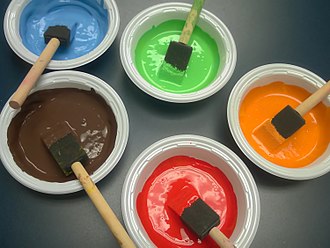
Titanium dioxide is the most common white color used in paints, plastics, and many products because it shines very brightly. Tiny pieces of this material help make things look white and opaque, like in paints, papers, and even toothpaste. In paints, people often call it “brilliant white” because it makes colors look very clean and bright.
Additive for food
Titanium dioxide is used to add white color to many foods, such as ice cream, candies, and cakes. It is allowed in many places, but some countries stopped letting it be used in food.
Thin films
When put in very thin layers, titanium dioxide can help make special coatings that shine or change color in the light.
Sunscreen and UV blocking pigments
Titanium dioxide is used in many sunscreens to block harmful sunlight. It works well and is often used in sunscreens for babies or people with sensitive skin because it usually does not irritate the skin. It is also used in some skin care products to help protect the skin from the sun.
Other uses of titanium dioxide
Titanium dioxide is used in many other ways, like in ceramics, tattoos, and even in space rockets. It helps make things white and can also help protect materials from sunlight. It is also used in some electronic parts.
Research
From 2002 to 2022, many inventors found new ways to make titanium dioxide from a material called ilmenite. Some of these ways use special steps like heating and separating to get more titanium from ores. Two main ways to make titanium dioxide are the sulfate process and the chloride process. Companies in China, Australia, and the United States helped create these new methods.
Very small pieces of titanium dioxide, especially in a form called anatase, can break down harmful things when sunlight shines on them. This works best with ultraviolet light. Scientists learned about this helpful quality in 1967. Because of this, titanium dioxide is added to paints, glasses, and other products to keep the air and surfaces clean. It can also help make solar cells work better.
Health and safety
Titanium dioxide is used to make foods look white, like cheeses, ice cream, candies, and frostings. In the United States, it is allowed in foods, but some places in Europe have stopped using it because they are not sure how much is safe to eat.
If titanium dioxide dust is breathed in, it can be harmful. There are special rules to protect workers who might be around it for a long time. Most titanium dioxide that gets into the environment comes from things like cosmetics that go down the drain. It usually ends up in soil and stays there.
Images
Related articles



This article is a child-friendly adaptation of the Wikipedia article on Titanium dioxide, available under CC BY-SA 4.0.
Images from Wikimedia Commons. Tap any image to view credits and license.