Tongva
The Tongva are an indigenous people of California from the Los Angeles Basin and the Southern Channel Islands. Their homeland covers about 4,000 square miles (10,000 km2). Before colonization, the Tongva lived in as many as 100 villages. They usually called themselves by their village name rather than by one name for all the people. During colonization, the Spanish called them Gabrieleño and Fernandeño. These names came from the Spanish missions built on their land, Mission San Gabriel Arcángel and Mission San Fernando Rey de España. The name Tongva is the most widely used name among the people. Narcisa Higuera used it in 1905 for people near Mission San Gabriel. Some people who are direct lineal descendants of the Tongva prefer their ancestral name, Kizh, as an endonym.
The Tongva, together with neighboring groups such as the Chumash, played an important role in the region's culture and economy when European explorers arrived. They built a large trade network using te'aats, which were plank-built boats. Their food and way of life came from a view that saw humans as one part of a web of life, as shown in their creation stories. Different communities spoke different dialects of the Tongva language. This language belongs to the Takic subgroup of the Uto-Aztecan language family.
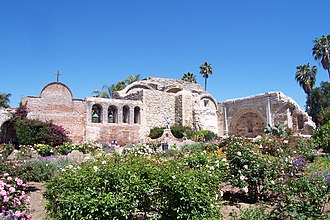
The first contact with Europeans happened in 1542, when Spanish explorer Juan Rodríguez Cabrillo was greeted at Santa Catalina by people in a canoe. The next day, his men entered a large bay that they named Baya de los Fumos ("Bay of Smokes") because of the many smoke fires they saw there. This bay is commonly believed to be San Pedro Bay. In 1769, the Gaspar de Portolá land expedition led to the founding of Mission San Gabriel by Catholic missionary Junipero Serra in 1771. Under the mission system, many people were made to leave their homes and were treated very badly while they worked for the missions. The Native Americans were also exposed to Old World diseases, which they had no immunity against. Many people became sick and died, which led to the rapid collapse of Tongva society and lifeways.
The Tongva resisted and rebelled. One rebellion in 1785, led by Nicolás José and the female chief Toypurina, was not successful. In 1821, Mexico gained its independence from Spain and secularized the missions. The mission lands, known as ranchos, were sold to wealthy ranchers, and the Tongva were pushed to adopt new ways. Most became landless refugees. In 1848, California was ceded to the United States after the Mexican-American War. Between 1851 and 1852, the US government signed 18 treaties promising land for reservations, but the Senate never approved them. Many Tongva and other Indigenous people were then targeted with arrest. Unable to pay fines, they were made to work as convict laborers to help build the city of Los Angeles for Anglo-American settlers, who became the majority in the area by 1880.
In the early 20th century, people wrongly claimed that the Gabrieleño had died out, even though many of them by then identified publicly as Mexican-American. However, a close-knit community stayed in contact between Tejon Pass and San Gabriel township into the 20th century. Since 2006, four organizations have claimed to represent the people. Two of these groups formed after a bitter split over building an Indian casino. In 1994, the state of California recognized the Gabrielino "as the aboriginal tribe of the Los Angeles Basin." However, no organized Tongva group has yet gained recognition as a tribe by the federal government. Without this recognition, Tongva descendants do not control Tongva ancestral remains and artifacts, and they have no land base in their traditional homeland. The Tongva Taraxat Paxaavxa Conservancy was set up to work for the rematriation of Tongva homelands. In 2022, a 1-acre site in Altadena was returned to the conservancy, the first time in 200 years that the Tongva had land in Los Angeles County.
Geography
Tongva lands bordered those of many other tribes in the region. The historical Tongva lands covered the coastal area of Los Angeles County, the northwest part of Orange County, and nearby islands.
In 1962, Curator Bernice Johnson of the Southwest Museum said the northern boundary was somewhere between Topanga and Malibu, perhaps near Malibu Creek. She said the southern boundary was Aliso Creek in Orange County.
Names
The word Tongva was named by C. Hart Merriam in 1905. He learned it from many people, including Mrs. James Rosemyre (born Narcisa Higuera), who lived near Fort Tejon, not far from Bakersfield. Some descendants prefer the name Kizh, which is an endonym, or a name a people uses for itself. They say it is an older name and more accurate. Records from the Smithsonian Institution, Congress, the Catholic Church, the San Gabriel Mission, and other historians support this.
The Spanish called the Indigenous peoples near Mission San Gabriel the Gabrieleño. This was not the name these peoples used for themselves. Because the groups did not agree on Tongva, people often use Gabrieleño as a name that most can accept. For example, in 2017, Debra Martin, a city council member from Pomona, led a project to place wooden statues in Ganesha Park. The groups disagreed about whether the plaque should say Tongva or Kizh. Tribal officials agreed, for now, to use Gabrieleño.
History
Further information: Takic languages, Uto-Aztecan, Indigenous peoples of California, Population of Native California, and Archaic Southwest
Further information: Mission Indians and Spanish missions in California
Further information: Mexican Secularization Act of 1833 and Ranchos of California
Further information: California genocide and Forced labor in California
Further information: American Indian boarding schools
Further information: Land Back
Many clues suggest that the Tongva come from Uto-Aztecan-speaking peoples. These people may have moved from what is now Nevada about 3,500 years ago. Before Spanish colonization, the Tongva lived in many villages. People mostly knew them by their village names.
In 1542, the Spanish explorer Juan Cabrillo reached Santa Catalina. Tongva people greeted his ships from a canoe. Spanish colonization began in 1769 with the Gaspar de Portola expedition. The Spanish built missions, including Mission San Gabriel and Mission San Fernando. Many Tongva were made to work there, and they were treated very unfairly.
The Tongva pushed back in many ways. Toypurina helped lead a revolt in 1785. The mission period ended in 1834 when Mexican rule took over the missions. Most Tongva were not given land and had to work for others. After the Mexican-American War, Los Angeles became a town in the United States in 1848. The Tongva faced unfair treatment and convict labor.
In the late 1800s and early 1900s, many Gabrieleño hid their Indigenous identity. People spread the false idea that they had disappeared. Today, the Tongva work to protect their sacred sites and ancestral remains. They are part of the Land Back movement. In October 2022, a 1-acre site in Altadena was returned to a Tongva conservancy. It was the first time in 200 years that the Tongva had land in Los Angeles County.
Culture
The Tongva lived in a fertile lowland in southern California. They had a mild coast, plenty of food, and lived on Santa Catalina, San Clemente, and San Nicolas Islands. They were an important group south of the Tehachapi and were one of the Uto-Aztecan speaking peoples of California. They also influenced other Indigenous groups through trade. Their land was the center of a trade network that stretched from the Channel Islands to the Colorado River. It connected them with the Cahuilla, Serrano, Luiseño, Chumash, and Mohave. Like all Indigenous peoples, they lived alongside the flora and fauna of their land. Their villages spread across four ecological zones, which gave them many plants, animals, and minerals to use for food and materials. Plants included oak (Quercus agrifolia) and willow (Salix spp.) trees, chia, cattail, datura or jimsonweed (Datura innoxia), white sage (Salvia apiana), Juncus spp., Mexican Elderberry (Sambucus), wild tobacco (Nicotiana spp.), and yucca (Hesperoyucca whipplei). Animals included mule deer, pronghorns, black bears, grizzly bears, black-tailed jackrabbits, cottontails, bald eagles, red-tailed hawks, dolphins, and gray whales.
Main article: Tomol
Many Tongva lived along the coast, so they fished and hunted in the estuary of the Los Angeles River. Like their neighbors the Chumash, the Gabrieleño built seaworthy plank canoes, called te'aat, from driftwood. They sewed the planks together and sealed them with tar from the La Brea Tar Pits or asphalt that washed ashore. Then they coated the canoes with red ochre. A te'aat could hold up to 20 people and their goods, as noted by the Sebastián Vizcaíno expedition. These canoes helped trade grow between the mainland and the offshore islands, where the Gabrieleño gathered abalone.
Food was shared carefully. The village chief managed food supplies, and families stored food for hard times. Villages were placed where water, shelter, and different ecological niches met, so people could gather plants from two or more zones. Men hunted, fished, and traded. Women gathered and prepared plant foods, made baskets and clothing, and taught young people Tongva lifeways. Acorns were a major food. People gathered them each October and prepared them over about a week into acorn mush, a staple also eaten by Indigenous peoples who were forcibly relocated to missions in Southern California. The Tongva did not farm, but they used chia seeds, rhizomes of cattails, and other wild foods. Hunters used bows, deadfall traps, and buckeye wood bows. Chaparral burning helped with rabbit hunts. Sharing was a core value, and hoarding food was looked down upon.
Tongva material culture used natural materials and skilled craftsmanship. Most items, such as baskets, were made from materials that break down over time. Soapstone from Catalina Island was used for cooking tools and carvings. Women wove baskets from rushes, grass (Muhlenbergia rigens), and squawbush (Rhus trilobata). They used tule reeds and cattails to weave mats and shelters. Clothing was simple because of the mild climate. Father Gerónimo Boscana wrote that relations between the Chumash, Gabrieleños, Luiseños, and Diegueños were generally peaceful, though wars could be fierce.
Contemporary tribe
The Gabrieleño language was almost gone by 1900, so only some records of the language and culture still exist. It was one of the Cupan languages in the Uto-Aztecan family. Today, most Gabrieleño people speak English, but a few are working to bring back their language. The library of Loyola Marymount University in Westchester, Los Angeles, has many records about the Tongva. An estimated 1,700 people say they are Tongva or Gabrieleño.
In 1994, California recognized the Gabrielino-Tongva Tribe (Spanish: Tribu de Gabrieleño-Tongva) and the Fernandino-Tongva Tribe (Spanish: Tribu de Fernandeño-Tongva). Neither one has federal recognition. The Tongva do not agree on one organization to speak for them all. In the 2000s, they disagreed strongly, mostly about plans for a gaming casino on land they consider part of their homeland. In 2001, the San Gabriel group was split over deals with the developers of Playa Vista and a proposed casino in Compton, California. In 2006, the Santa Monica group split apart. The slash group later hired former state senator Richard Polanco as its chief executive officer. In 2007, the city council of Garden Grove, California, near Disneyland, said no to a casino plan. Instead, it chose to build a water park on the land.
The Tongva have taken local development plans to court to protect some of their sacred places. Sometimes land developers have accidentally disturbed Tongva burial grounds. The tribe spoke out when archaeologists disturbed ancestral remains found during a dig at Playa Vista. In the 1990s, the Gabrielino/Tongva Springs Foundation brought back use of the Tongva Sacred Springs, also called Kuruvungna Springs. The springs are on the site of a former Tongva village. Today that site is the campus of University High School in West Los Angeles.
The Tongva have another sacred area called Puvungna. They believe it is the birthplace of the Tongva prophet Chingishnish. Part of it is a Tongva burial ground on the campus of California State University, Long Beach. That part is listed on the National Register of Historic Places. In 2019, soil and construction waste were dumped on land used for ceremonies. The Acjachemen Nation–Belardes, which self-identifies as a Native American tribe, and other groups filed a lawsuit against the university. In November 2019, the university agreed to stop dumping materials on the site. As of 2020, the lawsuit was still ongoing.
Traditional narratives
Further information: Traditional narratives of Indigenous Californians
Few of the old Tongva, Gabrieleño, and Fernandeño stories are well known today. This is because Spanish missions in California brought Christianity to these people early, in the 1770s. The people had close cultural ties with their language relatives and neighbors to the south and east, the Luiseño and the Cahuilla.
According to Kroeber (1925), the Tongva who lived before Christian missions believed in six main gods. The most important was Chinigchinix, also called Quaoar. Another important figure was Weywot, a sky god whom Quaoar created. Weywot ruled over the Tongva, but he treated people badly, and his sons ended up killing him. When the Tongva gathered to decide what to do next, they had a vision of a ghostly being who called himself Quaoar. He said he had come to bring order back and to give laws to the people. He told them which groups would lead in politics and in spiritual matters. Then he began to dance and slowly rose up into the sky.
After talking with the Tongva, astronomers Michael E. Brown and Chad Trujillo named a large object in the Kuiper belt after Quaoar. They had discovered it earlier. The object became 50000 Quaoar (2002). Later, Brown found a satellite of Quaoar. He left the choice of its name to the Tongva, who chose Weywot (2009).
Toponymy
Main page: Category:Tongva populated places
Since the Spanish colonial period, many Tongva place names have been used across Southern California. Examples include Pacoima, Tujunga, Topanga, Rancho Cucamonga, Azusa (Azucsagna), and Cahuenga Pass. Some sacred sites have not been demolished, destroyed, or built over. These include Puvunga, Kuruvungna Springs, and Eagle Rock.
Some places have been named more recently to honor Indigenous peoples. The Gabrielino Trail is a 28-mile (45 km) path through the Angeles National Forest. It was created and named in 1970. A 2,656-foot (810 m) summit in the Verdugo Mountains, in Glendale, was named Tongva Peak in 2002. This followed a proposal by Richard Toyon. Tongva Park is a 6.2-acre (2.5 ha) park in Santa Monica, California. It was dedicated on October 13, 2013.
Notable people
Contemporary Tongva people are listed under their specific groups.
- Victoria Reid (c. 1809–1868) was a woman from the village of Comicranga. She became a respected landowner in Mexican California. Later, her standing in white American society became lower. She was married to Hugo Reid.
- Toypurina (1760–1799) was a Kizh medicine woman. She did not agree with Spanish missionaries ruling over people in California. In 1785, she tried to lead a rebellion against them, but it was not successful.
- Julia Bogany (1948–2021) was a teacher, activist, and member of the Tongva tribe. She worked to teach the Tongva language and culture, bring it back to life, and help more people learn about it.
- Tonantzin Carmelo is a Tongva film and television actress.

Quiz time!
4 questions about Tongva
Where is the Tongva homeland?
Pictures
Keep exploring


This article is a child-friendly adaptation of the Wikipedia article on Tongva, available under CC BY-SA 4.0.
Images from Wikimedia Commons. Tap any image to view credits and license.