 Safekipedia
Variscan orogeny
Adapted from Wikipedia · Adventurer experience
The Variscan orogeny or Hercynian orogeny was a big event that built mountains a very long time ago. It happened when two huge pieces of Earth’s surface, called Euramerica (also known as Laurussia) and Gondwana, crashed into each other. This helped create a giant land called Pangaea.
You can still see parts of these old mountains today. They appear in different places like the Ardennes, Bohemian Massif, Vosges-Black Forest, and many others. These spots are made of strong rocks changed by heat and pressure, showing what was once deep under the mountains.
The Variscan mountains were part of a big system that stretched from the Ural Mountains in Russia to the Appalachian Mountains in North America. Over time, these mountains have worn down, and now we find their old rocks hidden under younger layers of Earth.
Nomenclature
The name Variscan comes from the old name for a place called Variscia. A teacher of earth science first used the word in 1880.
The word Hercynian comes from the Hercynian Forest. These words were used to talk about directions seen by scientists. Over time, they started to name the old folds in the mountains. Today, Hercynian is sometimes used for Variscan, but not as much in English-speaking places. In the United States, Hercynian only talks about mountains in Europe, while mountains in the Appalachian Mountains have different names.
Distribution
The Variscan Belt includes mountains in many parts of Europe and beyond. In Portugal, Spain (Galicia, and the Pyrenees), southwestern Ireland (i.e. Munster), Cornwall, Devon, Pembrokeshire, the Gower Peninsula and the Vale of Glamorgan you can find parts of this ancient mountain range. In France, it runs from Brittany, under the Paris Basin to the Ardennes, in the Massif Central, the Pyrenees, the Vosges and in Corsica.
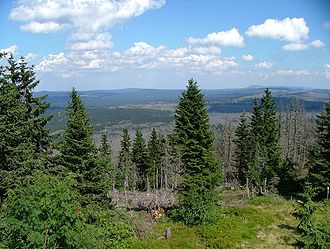
The belt continues in Sardinia in Italy and in Germany where places like the Rhine Massif (including the Ardennes, Eifel, Hunsrück, Taunus and areas around the Middle Rhine Valley), the Black Forest, the Odenwald and Harz Mountains are remnants. In the Czech Republic and southwestern Poland, the Bohemian Massif marks the eastern end of the Variscan belt in Europe.
The Variscan chain stretched about 5,000 kilometres long and 700 kilometres wide, reaching up to 6,000 metres in height. Important areas include the External crystalline massifs of the Alps, Vosges, Black Forest, Odenwald, Rhenish Massif including Ardennes, Harz, Bohemian Massif, Massif Central, Armorican Massif, Morvan, Maures Massif, Estérel Massif, Corsica (southern part), Sardinia (Gennargentu), Ural Mountains, Southwest Ireland, Portugal and western Spain, among others.
Formation
The Variscan orogeny happened in several steps. First, from the Cambrian to Ordovician, the supercontinent Rodinia broke apart, making a big ocean. Later, from the late Ordovician to Silurian, plates moved together. This caused Gondwana to crash into the northern continent, changing the Earth's crust deep below.
As the continents kept pushing together from the early to mid-Devonian, more changes happened in the rocks. Finally, from the late Devonian to late Carboniferous, the land rose up, like the Alps today. The thick crust melted in places and made new rocks. The land then settled and wore away, creating basins filled with sediments.
Images
Related articles



This article is a child-friendly adaptation of the Wikipedia article on Variscan orogeny, available under CC BY-SA 4.0.
Images from Wikimedia Commons. Tap any image to view credits and license.