 Safekipedia
Western Ghats
Adapted from Wikipedia · Adventurer experience
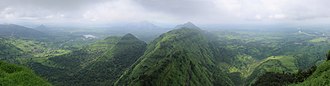
The Western Ghats, also known as the Sahyadri, is a mountain range that stretches along the west coast of India. It covers many Indian states: Gujarat, Maharashtra, Goa, Karnataka, Kerala, and Tamil Nadu.
The Western Ghats were formed when a very large landmass called Gondwana broke apart. The mountains have three main parts: a northern section, a middle section south of Goa, and a southern section. The highest peak is Anamudi.
These mountains help India’s water supply and climate. They block moist monsoon winds from the Arabian Sea, which creates rain along the western coast. The Western Ghats are home to many unique plants and animals. In 2012, this area was named a UNESCO World Heritage Site.
Etymology
The Western Ghats get their name from the word ghat and the way they face compared to the rest of India. In India, "ghat" can mean steep hills, like the Western Ghats, or steps to water. Scholars believe "ghat" comes from words in southern Indian languages, such as "kattu" in Tamil, which means mountain side or ridge. The mountains are also known as "Sahyadri", a Sanskrit word meaning kind or gentle mountain.
Geology
The Western Ghats are the tall, rugged edge of the Deccan Plateau. They were formed when the huge ancient landmass called Gondwana broke apart. This made rocks called basalt that pushed up the land on the western side.
Studies show that these mountains grew along India’s west coast long ago, when India moved away from Africa. Many cracks in the earth helped shape the mountains, creating valleys and deep gorges where rivers flow. Because the land rises on the west, most rivers run from west to east, making the eastern slopes gentle and the western slopes steep.
Geography
The Western Ghats stretch for about 1,600 km (990 mi) along the west coast of India. They start south of the Tapti River and end at Marunthuvazh Malai in Swamithoppe, Kanyakumari district. They cover 160,000 km2 (62,000 sq mi) and go through several Indian states, like Gujarat, Maharashtra, Goa, Karnataka, Kerala, and Tamil Nadu.
The Western Ghats are mountains that run next to India's western coast along the Arabian Sea. They are about 1,200 m (3,900 ft) tall on average. There are three gaps in these mountains: the Goa Gap, the Palghat Gap, and the Shencottah Gap. The narrow land between the mountains and the sea is called the Western Coastal Plains.
The mountains have three parts: north, middle, and south, each with different heights. The tallest peak is Anamudi, which is 2,695 m (8,842 ft) high. The Western Ghats help make important rivers like the Godavari, Kaveri, and Krishna. These rivers flow east to the Bay of Bengal and sometimes form pretty waterfalls. People use the rivers for hydroelectric power and irrigation.
Climate
The Western Ghats help decide the weather in India. In the dry months, heat on the land pulls air from the sea. This air, carrying moisture, is stopped by the Western Ghats. As the air rises, it cools and creates rain along the western coast. This marks the start of the monsoon season in June. After passing over the mountains, the air becomes dry, leaving a dry area called a rain shadow on the other side.
The climate in these mountains changes with height. The area stays warm and humid all year. Temperatures are usually between 20 °C and 24 °C. In higher areas, it can get colder, even near zero during winter. The southern part gets the most rain during the monsoon. Rainfall ranges from 100 cm to 900 cm yearly.
orographic precipitation monsoon rain shadow leeward Bay of Bengal equator tropical climate
Biodiversity
The Western Ghats region is a biodiversity hotspot. It has many plants and animals, and most of them live only here. At least 325 threatened species can be found in the Western Ghats.
Flora
The Western Ghats have different types of moist forests. The northern part is usually drier than the southern part. These forests have many plants, including dry forests, scrub forests, peat bogs, and swamps. There are also high mountain grasslands with special forests called sholas.
Scientists have found thousands of plant species in the Western Ghats. Many of these plants grow only here. There are also many types of mosses, liverworts, ferns, and lichens.
Fauna
The Western Ghats are home to many animal species, including at least 325 threatened species. There are over 6,000 types of insects here.
The region has many tigers and the largest wild population of Indian elephants. Other animals include the lion-tailed macaque, Nilgiri tahr, leopards, Nilgiri langur, dhole, and gaur. There are also many types of birds, reptiles, and amphibians, including several that live only here.
The Western Ghats have many kinds of fish and molluscs too. Some fish species are found only here, and there are also many types of freshwater snails and mussels.
Threats and conservation
Historically, the Western Ghats had thick forests that provided homes for many animals and native tribal people. During British colonial rule, large areas were cleared for farming and timber, which hurt many plants and animals.
Today, the Government of India protects the Western Ghats with many protected areas, including two biosphere reserves, 13 national parks, and several wildlife sanctuaries. In 2012, parts of the Western Ghats were declared World Heritage Sites by UNESCO.
| Region | Area | Areas covered |
|---|---|---|
| North Western Ghats montane rain forests | 11,900 mi2 (31,000 km2) | Goa, Karnataka, Maharashtra, Tamil Nadu |
| South Western Ghats montane rain forests | 8,700 mi2 (23,000 km2) | Kerala, Tamil Nadu |
| North Western Ghats moist deciduous forests | 4,831 mi2 (12,510 km2) | Gujarat, Karnataka, Maharashtra |
| South Western Ghats moist deciduous forests | 2,382 mi2 (6,170 km2) | Karnataka, Kerala, Tamil Nadu |
| Taxonomic group | Species | Endemic | % Endemic | Endangered |
|---|---|---|---|---|
| Mammals | 120 | 14 | 12% | 31 |
| Birds | 508 | 19 | 4% | 15 |
| Amphibians | 121 | 94 | 78% | 43 |
| Reptiles | 156 | 97 | 62% | 5 |
| Fishes | 218 | 116 | 53% | 1 |
Images
Related articles


This article is a child-friendly adaptation of the Wikipedia article on Western Ghats, available under CC BY-SA 4.0.
Images from Wikimedia Commons. Tap any image to view credits and license.