 Safekipedia
Western Nilotic languages
Adapted from Wikipedia · Adventurer experience
The Western Nilotic languages are one of the three main groups of Nilotic languages. The other two groups are the Eastern Nilotic languages and the Southern Nilotic languages. All of these languages belong to the larger Eastern Sudanic family, which is part of the Nilo-Saharan language group.
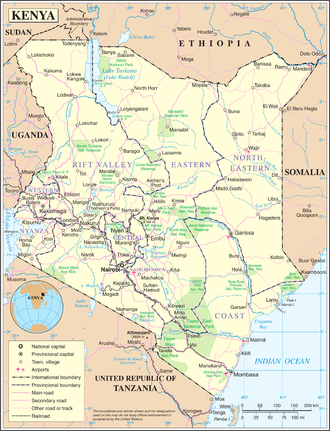
About 22 Western Nilotic languages are spoken by people in several countries in East and Central Africa. These languages are spoken from southwestern Ethiopia and South Sudan, through northeastern Democratic Republic of the Congo and northern Uganda, all the way to southwestern Kenya. One of the Luo languages even reaches into northern Tanzania. These languages are important because they help us understand how people in these areas communicate and share their culture.
History
The Western Nilotic languages started in the south of Blue Nile State around 2000 BCE. The language later split into two groups. The Burun group stayed in place, while the Jii group moved southwest. The Jii group then split into the Dinka–Nuer languages and the Luo languages.
Families
The Western Nilotic languages are a group of languages. They belong to the larger Nilotic languages family. They are part of the Kir–Abbaian and Eastern Sudan subfamilies. These subfamilies are part of the Nilo-Saharan language family.
Subdivisions
Western Nilotic languages are divided into three main groups: Dinka–Nuer, Luo, and Burun. The Luo languages are the most widely spoken. They include Shilluk, Luwo, Thuri, Belanda Bor, Burun, Päri, Anuak, and Southern Luo.
The Dinka–Nuer group includes languages such as Nuer and Dinka. The Burun group includes Northern and Southern Burun.
Related articles



This article is a child-friendly adaptation of the Wikipedia article on Western Nilotic languages, available under CC BY-SA 4.0.
Images from Wikimedia Commons. Tap any image to view credits and license.