 Safekipedia
Wildlife of Alaska
Adapted from Wikipedia · Adventurer experience
The wildlife of Alaska is rich and many kinds of animals live there. The land gives a home to fish, mammals, reptiles, and birds.
At the top of the food chain are the bears. Alaska has most of all North American brown bear families, plus many grizzly bears, black bears, and special Kodiak bears.
In winter, polar bears can be seen in places like the Kuskokwim Delta, St. Matthew Island, and the south part of St. Lawrence Island. Other important animals are moose, caribou, bison, wolves, and wolverines. There are also many fish, such as salmon, halibut, and pollock.
Birds are very common in Alaska, with hundreds of kinds. You can watch bald eagles, owls, falcons, ravens, ducks, geese, and swans. Near the coast, you might see sea lions, seals, and whales. The waters also have many small sea creatures, like shrimp, crab, and sponge.
Mammals
Main article: List of mammals of Alaska
Brown bear
Alaska is home to many brown bears. Most brown bears in the United States live here. Brown bears live in many parts of Alaska and like areas with plenty of food. The McNeil River Falls area has many brown bears.
Brown bears can be dangerous, especially when they have just caught food or when a mother bear has babies. It is important to treat them with respect.
Grizzly bears
Alaska also has many grizzly bears, which are a type of brown bear found across North America.
Kodiak bears
Kodiak Island is home to Kodiak bears, the largest type of brown bear in the world.
Black bear
Black bears are smaller than brown bears and live in many parts of Alaska. They sometimes come close to people because they are looking for food. There are thought to be many black bears in Alaska.
Polar bear
Polar bears in Alaska live near the Arctic coast. In winter, they are often found in places like the Kuskokwim Delta and St. Matthew Island. In summer, they move to the Arctic Ocean and the Chukchi Sea. Polar bears were once hunted but are now protected. Today, polar bear numbers may be at risk from changes in climate. There are about 4,700 polar bears in Alaska.
Grizzly-polar bear hybrid
Because of changes in climate, it is now more common to see hybrid bears called pizzly or grolar bears, which come from grizzly and polar bears mixing.
Caribou
Alaska has many caribou, a type of reindeer. They live in tundra and mountain areas. Caribou travel long distances each day looking for food and shelter. There are about 950,000 caribou in Alaska.
Moose
The moose in Alaska are the largest in the world. Moose are common and often seen on roads and near towns. They have been important to people in Alaska. Today, they are popular among hunters.
Mountain goat
Mountain goats live in the rocky, mountainous areas of Alaska, especially in the southeast. They move to lower areas in winter. They were also placed on islands like Baranof and Kodiak.
Bison
The American bison now in Alaska came from Montana in 1928. More bison have since spread naturally. There are also small groups of bison on islands and farms. Another type of bison, the wood bison, used to be common but disappeared long ago.
Dall sheep
Dall sheep live in the mountains of Alaska where the ground is rocky and steep. They are often seen in Denali National Park. Male Dall sheep, called rams, have big curved horns.
Orca
Orcas, also called killer whales, are large dolphins found in Alaska’s waters. They hunt in groups and eat other whales, seals, and sea lions. They live along the Continental Shelf from southeast Alaska to the Aleutian Islands and can also be seen in Prince William Sound.
Birds
Main article: List of birds of Alaska
Alaska has many different kinds of birds, especially near the coast. You can see many familiar birds that live in these rich areas.
Reptiles
Turtles
Alaska's waters are home to two types of turtles: the leatherback sea turtle and the green sea turtle.
The leatherback sea turtle is the largest turtle in the world. It can grow very big.
The green sea turtle is named for its green skin, not its shell. These turtles can also grow quite large. They live near coastal waters and have flippers to help them move.
Amphibians
Alaska has many interesting frogs and salamanders. Two kinds of frogs live there: the Columbia spotted frog and the wood frog. There are also two introduced frogs: the Pacific tree frog and the red-legged frog. The only toad is the western toad.
Alaska has three types of salamanders: the northwestern salamander, the long-toed salamander, and the rough-skinned newt. These animals live in forests and water. Some have special skin that helps keep them safe.
Fish
Alaska has many kinds of fish. You can find fish like trout, salmon, char, grayling, halibut, lampreys, lingcod, longnose sucker, pacific herring, black rockfish, salmon shark, sculpin, walleye pollock, white sturgeon, and many types of whitefish in its lakes, rivers, and oceans.
Salmon
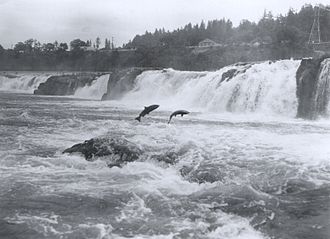
Alaska has five kinds of salmon. These are the chum salmon, sockeye salmon, coho salmon, Chinook salmon, and pink salmon. Every year, these salmon swim upstream against strong river currents. They often jump out of the water as they try to move forward. Bears, especially brown bears, gather near rivers to catch and eat the salmon. An area called Bear Lake near Seward on the Kenai Peninsula has been a special spot for salmon since 1962.
Rainbow trout
Alaska is home to two main types of rainbow trout: stream-resident and steelhead. These fish live most of their lives in freshwater but sometimes move into estuaries when they grow older. The largest rainbow trout ever caught weighed almost 15 pounds and was 19 inches long. They live in streams and are found in the North Pacific Ocean.
Char
Arctic char in Alaska are similar to trout and salmon but can survive in much colder and deeper water. These fish can weigh up to 20 pounds.
Grayling
Grayling live in mountain lakes and calm rivers. They have a long, colorful dorsal fin that is usually red and blue.
Halibut
The Pacific halibut is the largest flatfish in its family. It swims sideways because its body is flattened. Most adult halibut have both eyes on the top side of their heads. Their scales blend into their skin, making them look smooth.
Lamprey
Lampreys are eel-like fish without jaws. They live in freshwater and are often found near coastal areas, where their young burrow into the water.
Lingcod
Lingcod are large fish that live on the ocean floor. They can grow up to 5 feet long and weigh up to 80 pounds. Their colors change from brown, grey, green, blue, to pink, and they have dark and light spots. They are found along the coast of Alaska and in the Bering Strait.
Longnose sucker
The longnose sucker is found all over Alaska. It can weigh up to 5 pounds and lives in cold streams. Its body ranges from dark green to black on top, with a white or yellow belly.
Pacific herring
Pacific herring are smooth and silver with a bluish-green color. The scales on their underside have a slightly jagged look. They can grow up to 18 inches long but usually stay around 9 inches.
Black rockfish
Black rockfish are grey with a large mouth and a spiny dorsal fin. They have dark stripes from their eyes to their gills. These fish can weigh up to 11 pounds and grow up to 27.6 inches long.
Salmon shark
Salmon sharks can grow up to 10 feet long. They are light grey with a white tail. Male salmon sharks become adults between 9–10 years old, while females take about 10–11 years.
Sculpin
Sculpin are small fish that live in both fresh and saltwater. They rarely grow longer than 7 inches and have flat bodies with wide fins that help them stay on the bottom of water bodies.
Walleye pollock
The walleye pollock is an important fish for Alaska’s fishing industry. It is a type of cod with colors ranging from brown, green, silver, and white. It can grow up to 3.5 feet long and weigh up to 13.3 pounds, and is sometimes called fake walleye.
White sturgeon
White sturgeon are different from other fish because they do not have scales. Instead, they have bony plates called scutes along their bodies. They live on the sea floor and use suction to eat, with tastebuds on the outside of their mouths.
Marine macroinvertebrates
Alaska has many sea creatures living in its ocean waters. There are 3,708 different kinds of these sea creatures. They live in shallow water near the shore and in deep parts of the sea. You can find them in the Beaufort Sea, the Chukchi Sea, the Bering Sea, the Aleutian Islands, and the Gulf of Alaska.
Some common sea creatures you might see are shrimp, crab, lobster, and sponge.
Endangered species
Alaska has very few animals that are in danger of disappearing in the United States. According to the Alaska Department of Fish & Game, there are only 12 such animals, and almost all of them live in the ocean.
Extinct species
Some animals that once lived in Alaska can no longer be found there. Since people from Europe arrived, a few species have disappeared. Two of these are the Steller's sea cow and the Spectacled cormorant.
Images
Related articles




This article is a child-friendly adaptation of the Wikipedia article on Wildlife of Alaska, available under CC BY-SA 4.0.
Images from Wikimedia Commons. Tap any image to view credits and license.