 Safekipedia
Yukon Quest
Adapted from Wikipedia · Adventurer experience
The Yukon Quest, formally the Yukon Quest 1,000-mile International Sled Dog Race, is a sled dog race held every February since 1984 between Fairbanks, Alaska, and Whitehorse, Yukon, switching directions each year. Because of the cold winter weather and the difficult trail, it is called "the most difficult sled dog race in the world."
In the race, a dog team leader (called a musher) and a team of 6 to 14 dogs race for 10 to 20 days. The course follows the route of the historic 1890s Klondike Gold Rush, mail delivery, and transportation routes between Fairbanks, Dawson City, and Whitehorse. Mushers carry up to 250 pounds of equipment and food for themselves and their dogs to use between stops.
The route runs on frozen rivers, over mountains, and through small northern villages. Racers travel 1,016 miles or more. Temperatures can drop as low as −60 °F, and winds can reach 50 miles per hour. Because it starts a month earlier than the Iditarod, the Quest is a colder race, with shorter days and longer, darker nights.
History
The Yukon Quest started in February 1984. It is a 1,000-mile sled dog race between Fairbanks, Alaska and Whitehorse, Yukon. The race celebrates old routes from the Klondike Gold Rush time.
The race was made to be very tough. Racers must use their own skills, and staying safe is just as important as being fast.
The first race had many problems, like broken snowmobiles and missing markers. Over the years, the race became more popular. Mushers have faced storms and hard trails. The race has had many winners, with some people winning more than once. Even with bad weather and changes to the route, the Yukon Quest is still one of the toughest sled dog races in the world.
Route
The course of the race changes a little each year because of ice on the Yukon River, snowfall, and other factors. The distance of the race has also changed over time. In even-numbered years, the race starts in Fairbanks and ends in Whitehorse. In odd-numbered years, the start and finish lines switch.
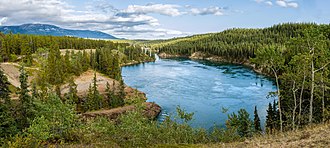
The route follows the Yukon River for much of its course and goes over four mountains: King Solomon's Dome, Eagle Summit, American Summit, and Rosebud Summit. Racers face ice, snow, and very cold weather. Wildlife like moose and wolves is common on the trail. Because of the tough conditions, the Yukon Quest is called the "most difficult sled dog race in the world" and the "toughest race in the world".
Because of how difficult the race is, mushers need to prepare carefully. First, they place food and supplies at checkpoints along the trail. One week later, their dogs have a check-up to make sure they are healthy enough for the race. Finally, two days before the race, mushers pick their starting order by drawing names from a hat.
The modern start/finish in Whitehorse is at Shipyards Park, but the traditional start was near the former White Pass and Yukon Route train station. Shortly after leaving the starting line, racers follow the frozen Yukon River north out of town. They cross onto the Takhini River and follow it north to the Klondike-era Overland Trail. Racers take the trail to Braeburn Lodge, the first checkpoint.
This trail segment is about 100 miles long. The terrain has small hills and frozen streams and lakes. When the race runs from Fairbanks to Whitehorse, the Braeburn checkpoint is where mushers must stop for eight hours to make sure their dogs are healthy before the final stage. In odd years, mushers must take a four-hour rest here or at Carmacks.
From Braeburn, mushers travel to Carmacks, which is 39 miles away. In odd years, they can choose to take their four-hour rest here or at Braeburn. Coming out of Braeburn, competitors cross the Klondike Highway and proceed east for about 10 miles to Coghlan Lake. From there they turn north, then northwest, and travel along a chain of lakes for about 30 miles. They then enter a stretch of hilly, forested terrain nicknamed "Pinball Alley" because the rough ground bounces sleds into trees and rocks. After Pinball Alley, racers follow the Yukon River before climbing to the Carmacks checkpoint. They then follow a road for about 15 miles and turn onto a firebreak trail. After leaving the trail, they travel alongside and across the Yukon River to McCabe Creek, the first dog drop on the Whitehorse–Fairbanks route. From McCabe Creek, the race trail parallels a driveway and the Klondike Highway before turning north to cross the Pelly Burn, an area burned by a wildfire in 1995. From the McCabe Creek site it is about 32 miles to Pelly Crossing.
The stretch between Pelly Crossing and Dawson City is the longest distance between checkpoints in any sled dog competition in the world. Between the two sites are 201 miles of open trail, with a dog drop at Scroggie Creek, an abandoned gold-mining site used only during the Yukon Quest.
From Pelly Crossing, mushers travel west on the frozen Pelly River, or on a road that follows the river if the ice is bad. At Stepping Stone, shortly before the Pelly and Yukon rivers meet, they can rest before turning north. From Stepping Stone to Scroggie Creek the trail follows a mining road. The Scroggie Creek dog drop is at the meeting point of the Stewart River and Scroggie Creek.
After Scroggie Creek, the trail heads almost directly north. At this point, mushers enter the gold-mining district around Dawson City. From the Stewart River near Scroggie, the trail climbs, crossing the Yukon Territory's Black Hills. Fifty miles from Dawson City and 55 miles from Scroggie Creek, it crosses the Indian River, and mushers begin the climb to King Solomon's Dome, the highest point on the trail. The trail climbs more slowly in the Whitehorse–Fairbanks route than the opposite direction. When mushers start in Whitehorse, they have already climbed several thousand feet from the ascent into the Black Hills, including a climb over 3,550-foot Eureka Dome. The main challenges come during the descent from King Solomon's Dome to Bonanza Creek, the center of the Klondike Gold Rush. After reaching the creek, mushers go through an area of mining waste and follow the Klondike River to Dawson City, the halfway point of the race. They must rest for 36 hours in Dawson City.
The distance from Dawson City to Eagle, the first checkpoint in Alaska for the Whitehorse–Fairbanks route, is 144 miles. Mushers must rest for four hours in Eagle.
Racers leave Dawson City on the Yukon River and follow it for about 50 miles to the Fortymile River hospitality stop. The river's name comes from its distance from Fort Reliance, an old trading post. From the hospitality stop, mushers travel southwest on the Fortymile River in one of the coldest parts of the race, because cold air sinks to the bottom of the river valley. The trail crosses the United States–Canada border, which is only noticeable because of a strip of land cleared of all trees. Shortly past the border, the river turns northwest, and mushers leave its frozen surface when it meets the Taylor Highway, a road closed to cars in the winter. As the trail follows the highway for 49 miles conditions are often difficult, with high winds and drifting snow that can hide trail markers. After climbing the 3,420-foot American Summit, the trail gradually goes down 20 miles to Eagle, on the banks of the Yukon River.
The route from Eagle to Central covers a distance of 233 miles. In winter, Eagle is hit by high winds and drifting snow funneled through the town by nearby Eagle Bluff, which stands 300 feet above the Yukon River. Because it is the first stop in the United States, competitors are met at Eagle by a United States Department of Homeland Security official who checks passports and entry documents.
After leaving Eagle, mushers travel northwest for 159 miles on the Yukon River, except for a few short portages. During this stretch, two hospitality stops are available. The first is 28 miles from Eagle at Trout Creek. The next is Biederman's Cabin, the former home of Charlie Biederman, one of the last people to deliver mail by sled dog. A dog drop site is located 18 miles from Biederman's Cabin at Slaven's Cabin, a historic site operated by the National Park Service. Some 60 miles past Slaven's Cabin mushers arrive in Circle, named because its founders thought it was on the Arctic Circle. (Circle is actually about 50 miles south of that line.)
From Circle, it is 74 miles to the checkpoint in Central. Mushers follow Birch Creek south until just before Circle Hot Springs. This area, along with the Fortymile stretch, is thought to be among the coldest on the trail, and mushers are told to prepare for −60 °F (−51 °C) temperatures. Turning west, they travel through frozen swamps before reaching the Steese Roadhouse checkpoint in Central. In Central during even years, mushers can choose to take their four-hour rest here or at Mile 101. If they choose to, the three minute start difference will be taken away from their rest time.
From Central to the final (or first, in the Fairbanks–Whitehorse direction) checkpoint in Two Rivers is 114 miles. Despite the closeness of the checkpoints and the location of a dog drop between them, this is thought to be the most difficult stretch of dog sled trail in the world. At this point, mushers must climb the two steepest and most difficult mountains on the trail: Eagle Summit and Rosebud Summit.
After leaving Central, mushers head west, following the Steese Highway, which connects Central and Circle with Fairbanks. The trail goes through frozen swamps, mining areas, and firebreaks for about 20 miles. Mushers then meet the Steese Highway again before crossing several creeks to begin the climb of Eagle Summit. They eventually go above the tree line and are exposed to the wind as they continue upward. The weather at the top of Eagle Summit is difficult as this is a place where weather from the Yukon Flats to the north and the low ground of the Tanana Valley to the south meet. The last few hundred yards of the climb has a 30-degree slope often scoured to bare rock and tundra by the strong wind. The Mile 101 checkpoint is a cabin at mile marker 101 (the distance from Fairbanks) on the Steese Highway. At Mile 101, mushers can choose to take their four-hour rest during even years. They can also take the rest at Central during even years. The cabin gives mushers a chance for a short rest between Eagle Summit and Rosebud Summit. The climb of Rosebud Summit begins about 10 miles south of the dog drop. It has a gradual climb of 5 miles followed by a steep descent into the valley that contains the north fork of the Chena River. The descent also brings mushers back into forested terrain. The trail then follows a road for about 27 miles before entering the final checkpoint at Twin Bears Campground near Two Rivers.
Two Rivers is the final checkpoint in the Whitehorse–Fairbanks route. Mushers must rest for at least eight hours in Two Rivers in odd years to make sure their dogs are healthy during the final part of the race. The terrain in this stretch is among the easiest on the trail, with gently rolling hills and forest which gradually change into an urban landscape as racers approach Fairbanks. The biggest challenge for racers in the Two Rivers area is telling the Yukon Quest trail from other sled dog trails, many of which have similar markings. Mushers have sometimes been tricked by these markings and taken wrong turns.
Beyond Two Rivers, the trail reaches the Chena River northwest of Fairbanks. This is the final stretch, and mushers use the river to enter Fairbanks and reach the finish line, which is on the river itself in the middle of downtown Fairbanks. No matter when the race ends, several thousand spectators usually gather to watch the first musher cross the finish line.
The 1984 route was a little different from today's. It had only one non-checkpoint dog drop, at the Mile 101 location, and did not go through American Summit, Pelly Junction, or Braeburn. Instead of going through Braeburn, mushers traveled across Lake Laberge for 60 miles between Whitehorse and Minto. The first race also included a checkpoint at Chena Hot Springs Resort near Fairbanks. This site was moved to nearby Angel Creek after mushers said that the hot springs melted nearby snow, making their dogs wet—an extreme danger in very cold temperatures. Two more dog drops were added for the 1994 race: Biederman's Cabin (since replaced by Slaven's Cabin) and McCabe Creek. In 1995, the Whitehorse end of the trail was moved away from Lake Laberge to near the Takhini River. Additional changes that year included rerouting the trail around the southern and eastern sides of King Solomon's Dome south of Dawson City and the addition of the Scroggie Creek dog drop site on the shore of the Stewart River.
In 1996, the trail was rerouted through Pelly Crossing and a checkpoint was added there, and the Lake Laberge stretch was replaced by a route through Braeburn and along the Dawson-Whitehorse Overland Trail. In 1997, mushers were routed through the Chena River Lakes Flood Control Project and to the Alaska town of North Pole before continuing on to Fairbanks. The North Pole loop was removed before the 2009 race, and mushers were sent through Two Rivers instead. Starting in the 2010 race, the Mile 101 location was made from a dog drop to a full checkpoint. In the past several races, the Two Rivers checkpoint has changed places each year: from a lodge to a campground, and then to a gravel pit in 2011.
Weather
The Yukon Quest trail has very cold weather. In Fairbanks, the temperature in February is usually around −3.8 °F (−20 °C), but it can get much colder. There is also a lot of snow each February.
The weather can be tough away from the cities. Strong winds and deep snow make conditions hard for the racers. The cold can cause health problems, so racers need to be careful to stay safe.
Participants
Main article: List of Yukon Quest competitors
Since 1984, the Yukon Quest has had racers from many countries. Each year, between 21 and 47 people join the race. Some racers have tried many times. They may have jobs like taxi drivers, swimming teachers, or lawyers.
Racers get awards for their work. The biggest award goes to the winner. There is also an award for the racer who takes the best care of their dogs. Other awards honor sportsmanship and the spirit of the race. There is even an award for the racer who finishes last.
Dogs
See also: Sled dog
The dogs in the Yukon Quest come in many sizes and types. The most common are Alaskan and Siberian Huskies. Alaskan Huskies are mixes bred for speed and strength. Siberian Huskies are a recognized breed known for their thick fur and strong pulling ability.
Rules
The Yukon Quest has special rules to keep racers and their dogs safe during the race. Racers cannot get help from others and must care well for their dogs. They must carry things like food, camping gear, an axe, a cold-weather sleeping bag, snowshoes, and special booties for each dog. They also need to carry veterinary records and some promotional materials for the race.
Racers must have their own team of dogs and finish at least two shorter races before joining the Yukon Quest. All dogs must be checked by doctors before the race to make sure they are healthy. During the race, doctors will check the dogs at each stop to make sure they are being treated well. Racers must give their dogs enough food and care. If a racer does not follow these rules, they can be removed from the race. Each year, one racer is given a special award for taking great care of their dogs.
Junior Yukon Quest and Yukon Quest 300
The Yukon Quest organization also holds two shorter races: the Junior Yukon Quest and the Yukon Quest 300. These races began in 2000. The Quest 300 was originally 250 miles and called the Quest 250 for its first three years.
The Junior Yukon Quest is a 135-mile race for young racers aged between 14 and 18. It always starts and ends in Fairbanks. This race lets young racers try a middle-length sled dog race. They need to plan food drops, camp away from stops, and carry similar gear to racers in the longer races.
The Yukon Quest 300 is a 300-mile race on the same trail as the main Yukon Quest. It switches starting points each year, like the main race, and is meant for less-experienced racers preparing for longer races. This race also serves as a qualifier for the Iditarod Trail Sled Dog Race and the next year’s Yukon Quest. Some racers, including Fort Yukon Native Josh Cadzow, have used this race to test themselves before the longer challenges.
In 2009, the Quest 300 limited entries to 25 racers. When the race starts in Whitehorse, it follows the main trail until a stop called Stepping Stone, then heads southwest to end in Minto Landing, Yukon. If it starts in Fairbanks, the route goes to Circle and then turns back to end in Central.
Images
Related articles




This article is a child-friendly adaptation of the Wikipedia article on Yukon Quest, available under CC BY-SA 4.0.
Images from Wikimedia Commons. Tap any image to view credits and license.